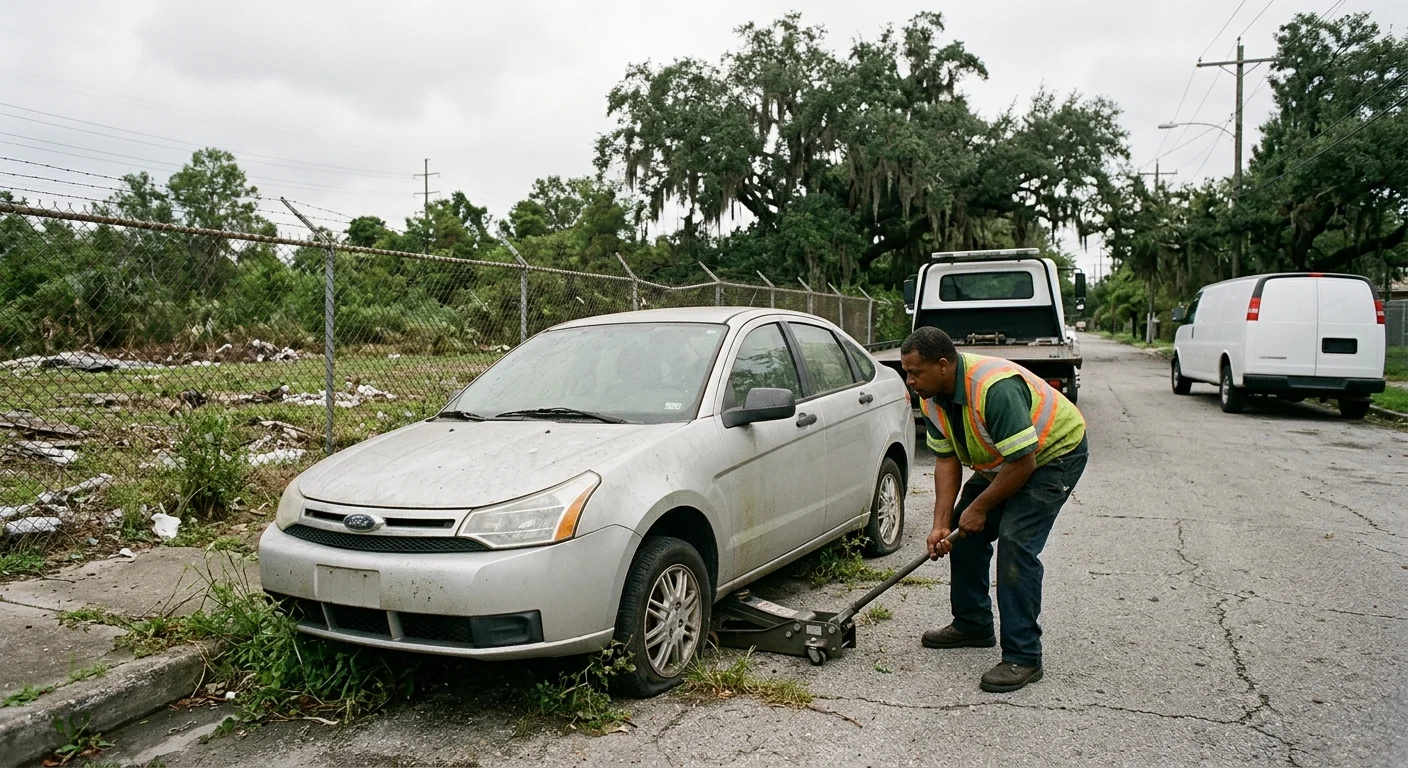
Abandoned vehicle removal in New Orleans starts with 311, or the City’s Report Abandoned Vehicle form, not a private tow truck. Do not invent a City disposal date.
Public street: Report through 311 or nola.gov. An officer, not a neighbor, starts lawful removal. If the car later goes into City custody, use Find My Towed Vehicle and our find-your-towed-car walkthrough. We do not publish City storage or boot dollars.
Private lot: The owner or occupant controls consent, tagging, and the towing contract. See the private-property path below. Don’t move either vehicle until you know who has authority.
What the City counts as abandoned
New Orleans uses several conditions when deciding whether a vehicle is abandoned. The definition covers more than a car with weeds around its tires.
A vehicle can qualify when it’s left on a public street in violation of parking law. It can also qualify when it’s inoperable and unattended on public property for more than three days.
Different timing applies on private property. A vehicle left there without the owner’s or occupant’s consent for more than 24 hours can meet the City’s definition. A vehicle left on City property for more than three days can also qualify.
That distinction matters across New Orleans. A car parked near a Mid-City house isn’t handled like one abandoned on a vacant lot. A damaged vehicle beside a business in New Orleans East may involve both property authority and public access. In Algiers, the address still falls within the City’s reporting system, even though it sits across the river.
Reports go through 311. The service accepts phone reports 24 hours a day, and reports can also be filed through NOLA 311.
Give the most precise location you can. Note the street, nearest cross street, vehicle description, plate if visible, and apparent condition. Photos taken from a lawful and safe location may help you preserve what you saw.
A report doesn’t give the person reporting it authority to enter or move the vehicle. It starts the City’s review. If the vehicle creates an immediate danger, contact emergency services instead of approaching it.
How the process starts on a public street
Louisiana law supplies a general process for abandoned vehicles on public streets. Under R.S. 32:473.1, an officer who finds an abandoned vehicle posts a notice on its windshield.
That notice directs the vehicle’s removal within 24 hours. It also warns that the municipality, parish, or an operator acting for that government may remove the vehicle afterward. If it remains, the vehicle can be taken away and stored.
The 24-hour notice is part of the state framework. It isn’t a promise that New Orleans will inspect a 311 report or complete a removal within a particular period. The City controls its own response to the report, and conditions vary by location.
This difference becomes important during busy local events. A vehicle near a Mardi Gras route may also be subject to temporary parking controls. A car along a flooded street may need a safety review before anyone treats it as ordinary abandoned property. Reporting the exact location lets the responsible agency classify the situation.
Don’t place your own warning on a vehicle parked in the public right of way. Don’t tow it to another block or push it into traffic. The statutory notice comes from an officer, and the removal follows government authority.
If the vehicle disappears after you report it, don’t assume it was stolen or scrapped. It may have been moved by its owner or taken into official custody. Our guide to finding a towed car in New Orleans explains how to check the City system and separate an impound from a private tow.
Who actually handles abandoned vehicle removal in New Orleans
R.S. 32:474 gives custody authority to the state department, a municipality, or a parish authority. Those public bodies may use their own personnel or contracted operators to remove an abandoned vehicle from public or private property.
That authority belongs to government, not to the person who noticed the car. It also doesn’t belong to Quick Tow New Orleans. We’re a referral service that connects callers with independent, licensed local operators. We don’t issue official notices, run an impound lot, or decide that a vehicle is legally abandoned.
A licensed operator may enter the process in two different ways. The operator might act under authority from the City or another public body. An operator might also handle a lawful private-property removal requested through the proper process. Those aren’t interchangeable situations.
Custody also differs from ownership. Taking a vehicle to storage doesn’t automatically make it property of the towing company, the reporting resident, or the landowner. Notice and disposal rules can still apply.
The Louisiana Towing and Storage Act provides the broader framework for towing, storage, notice, and vehicle disposition. Local ordinances can affect how a municipality handles vehicles within that framework.
Jurisdiction matters throughout the metro. New Orleans 311 covers the City of New Orleans. It doesn’t control an abandoned vehicle in Jefferson Parish. The Jefferson Parish Sheriff’s Office handles impound matters in unincorporated Jefferson Parish, while incorporated cities may have their own process. Confirm the jurisdiction before filing a report or arranging private-property service.
The state’s default sale timeline, and why the City may not follow it
Louisiana has a default procedure for certain vehicles seized from public streets. R.S. 32:476 covers vehicles held for illegal parking, stationing, or abandonment that remain unclaimed for three months or more.
Under that state default, the municipality or parish sends an initial notice by registered or certified mail within ten days of seizure. The notice goes to the owner and any known lienholder. A second notice follows at the three-month point.
The default process also requires an appraisal by a competent appraiser before a sale. Notice of the sale must appear in the official journal at least three times within a ten-day period. Remaining proceeds are held for one year for the owner or lienholder, after allowed costs. Unclaimed proceeds then pass to the general fund.
Those details describe Louisiana’s general default. They shouldn’t be treated as the confirmed schedule for a vehicle held by the City of New Orleans.
R.S. 32:476 allows a parish or municipality to replace that process with its own ordinance governing derelict and junk vehicles. New Orleans has local towing rules in Chapter 162, Article XI, and Chapter 154, Article VIII, Division 3. However, the controlling ordinance text and the City’s current disposal timeline couldn’t be confirmed from a readable primary source.
That means there’s no verified basis for telling a reader when the Claiborne Avenue facility may dispose of an unclaimed vehicle. Don’t calculate a deadline from the state default. Check directly with the City Department of Public Works Parking Division before relying on any date.
The City’s Find My Towed Vehicle page is the starting point for checking custody, release information, and current facility details. If the vehicle is yours, act promptly and keep records of every notice and payment.
If it is sitting on your property, not the street
A vehicle on private property presents two separate questions. First, does it meet the City’s abandoned-vehicle definition? Second, does the property owner have a lawful path for removal?
The City definition includes a vehicle left on private property without the owner’s or occupant’s consent for more than 24 hours. That definition doesn’t turn the vehicle into the landowner’s property. It also doesn’t authorize a resident to drag it onto the street or dispose of it.
Start with a 311 report when you want the City to evaluate an abandoned vehicle within New Orleans. Record when the vehicle appeared and why it lacks permission to remain. If you’re a tenant, manager, or association representative, confirm who controls the property before requesting a tow.
A direct non-consensual tow from a parking area must follow R.S. 32:1736. The tow needs law-enforcement authorization or proper tagging for removal. Required entrance and exit signs must identify the towing company, its address, and phone number in lettering at least two inches high. The property owner’s authorized representative also can’t be the tow truck’s owner or operator.
Those rules make a private lot different from a curbside report. A vehicle behind an apartment in Gentilly may involve posted-lot rules. One left on the public street outside belongs in the City process. On the West Bank, an Algiers address and a Harvey address can involve different authorities despite their proximity.
If the unwanted vehicle belongs to you, use the junk car and abandoned vehicle removal service guide. If someone else left it on property you control, review the private-property towing process before arranging removal. A licensed operator can explain what authorization or documentation is needed for that specific property.
When to call us
Call when a vehicle you own needs lawful transport, or when private property you control needs service from a licensed towing professional. The line takes calls 24/7. Call (504) 474-5530. We match you with a licensed local operator who quotes before the truck rolls.