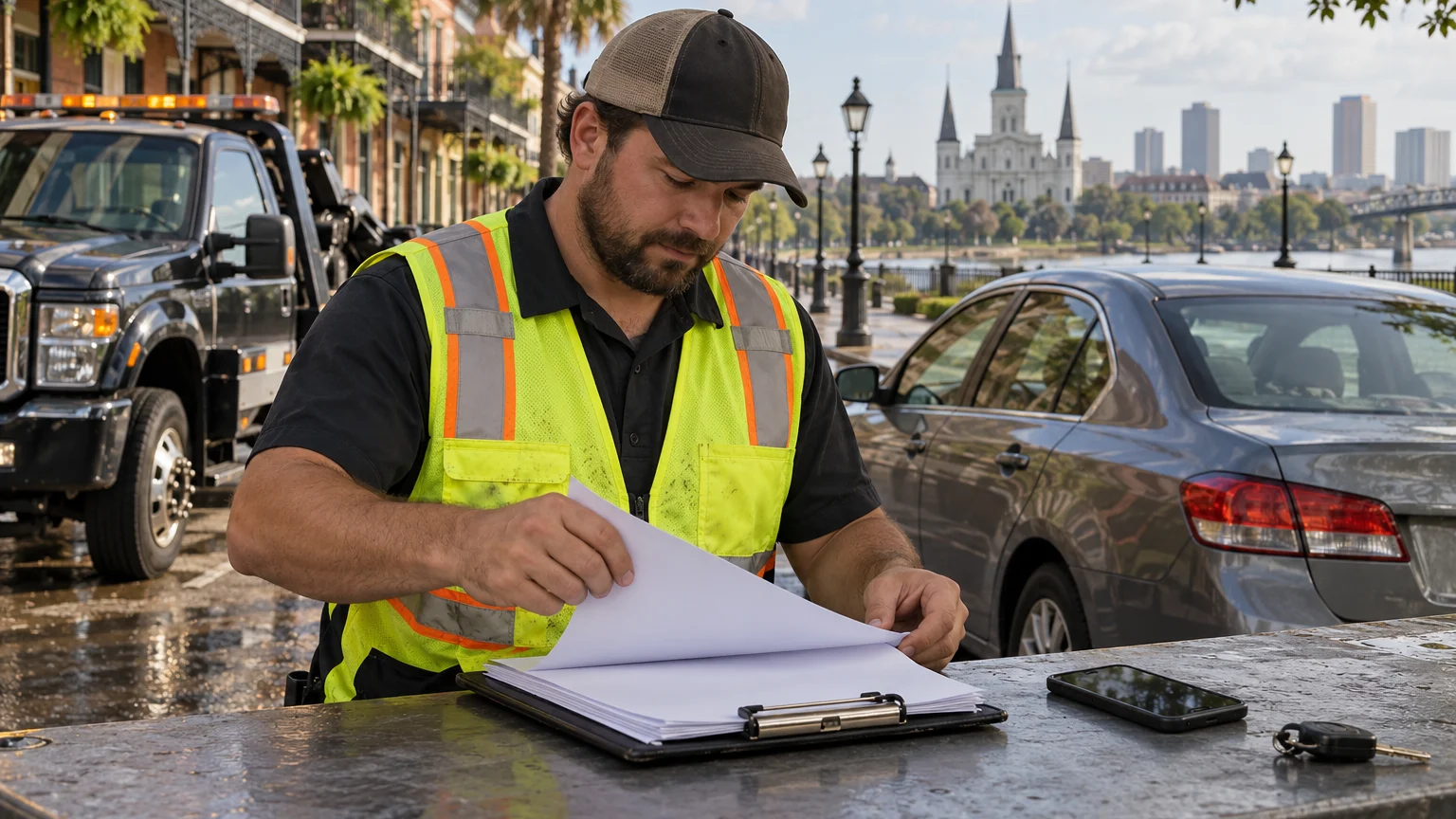
A tow complaint is easier to pursue when the paperwork tells one clear story. Identify who ordered the tow, secure the invoice, and send each dispute to the authority that can address it.
Quick Tow New Orleans can’t change another operator’s invoice, release an impounded vehicle, or decide whether a tow was proper. Your paperwork determines which Louisiana authority can address the complaint.
Start by identifying who ordered the tow
Begin with the event, not the company’s name. A police-ordered tow, private-property removal, and customer-requested tow follow different paths.
Look at the invoice, notice, citation, and signs near the parking area. Write down where the vehicle was parked, when you last saw it, and where it was taken. Preserve photographs of the space, entrances, exits, curb markings, and posted signs.
For a private-property tow, Louisiana law requires law-enforcement authorization or proper tagging before removal from a parking area. There are exceptions to the tagging step when the property owner or authorized representative signs the invoice before the tow, or compliant signs are posted. The property owner’s authorized representative can’t be the tow truck owner or operator.
Posted signs at entrances and exits must warn that unauthorized vehicles may be towed. When the property has a towing contract, those signs must identify the towing company by name, address, and phone number. That information must appear in lettering at least two inches high. Our guide to Louisiana private-property towing law explains these requirements in more detail.
A public-agency tow is different. The agency that ordered it matters because Louisiana’s administrative hearing right applies to vehicles stored by a public agency. It isn’t a universal hearing process for every tow.
In Orleans Parish, start with the City when its Parking Division ordered the removal. The City directs impound payments to 400 N. Claiborne Avenue, even when a vehicle is stored elsewhere. Confirm the actual pickup location before traveling. The City’s towed-vehicle page provides its current location and release information.
Jefferson Parish has a separate process. For an impound ordered in unincorporated Jefferson Parish, confirm the yard and payment instructions with the Jefferson Parish Sheriff’s Office or the agency that ordered the tow. Don’t assume an Orleans Parish office can resolve a Metairie, Harvey, or Westbank dispute.
Collect the invoice and vehicle records
A strong towing complaint is document-first. Ask for a complete, itemized invoice before arguing about the total. Louisiana’s LPSC rules say you don’t have to pay the invoice first to obtain a copy.
For a non-consensual tow, the invoice should identify each charge separately. It should show dispatch and unhook times, then separate towing, recovery, standby, storage, fuel surcharge, and added fees. Louisiana law also requires private-property tow invoices to include the service date and time, the operator’s name, the departure time, and the requesting law-enforcement agency when applicable.
Compare the invoice with the vehicle’s release paperwork and any mailed notice. Keep the original envelope because its postmark can matter. Save payment receipts, card-processing charges, photographs, emails, and written messages. If you paid cash and change wasn’t available, record the amount tendered and the date. LPSC rules require unavailable cash change to be returned by mailed check within ten days.
Build a short timeline containing only facts:
- When and where the vehicle was parked
- When you discovered it missing
- Who confirmed the tow
- Which agency or property ordered it
- When storage began
- When you received each notice
- When you requested the invoice
- When you paid or recovered the vehicle
Check the paperwork against this Louisiana impound receipt checklist. Missing documentation doesn’t automatically prove the tow was improper. It does help you state exactly what information wasn’t provided.
If the vehicle remains stored, request the current balance in writing when possible. Don’t rely on a remembered total from a phone conversation. A dated record makes later storage calculations easier to examine.
Separate an overcharge from an authorization dispute
A towing complaint should name the exact problem. “The bill is unfair” doesn’t tell an authority whether you’re challenging the rate, the tow’s authorization, or both.
An overcharge dispute concerns the invoice. Louisiana’s LPSC sets maximum rates for non-consensual towing, recovery, storage, and related fees. A tow can count as non-consensual even when the vehicle’s owner asks a police officer to arrange it.
The current schedule applies to qualifying tows performed on or after April 1, 2026. It varies by vehicle class, service, minimum time, storage type, and documented additions. Don’t compare one line against an isolated online price. Use the official LPSC non-consensual towing schedule and match every charge to its category.
An authorization dispute asks whether the vehicle could be removed at all. For a private-property tow, relevant evidence may include:
- Entrance and exit signs
- Markings around the parking space
- A removal tag attached to the vehicle
- The identity of the property representative
- The property owner’s authorization
- The towing contract and stated parking rules
Louisiana law requires the written towing contract to be kept at the property owner’s office, the towing company’s office, and inside the tow truck. It must identify the parking rules and reasons for towing, include contact details, and carry defined start and termination dates.
For a public-agency tow, the issue may be whether the removal and storage were proper. That question belongs in the statutory administrative hearing process, not merely in a rate complaint.
You may have both disputes. Keep them separate in your letter. Label one section “authorization” and another “charges.” Our broader guide to New Orleans towing rights can help you distinguish the two.
Send the complaint to the correct authority
Rate complaints about non-consensual towing go to the Louisiana Public Service Commission. Every covered invoice must state the LPSC complaint address:
Louisiana Public Service Commission P.O. Box 91154 Baton Rouge, LA 70821
A written complaint may also go to a district commissioner’s office. The complainant doesn’t need to pay the invoice first to have standing. The Commission can order a refund of up to 200 percent of an overcharge, but that is not a promised outcome.
Attach copies rather than surrendering your only originals. Include your timeline, invoice, payment records, tow notice, photographs, and the specific line items you dispute. State whether you’re challenging a rate, storage calculation, card fee, gate fee, or another item. Explain your calculation without rounding or guessing.
Private-property authorization rules are enforced by state and local law-enforcement officers and appointed LPSC officers. If your complaint concerns missing signs, improper tagging, or unauthorized removal, identify that issue clearly. Ask the relevant authority how it accepts supporting records. Don’t assume the rate-complaint mailing alone begins every other kind of review.
A separate deadline applies when a public agency ordered the tow. Under R.S. 32:1727, an owner whose vehicle is stored by a public agency may request a hearing on whether the tow and storage were proper. The request must be made within ten days after the required owner notice was mailed and directed to the agency that ordered the tow. The request itself must be sent by certified mail, return receipt requested.
The agency must hold that hearing within three business days after receiving the request. The statute provides a decision about whether the tow and storage were proper. It doesn’t promise damages, a refund, or automatic vehicle release.
A complaint involving private-property towing should still identify the exact parish and municipality. New Orleans, unincorporated Jefferson Parish, and other metro jurisdictions don’t share one impound office.
Track what happens to storage charges
Filing a complaint doesn’t automatically erase the invoice. It also doesn’t guarantee that the vehicle will be held without additional charges while every issue is reviewed.
Louisiana’s LPSC rules provide a specific protection for qualifying rate complaints. When a written complaint is filed with the LPSC or a district commissioner’s office, storage fees stop accruing from the complaint date if the charges are later found excessive or the company pleads guilty to excessive charges.
That condition matters. Don’t write your complaint as if storage has already been waived. Keep proof of the date the authority received it. Certified mail, delivery confirmation, or a dated acknowledgment can establish that record.
Ask the storage facility for an updated, itemized balance. Compare the new statement with the original invoice. Track each calendar day and note any newly added line item. If you recover the vehicle during the dispute, preserve the final receipt and proof of payment.
Retrieving personal property follows a separate fee rule. A towing or storage company can’t charge for access to vehicle contents during the statutory normal business hours of 8:00 a.m. to 5:00 p.m., Monday through Friday, excluding legal holidays. Outside those hours, the LPSC schedule allows a capped retrieval fee. That rule controls the fee, not a broad right to immediate access.
Don’t confuse a billing complaint with the public-agency hearing deadline. Sending a letter to the LPSC doesn’t replace a timely hearing request to the agency that ordered a public tow. When both paths apply, preserve both deadlines and keep separate delivery records.
The safest file is chronological. Keep the first invoice, each revised balance, the complaint, delivery proof, agency responses, and the final receipt together. That record gives the reviewing authority facts it can verify.
When to call us
Call when you need a licensed operator for a new, customer-requested tow after the complaint issue is separated from the vehicle’s current transport needs. The line takes calls 24/7, but Quick Tow can’t alter another company’s bill or decide an impound dispute. Call us at (504) 474-5530 and we’ll connect you with a licensed local operator.