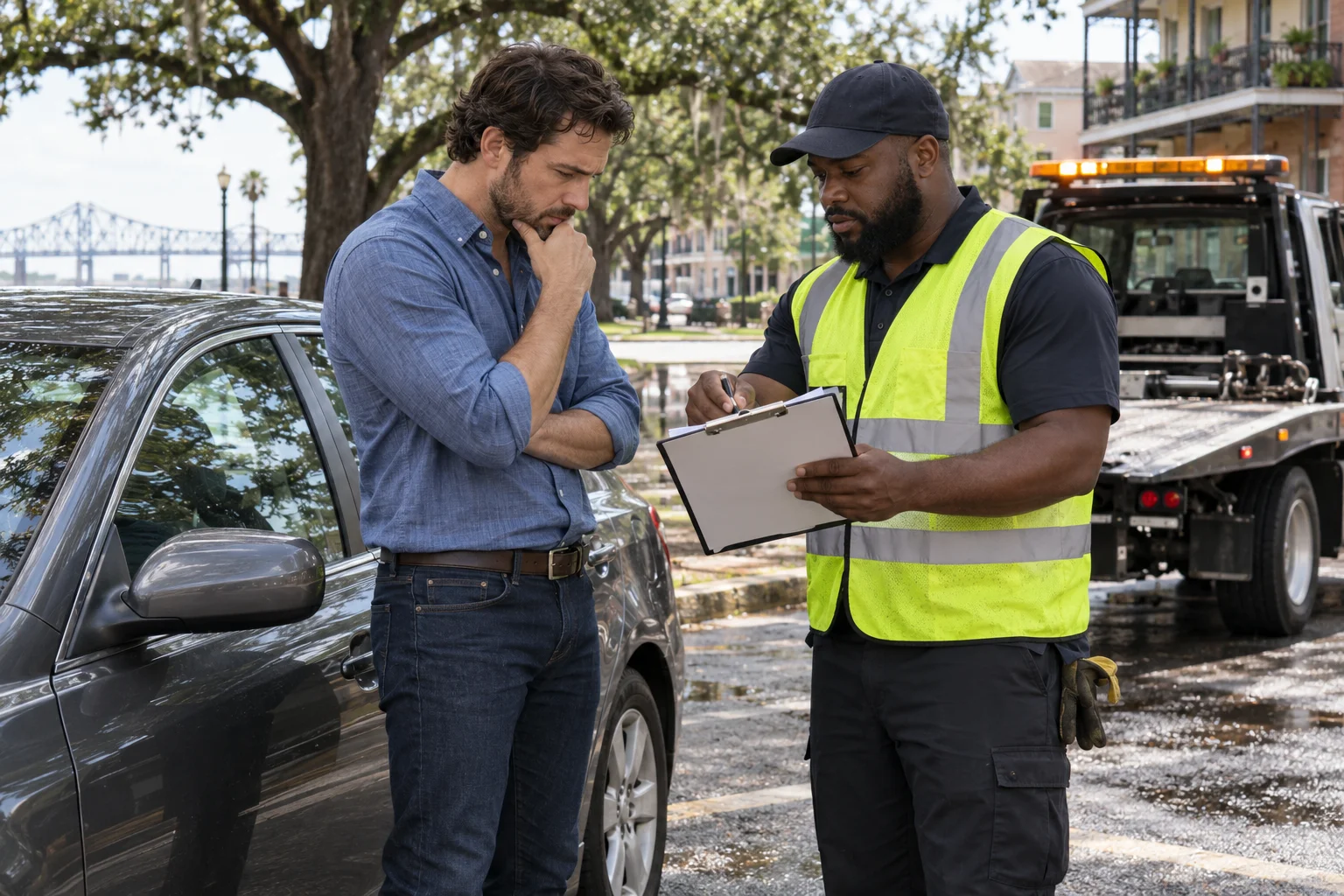
There’s no verified flat answer to how much a car lockout costs in metro New Orleans. A current local market price couldn’t be confirmed from an approved source. Ask the independent operator for the full charge before work begins.
The independent operator sets the lockout charge
Quick Tow New Orleans is a referral service. We match drivers with independent, licensed local roadside operators. We don’t perform lockout work, employ drivers, or set operator prices.
That distinction matters when you’re comparing a car lockout service cost. The operator handling the request decides what to charge. A number mentioned before the vehicle is inspected may cover only part of the job. Ask whether it represents the complete charge for the situation you described.
Start by giving clear details:
- Your vehicle’s year, make, and model
- Whether the keys are visible inside
- Whether the key is lost, broken, or stuck
- Whether the vehicle uses a traditional key or electronic fob
- Whether a child, vulnerable person, or animal is inside
- Your exact location and any access restrictions
Then ask the operator to explain every expected charge. Confirm whether the amount includes travel, labor, and any separate service-call charge. If the scope changes after inspection, ask for the revised total before authorizing more work.
Don’t compare a lockout with towing prices. Louisiana’s published LPSC schedule covers maximum rates for non-consensual towing, not customer-requested lockout service. It doesn’t establish a roadside lockout price.
Our published towing hookup figure also doesn’t apply here. A lockout is a different service with a price set by the independent operator.
For help deciding whether the situation calls for unlocking or moving the vehicle, read our guide to roadside help or towing after locking keys inside.
Vehicle access can change the request
“Locked out” can describe several different problems. The keys might be visible on a seat. The only key might be missing. A key could be broken inside a lock. The electronic fob might not be working. Each description can lead to a different service request.
Tell the operator exactly what happened. Don’t describe a lost-key problem as a basic door opening. Opening a vehicle doesn’t create a replacement key. It also doesn’t program an electronic fob or repair a damaged lock.
The vehicle itself matters to the scope. Give the full year, make, model, and trim when known. Mention aftermarket alarms, modified handles, prior door damage, or a weak battery. Those details help the operator decide whether the requested service fits the vehicle.
You shouldn’t try forced-entry methods with improvised tools. They can bend trim, affect weather seals, scratch glass, or interfere with parts inside the door. This page doesn’t promise that any access method will be damage-free. Ask the operator to explain the proposed method before authorizing it.
Proof of control should also be ready. Keep your identification and available vehicle documents nearby. If those documents are locked inside, explain that before work starts. Ask what the operator will accept for that situation.
If the door can’t be opened through the service offered, towing may become a separate decision. Our roadside assistance service page explains how we connect callers with local operators. The matched operator can explain whether the request remains a lockout or requires another service.
Location and property access may affect the job
Metro New Orleans changes quickly from one block to another. A locked car in a Metairie shopping center presents different access questions from one inside a French Quarter garage. A vehicle on the Westbank may also be separated from an available operator by the Mississippi River crossings.
Give a precise location, not only a neighborhood name. Include the street, cross street, parking level, entrance, or nearby business. In a garage, report the clearance shown at the entrance. In a gated apartment complex, explain how the operator can enter.
Property rules can also affect access. A garage attendant, apartment manager, hospital security desk, or event parking staff may control the entrance. Ask them what authorization is needed before requesting service. The operator shouldn’t arrive to discover that the vehicle can’t be reached.
Roadside position is another concern. A lockout in a parking space isn’t the same situation as a disabled vehicle near moving traffic. If anyone faces immediate danger, call 911.
Louisiana DOTD’s Motorist Assistance Patrol provides certain minor services on covered routes. It’s a fixed-schedule patrol, not a call-out lockout service. Its published help includes flat-tire changes, battery jumps, limited emergency fuel, radiator water, and scene protection. Car unlocking isn’t listed among those services.
Weather and events can also complicate access. Street flooding, Mardi Gras barriers, festival closures, and garage restrictions may change how an operator reaches the vehicle. These details don’t establish a specific surcharge. They’re facts to report so the operator can discuss the complete charge.
Check roadside coverage before paying
Your auto policy, motor-club membership, vehicle warranty, credit card, or connected-car plan may include roadside benefits. Coverage isn’t automatic, and this site couldn’t confirm a universal lockout benefit or payment amount. Check the terms attached to your own account.
Look for “lockout,” “roadside assistance,” or “towing and labor” in the policy or membership documents. Confirm whether the plan sends its own provider, reimburses you afterward, or excludes the situation entirely. Ask whether there’s a benefit limit, required authorization, or claim form.
Louisiana requires liability insurance, but it doesn’t require towing or roadside coverage. A driver’s optional policy terms decide whether a roadside bill is covered. Our guide to insurance and towing coverage in Louisiana explains that distinction.
Don’t assume a familiar membership name means the lockout will cost nothing. No approved current figure establishes what AAA or another program charges for unlocking a car. Membership level, account status, service terms, and benefit use may matter. Check the program directly before authorizing outside service.
If you don’t have a membership, you can still request help from an independent operator. Read how roadside assistance works without a membership before choosing a provider.
When time and safety allow, check coverage before paying. If you hire an operator independently, save the itemized receipt and any authorization record. Those documents may help if your plan allows reimbursement, but reimbursement isn’t guaranteed.
What to confirm before work begins
A clear conversation can prevent confusion at the vehicle. Start by asking for the operator’s full charge based on the details provided. A verified New Orleans market average wasn’t available for this page, so don’t use an unsourced online range as a promise.
Confirm these points:
- Is the stated amount the total or only a service-call charge?
- Are travel and labor included?
- Does the vehicle type change the proposed service?
- Could key replacement or programming become a separate job?
- What payment methods does the operator accept?
- What proof of control will the operator require?
- What happens if the vehicle can’t be opened as described?
- Will you receive an itemized receipt?
Listen for a clear description of the work. “Unlocking the door” shouldn’t quietly become key cutting, fob programming, lock repair, or towing. Those are separate requests. If the operator proposes additional work, ask what changed and what the revised total will be.
Don’t authorize work based only on an unusually low opening number. Ask whether every expected charge is included. If the operator can’t confirm the complete amount remotely, ask how the final charge will be determined at the vehicle.
Police departments don’t have one confirmed metro-wide policy promising free car unlocking. Check the responsible agency’s current policy through its official non-emergency channel. Call 911 only when someone faces immediate danger, such as a child or vulnerable person trapped inside.
Keep the operator’s name, the amount discussed, and the receipt. Those basics give you a clear record of the service you approved and paid for.
When to call us
Call when you’re locked out and need help finding a licensed local roadside operator. The line takes calls 24/7, and Quick Tow New Orleans matches callers with independent operators rather than performing the work itself.
Call us at (504) 474-5530 and we’ll connect you with a licensed local operator.