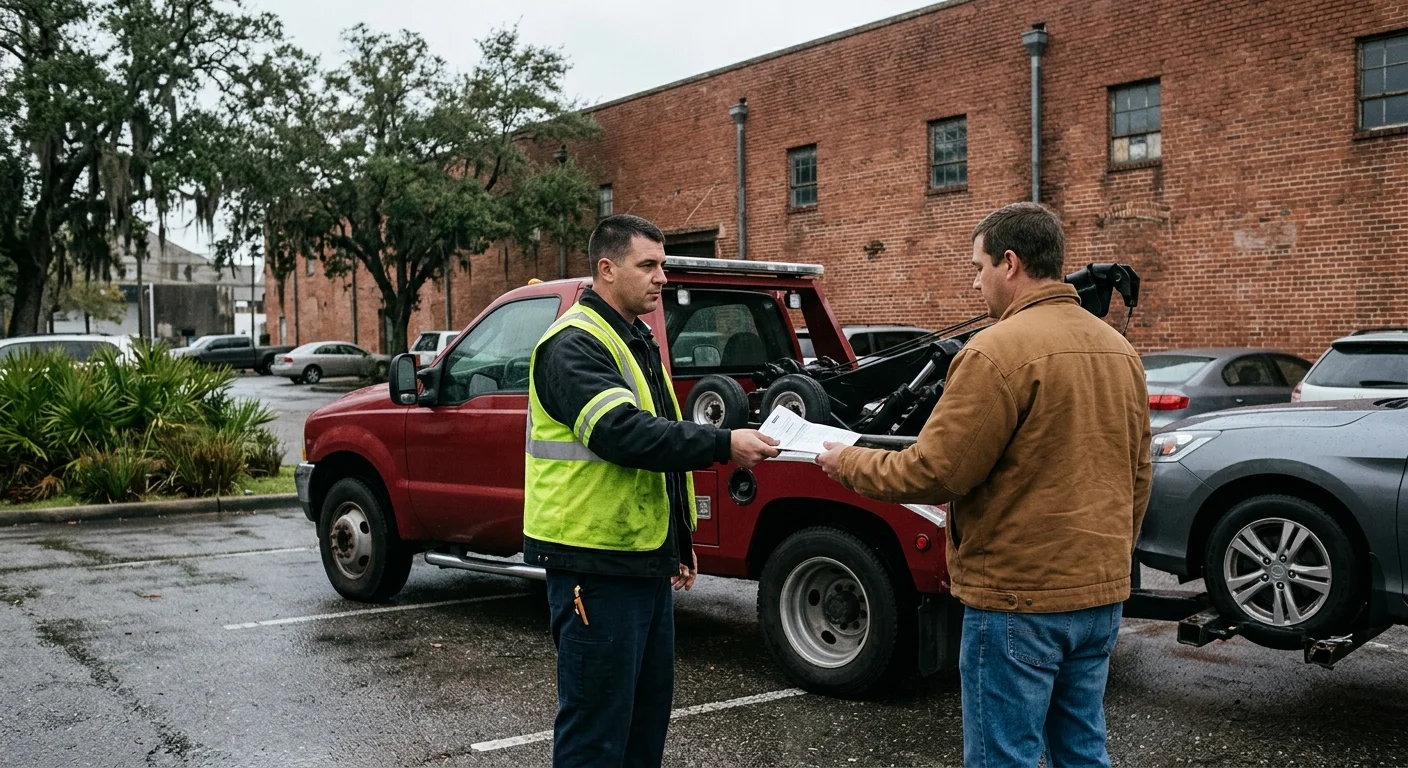
Choose a licensed operator, not a star rating. Start at Quick Tow New Orleans or the New Orleans city hub. A strong operator names the company, explains charges, and gives an itemized invoice under LPSC rules for non-consensual jobs. We do not publish reviews or testimonials.
Start with what the state already guarantees you
Louisiana regulates towing through the Office of State Police. Non-consensual towing rates are governed by the Louisiana Public Service Commission, or LPSC. That gives you a useful baseline before comparing operators.
A non-consensual tow includes more than a private-lot removal. It also includes a tow arranged by police, even when the vehicle’s driver asks the officer for help. Those jobs remain subject to the current LPSC rate schedule.
The schedule sets maximum charges for towing, recovery, storage, labor, and certain equipment. These limits adjust every April, so an old online price table may be wrong. Our guide to New Orleans towing costs explains the current categories and their differences.
Every invoice for a nonconsensual tow must be itemized. It must also state the LPSC complaint address. You can request a copy without paying first. For those regulated jobs, tow companies must accept credit cards, and any passed-through processing fee must appear separately. A customer-requested consensual tow is priced by the operator, not by that LPSC invoice rule.
These rules don’t tell you whether an operator communicates well. They do establish what lawful billing should look like. The Louisiana Towing and Storage Act provides the wider state framework.
Customer-requested towing works differently because the operator sets that price. Ask what the quoted amount covers before the vehicle moves. Confirm the destination, towing method, mileage treatment, and possible storage charges. Get the operator’s business name for your records.
Four questions that find the best towing in New Orleans
A calm, specific conversation can uncover problems before the hook goes on. Ask these four questions when you’re able to choose the operator.
-
Who is performing the tow? Quick Tow New Orleans is a referral service. We match drivers with independent, licensed local operators. Ask for the operating company’s name and confirm who receives payment. Louisiana regulates towing operators through the Office of State Police.
-
How will the charges appear? Ask whether the job is customer-requested or non-consensual. For a regulated tow, ask which LPSC weight class and service category apply. For a customer-requested tow, ask the operator to explain its price and possible additions. Don’t accept a vague answer such as “plus fees.”
-
What equipment does the vehicle need? Tell the operator whether the car rolls, steers, and has accessible wheels. Mention collision damage, a parking-garage clearance, mud, standing water, or a blocked wheel. This helps the operator decide whether the job needs a wheel lift, flatbed, or recovery equipment. Louisiana’s non-consensual schedule bars charges for ordinary equipment already required on the truck.
-
Where will the vehicle go? Give the exact pickup and destination. Confirm whether it’s going to your home, a repair shop, or a storage facility. Ask for that facility’s address and access hours before agreeing.
Sometimes a tow isn’t needed. A jump-start, tire change, or small fuel delivery may fit roadside assistance. A disabled, wrecked, or immobile vehicle may require emergency towing by a licensed operator.
Red flags that are actually illegal here
Some warning signs aren’t merely poor service. They conflict with Louisiana towing rules.
For a non-consensual private-property tow, the operator needs law-enforcement authorization or a vehicle properly tagged for removal. The property owner must post signs at entrances and exits. Those signs must identify the towing company, its address, and its phone number. The lettering must be at least two inches high.
The property owner’s authorized representative also can’t be the tow truck owner or operator. That rule blocks an operator from authorizing its own removals.
An invoice without itemized charges is another serious warning. It should show the service date and time, operator information, applicable law-enforcement agency, and each fee. It must include the LPSC complaint address.
Watch for separate charges covering ordinary truck equipment. The LPSC schedule doesn’t allow non-consensual towing companies to bill for required items such as chains, hooks, blocks, warning devices, brooms, or fire extinguishers. Specialized equipment and labor can be billed only under the schedule’s rules, including documentation where required.
An operator also can’t refuse credit cards. Any processing charge passed through to you must appear as its own item. If you pay cash and exact change isn’t available, the required change must be mailed by check within ten days.
Personal-property access has a narrower rule. A storage company can’t charge for retrieving vehicle contents during normal business hours, defined as 8:00 a.m. through 5:00 p.m., Monday through Friday, excluding legal holidays. Outside those hours, the current fee can’t exceed $64.50. Louisiana hasn’t enacted a broader one-hour property-release guarantee.
Metro geography changes who is right for the job
New Orleans Metro crosses several jurisdictions and distinct road networks. The operator who fits an Orleans Parish pickup may not fit a North Shore destination. Confirm both locations before accepting the tow.
In Orleans Parish, I-10, I-610, and US-90B can place a disabled vehicle in fast traffic. Roadside help and a full tow aren’t interchangeable. DOTD’s Motorist Assistance Patrol covers defined routes and schedules, but it isn’t a call-out towing service. It may provide minor help or clear a travel lane. It doesn’t tow a vehicle away for repair.
A City of New Orleans impound is also different from a customer-requested tow. The Parking Division controls the release process and its own fees. If your parked car disappeared, start with our guide to finding a towed car in New Orleans before hiring another operator.
Jefferson Parish requires another check. The Jefferson Parish Sheriff’s Office at 1233 Westbank Expressway in Harvey handles impound matters for unincorporated Jefferson Parish. Don’t apply City of New Orleans impound rules or dollar figures to that process. Non-consensual towing elsewhere in the parish remains governed by the statewide LPSC schedule.
St. Bernard Parish is another jurisdiction. Tell the operator when a pickup or destination crosses the parish line. Ask how that distance affects a customer-requested job before work begins.
North Shore trips cross Lake Pontchartrain or take a longer land route. On the Causeway itself, follow Causeway Police instructions and use designated Crossovers or Safety Bays when safely reachable. The bridge is patrolled around the clock, and special fog procedures can restrict lanes or place traffic in a controlled convoy.
What to do if you were overcharged
Keep the invoice, payment receipt, photographs, and messages with the operator. Write down the pickup location, destination, service time, and who authorized the tow. Save any private-property sign photos before signs change.
Compare each non-consensual charge against the current LPSC schedule. Check the weight class, minimum billing period, storage days, fuel surcharge, and any recovery equipment. A lawful specialized charge should have the required supporting records. Ordinary required truck equipment shouldn’t appear as an extra charge.
Request an invoice copy if you don’t have one. Payment isn’t required before the company provides it. The invoice should direct complaints to the Louisiana Public Service Commission at P.O. Box 91154, Baton Rouge, LA 70821, or lpsc.louisiana.gov.
Send the complaint in writing. A complaint submitted to the LPSC or a district commissioner’s office can stop storage charges from accruing on the complaint date if the charges are later found excessive. That makes the filing date important.
You don’t need to pay the disputed invoice first to have standing before the Commission. If the LPSC finds an overcharge, it can order a refund of up to 200 percent of that overcharge. Louisiana law may also allow recovery of excess charges, storage costs, attorney’s fees, and court costs for certain private-property towing violations.
Describe the dispute with facts rather than labels. Identify each questioned line item and cite the current schedule. Include copies while keeping the originals. If the vehicle remains stored, state that clearly in the written complaint.
When to call us
A disabled vehicle in a travel lane, a crash-damaged car, or a vehicle that can’t roll safely needs a licensed towing professional. Our line takes calls 24/7, including holidays. Call (504) 474-5530. We match you with a licensed local operator who quotes before the truck rolls.