Lead with title versus no-title, your ID, and an authorized dismantler. A landlord junk job is in junk car on New Orleans rental property. We do not promise cash amounts.
What Louisiana counts as a total loss, and who decides
Louisiana uses a specific threshold for a total-loss vehicle. Under R.S. 32:702, the damage must equal at least 75% of the vehicle’s market value. That value comes from the current NADA Handbook.
An insurance settlement can declare the vehicle a total loss. Louisiana OMV then issues a salvage title showing that status. The vehicle’s age, appearance, or inability to start doesn’t replace that title process.
The hail exception matters in South Louisiana. Cosmetic hail damage can reach the 75% threshold without creating a statutory total loss. That exception covers damage to glass, paint, and body panels. OMV issues a branded title disclosing hail damage instead of a salvage title.
Check the actual title before accepting instructions from a buyer. Don’t label the car “salvage” based only on repair costs or its condition in the driveway. If an insurer handled the loss, compare its paperwork with the current OMV record.
A reconstructed vehicle follows another path. A vehicle rebuilt from a salvage title can’t return to the road until OMV issues a reconstructed title after inspection. A reconstructed-title vehicle also can’t be plated for hire as a public or motor carrier of passengers.
These rules are statewide. They apply whether the vehicle sits in Orleans Parish, Jefferson Parish, St. Bernard Parish, or across Lake Pontchartrain.
How to junk a car in Louisiana through a licensed crusher
Start by confirming that the buyer is a licensed crusher or dismantler. Ask for the legal business name that will appear on your disposal paperwork. That information should match the party taking possession of the vehicle.
Once the vehicle is sold to a licensed crusher or dismantler, the sale is reported electronically to OMV on an OMV form. If the vehicle has a salvage title, the dismantler surrenders that title to OMV. The dismantler must keep a copy for five years after dismantling.
OMV’s forms library includes forms for dismantling, crushing, salvage, and related affidavits. Form numbers circulate on third-party sites and are easy to get wrong. Ask OMV and the dismantler which current form fits your vehicle.
Keep a receipt showing the VIN and disposal date. OMV accepts a junked or salvage receipt showing the VIN as one form of proof when canceling a plate. Check every VIN character before leaving the lot.
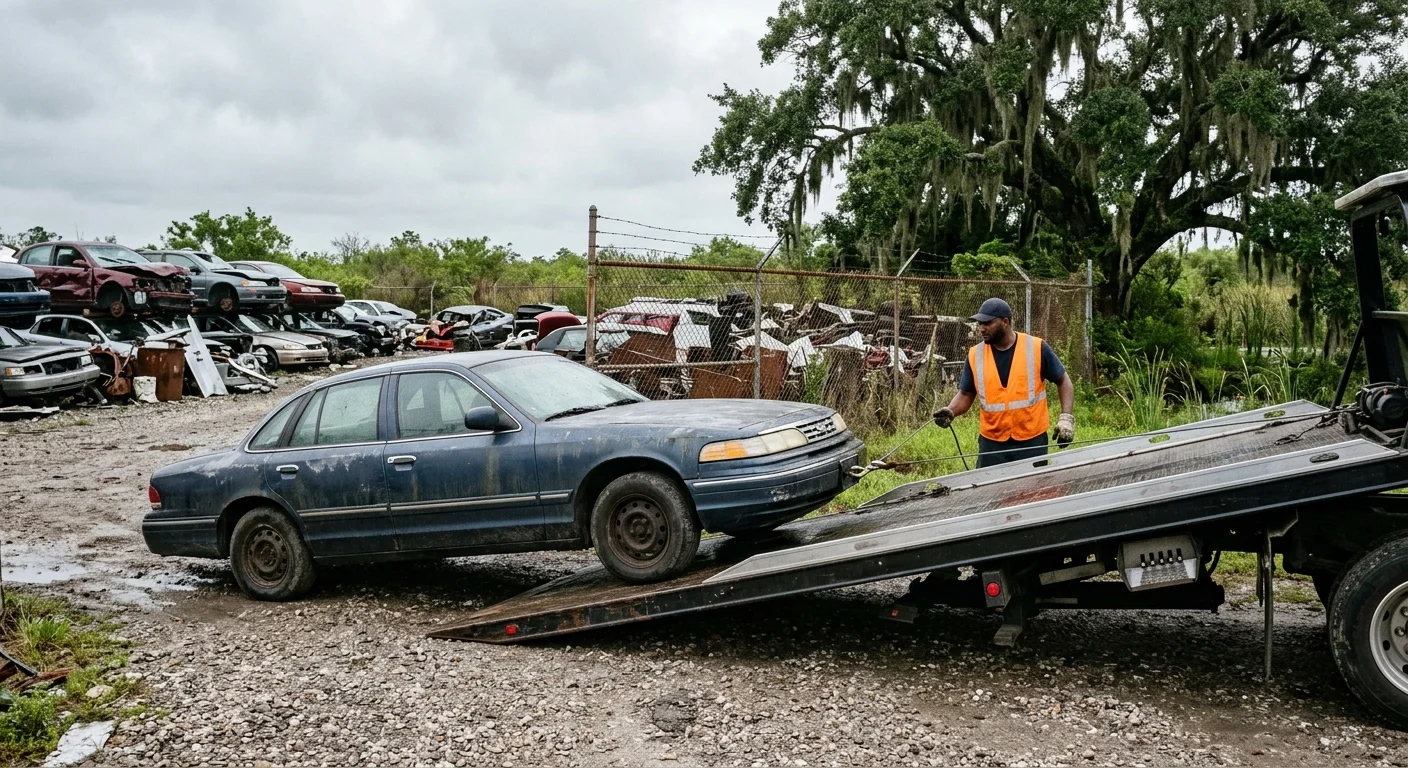
If the car can’t move under its own power, it may need professional transport. Our junk car and abandoned vehicle removal service connects owners with licensed local operators. A flatbed towing operator may be suitable when the vehicle won’t roll, steer, or load normally.
Confirm the dismantler’s paperwork requirements before arranging that move. The approved Louisiana sources don’t establish one universal document list for every title, lien, and vehicle condition.
Telling OMV you sold it
Louisiana OMV offers an online Notice of Vehicle Transfer service. It’s the closest Louisiana process to a release of liability, but OMV calls it voluntary. OMV’s published information doesn’t state a filing deadline.
The notice asks for the plate number and registration expiration date. You’ll also need the VIN, your driver’s license information or EIN, and the buyer’s name and address. The service requests the transfer date and sale price too.
Use the licensed crusher or dismantler’s correct legal details. Don’t substitute the tow operator’s information unless that operator is also the documented buyer. A company moving the car isn’t necessarily the company buying it.
Filing the notice flags the OMV record immediately. However, it doesn’t legally complete the sale. OMV states that the sale remains incomplete until the buyer applies for a new title.
That distinction is easy to miss. A receipt documents the handoff, while the notice updates OMV’s record. The buyer’s title application completes the sale. Keep confirmation of the notice with the signed disposal paperwork and VIN receipt.
Don’t invent a deadline or use an unconfirmed form number. OMV hasn’t published a deadline on the verified service page, and the form number sometimes repeated by third-party websites wasn’t confirmed. If the online service rejects your information, contact OMV for its current correction process.
If the title is gone
A missing title doesn’t create permission to sign the car over with substitute paperwork. Louisiana provides a certified-copy process under R.S. 32:713.
The titled owner may apply to OMV for a certified copy. A perfected lienholder may also apply. The request must be sworn on OMV’s prescribed form and submitted with the required fee.
OMV charges a fee for the certified copy, and the current amount isn’t published here. Check it directly with OMV before sending payment. OMV has a form for this, and it’s worth taking the current one from OMV rather than a third-party site.
The certified copy must be plainly marked “duplicate copy” across its face. Every later title in that title chain must carry the same marking. If the original title later turns up, it must be surrendered to OMV for cancellation.
If a lien appears on the vehicle record, speak with OMV and the lienholder before arranging the sale. Don’t assume an old registration card, title photograph, or handwritten statement will satisfy the dismantler. Ask which current OMV-issued document the licensed buyer will accept.
Resolve the title question before scheduling transport when possible. That prevents the car from changing locations while the ownership paperwork remains unsettled. If the vehicle is already stored elsewhere, ask the facility what document it needs and confirm that answer with OMV.
Cancel the plate before you cancel the insurance
Louisiana allows plate cancellation online, at any OMV office, or by mail. Mailed requests go to OMV, P.O. Box 64886, Baton Rouge, LA 70896.
OMV asks for proof showing when the vehicle was disposed of. You can use one of several document types:
- A bill of sale, trade-in document, or lease-return record
- An insurer’s total-loss statement
- A lienholder’s proof of repossession
- A junked or salvage receipt
Whichever document you use must show the VIN. Compare it with the registration before submitting the cancellation. A missing or incorrect character can prevent the document from identifying the right vehicle.
Cancel the plate before canceling liability insurance. Louisiana requires continuous liability insurance on a registered vehicle. Canceling the insurance first can create a lapse penalty, even when the car no longer runs.
Treat plate cancellation as its own step. Don’t assume the Notice of Vehicle Transfer has completed it. Keep the submission record and confirm the plate’s status with OMV before ending the insurance policy.
The order remains the same throughout metro New Orleans. It doesn’t change because the car moved from New Orleans to a dismantler in another parish. The verified OMV material doesn’t provide a processing-time promise, so check the record rather than guessing when the cancellation became effective.
When a tow yard is holding the junk car
Louisiana has a separate process when a tow or storage facility holds the vehicle. R.S. 32:1728.2 defines a “junk vehicle” for this process as one worth $500 or less under the NADA rough trade-in guide.
The facility’s owner-operator may apply to OMV for permission to crush or dismantle it. That application can begin 30 or more days after the required owner notice was mailed under the Louisiana Towing and Storage Act.
The application must include an independent appraisal supporting the $500-or-less value. It must also include photographs showing all four sides of the vehicle. This is a tow-yard disposal process, not a shortcut an individual owner can apply to every worn-out car.
Check who ordered the tow before relying on any timeline. New Orleans may use its own ordinance for vehicles held through the City’s process. A readable primary source confirming the City’s disposal timeline couldn’t be found, so the state’s general timeline shouldn’t be presented as the Claiborne Avenue lot’s rule.
If you think the City moved the vehicle, use our guide to finding a towed car in New Orleans and check the City’s Find My Towed Vehicle page. Confirm the vehicle’s location and current status before arranging another tow or signing it over.
For a privately held vehicle, ask the storage facility when its owner notice was mailed. Then confirm the current OMV process and required paperwork. Don’t assume the vehicle’s low condition alone proves the statutory $500 value.
When to call us
Call when a non-running car needs transport to a licensed crusher or dismantler. Call (504) 474-5530. We match you with a licensed local operator who quotes before the truck rolls.