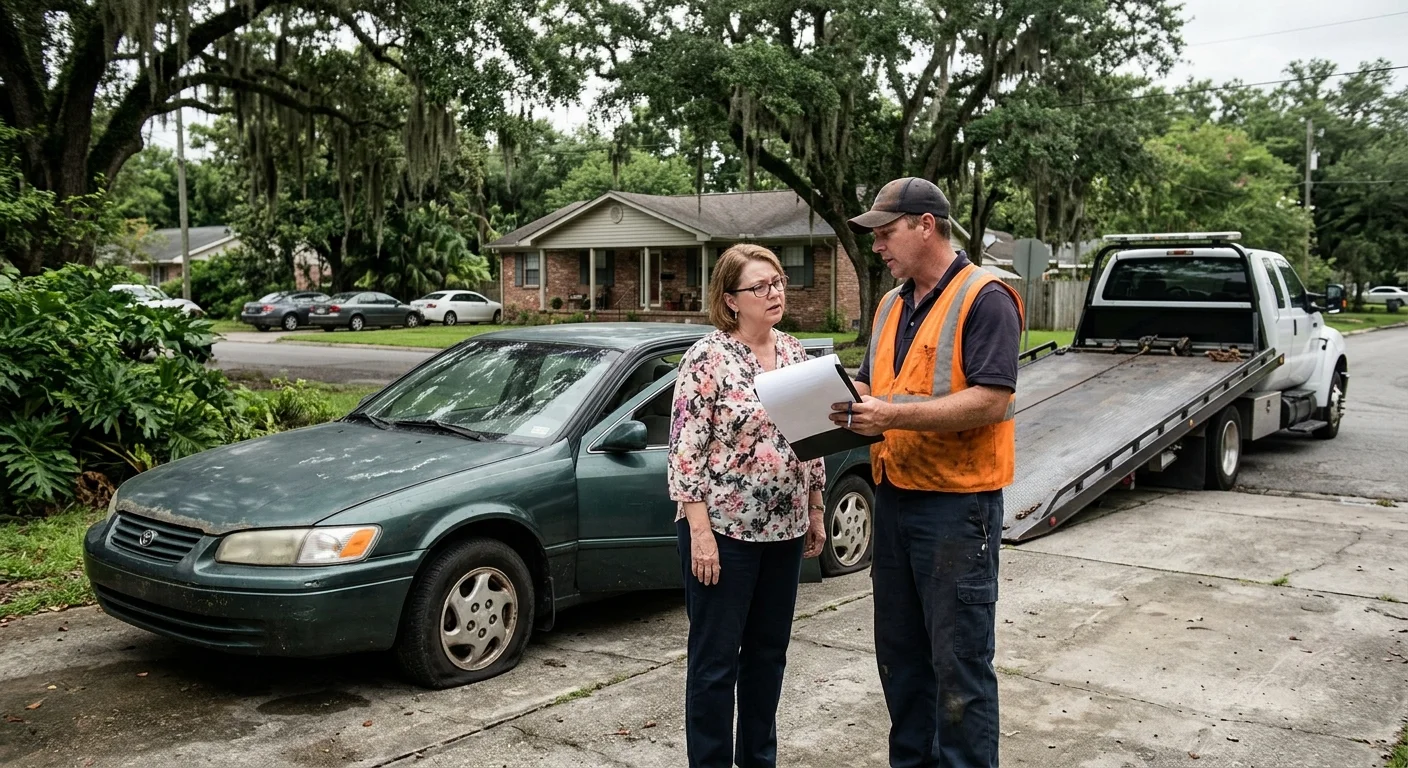
Repair destination versus junk. See how to junk a car in Louisiana and junk car removal. No cash offers.
Storage makes sense only when it supports a real next step. Otherwise, it can move the same decision into another driveway or parking space.
Start with the destination you actually want
Decide where the car should end up before arranging its movement. Your answer usually falls into one of three paths: repair, temporary storage, or sale and disposal.
Choose repair when you want the car back on the road. That decision should be based on a mechanic’s diagnosis, not the fact that it won’t start. A dead battery, failed starter, damaged wheel, or serious engine problem can all produce the same basic symptom.
Choose storage when you need time to settle a title, insurance, or family decision. Confirm that the destination accepts disabled vehicles before scheduling the tow. Ask about access, paperwork, and its own charges directly. Quick Tow doesn’t own or operate a storage yard.
Choose sale or lawful disposal when you’re finished investing in the car. A buyer may want it for parts, rebuilding, or dismantling. Those are different transactions, so don’t assume the same paperwork works for each.
Location also affects the movement plan. A car in an Uptown driveway presents different access issues than one parked curbside in Mid-City. A vehicle moving from Metairie to a Jefferson Parish buyer isn’t the same trip as one crossing Lake Pontchartrain for a North Shore destination. West Bank pickups can also involve a different route than moves within Orleans Parish.
Before calling, write down four details:
- The car’s exact location
- Its intended destination
- Whether it rolls, steers, and brakes
- Whether you control the keys and ownership documents
If disposal is the destination, review the available junk car and abandoned vehicle removal options before authorizing movement. The tow and the sale are separate decisions.
A repair-bound car needs a different plan
A repair-bound car should go somewhere prepared to diagnose it. Call the repair shop first. Confirm that it accepts the vehicle, has space for it, and knows it’s arriving by tow.
Describe the car’s condition accurately. Tell the operator if a wheel is damaged, the steering is locked, the transmission won’t shift, or the vehicle sits in a tight garage. Mention missing keys, low clearance, collision damage, and blocked access. These details help the licensed operator choose a safe loading method.
Don’t authorize major repairs based only on a roadside guess. Ask the shop for a diagnosis and written repair proposal. Then compare the proposed work against the car’s usefulness to you, its current condition, and any remaining loan balance. Quick Tow can help arrange vehicle movement, but it doesn’t inspect cars or advise whether a repair is financially worthwhile.
Distance deserves an early decision too. Your trusted mechanic may be in Kenner while the car sits in New Orleans East. A specialty shop may be across the lake. Confirm the destination before loading because changing it later can create another tow. Our long-distance towing referral service can connect you with an operator for an approved longer move.
Protect yourself at both ends. Remove loose personal items and photograph the car’s visible condition. Give the operator a reliable delivery contact. If you can’t meet the vehicle, ask the shop and operator how they’ll document the handoff.
Repair is the right path when diagnosis could restore a car you still want. It’s the wrong path when you’re only paying to postpone an ownership or disposal decision.
Sale and disposal paperwork must be verified
Selling a non-running car doesn’t automatically solve transportation. The buyer may arrange pickup, ask you to arrange towing, or require delivery to a specific facility. Put that responsibility in writing before money, keys, or documents change hands.
First, identify the buyer. A private buyer, repairable-vehicle buyer, dismantler, and crusher may follow different procedures. Ask exactly what title and identification documents the buyer needs. Confirm those instructions with Louisiana’s Office of Motor Vehicles when anything is unclear.
Louisiana provides an online Notice of Vehicle Transfer service. OMV describes that notice as voluntary and states no filing deadline. Filing it flags the OMV record, but it doesn’t complete the sale. The sale isn’t legally complete until the buyer applies for a new title.
Plate cancellation is another separate step. OMV allows cancellation online, in person, or by mail. For a junked vehicle, OMV asks for proof showing the disposal date and VIN. Acceptable proof may include a bill of sale, total-loss statement, lienholder document, or junked or salvage receipt.
Cancel the plate before canceling liability insurance. Louisiana requires continuous liability coverage on a registered vehicle, so reversing that order can create a lapse issue. Our guide to junking a car in Louisiana explains these confirmed steps in more detail.
A salvage title also has its own meaning. It isn’t simply another name for a car that won’t run. When a vehicle is sold to a licensed crusher or dismantler, that business reports the sale electronically to OMV using OMV’s form. The dismantler must surrender the salvage title to OMV and retain a copy for five years after dismantling.
Don’t sign blank ownership documents. Don’t leave buyer information empty for someone else to complete. Keep copies of the signed sale record, disposal receipt, vehicle photos, and any tow paperwork. Make sure the VIN on each record matches the vehicle before the car leaves.
Ownership problems can stop the handoff
A non-running car can be movable without being legally transferable. Missing titles, active liens, estate questions, and ownership mismatches should be resolved before a buyer removes the vehicle.
If the title is lost, Louisiana allows the titled owner or a perfected lienholder to apply to OMV for a certified copy. The request uses OMV’s prescribed form and includes a fee. A replacement is marked as a duplicate, and an original found later must be surrendered to OMV for cancellation.
That process doesn’t give an unrelated property owner authority to sell somebody else’s car. A landlord, relative, or new homeowner may possess the vehicle without owning it. Don’t guess at the correct transfer process. Contact OMV and ask the intended buyer what proof it requires.
A lien creates another checkpoint. Confirm the current title status with OMV and the lienholder before promising the vehicle to anyone. Don’t treat possession of the keys as proof that the title is clear.
An apparently abandoned car also requires a different path. In New Orleans, reports about vehicles meeting the City’s abandoned-vehicle definition go through the City. Our guide to abandoned vehicle removal in New Orleans separates public-street reporting from private-property concerns.
If a car has disappeared from a public street, check whether the City towed it before arranging a sale. The City’s Find My Towed Vehicle page provides its current location and release guidance. Don’t apply Louisiana’s general disposal timelines to a vehicle in a New Orleans City lot. The City’s own auction or lien-sale process couldn’t be confirmed from available primary material.
A towing operator can move an approved vehicle. The operator can’t cure a defective title, release a lien, or decide who owns an disputed car.
What Quick Tow can and cannot arrange
Quick Tow New Orleans is a referral service. We take calls and match drivers with independent, licensed local towing and roadside operators. We don’t own tow trucks, employ drivers, buy vehicles, run a salvage yard, or transfer titles.
For a non-running car, we can help connect you with an operator for the approved movement. That could mean taking a repair-bound car to a shop, delivering it to storage, or moving it to a buyer who has accepted the vehicle. The line takes calls 24/7.
You’ll contract with and pay the matched operator directly. The operator determines the loading method and provides its own charges. Quick Tow doesn’t set operator prices or warrant the operator’s work.
Have the destination ready before you call. Share whether the car rolls, steers, and brakes. Explain where it sits and what blocks access. Tell us if the destination is across Orleans Parish, in Jefferson Parish, on the West Bank, or across Lake Pontchartrain.
For a sale, confirm the transaction before scheduling the tow. The buyer should provide its legal name, destination, required documents, and pickup expectations. Quick Tow doesn’t pay cash for cars or decide their value. The towing operator also shouldn’t be treated as the buyer unless that operator separately identifies itself as one and provides the transaction terms.
For disposal, confirm that the receiving business will accept the exact vehicle and paperwork you have. If the title is missing, disputed, or tied to a lien, pause the handoff. OMV or the lienholder should resolve that issue first.
The cleanest sequence is simple: choose the outcome, verify ownership, confirm the destination, and then arrange the movement.
When to call us
Call when your non-running car has a confirmed destination and needs professional transport. Call (504) 474-5530. We match you with a licensed local operator who quotes before the truck rolls.