Owner, tenant, and landlord authority are three different questions. See Louisiana private-property towing law and how to junk a car in Louisiana. No City storage fees. No testimonials.
Start by identifying who controls the property
Begin with the address and the parking space. A vehicle beside a duplex in Gentilly presents a different question than one in an apartment lot in Mid-City. The same applies across the metro. Metairie and Kenner are in Jefferson Parish, while New Orleans addresses are generally in Orleans Parish.
Identify the property owner, current manager, and anyone authorized to handle parking. Review the lease, management agreement, and any parking rules given to tenants. If a homeowners association or parking contractor is involved, check its role too.
Louisiana’s private-property towing rules specifically include housing and apartment complexes within covered parking areas. The approved sources don’t confirm that the same procedure applies to every single-family driveway. A licensed operator should confirm what authority and records are needed for that location.
Also determine whether the vehicle belongs to:
- A current tenant
- A former tenant
- A guest or unknown person
- The property owner
- Someone who has agreed to dispose of it
Those situations aren’t interchangeable. A titled owner seeking voluntary junk car removal presents a different job from a landlord requesting a nonconsensual tow.
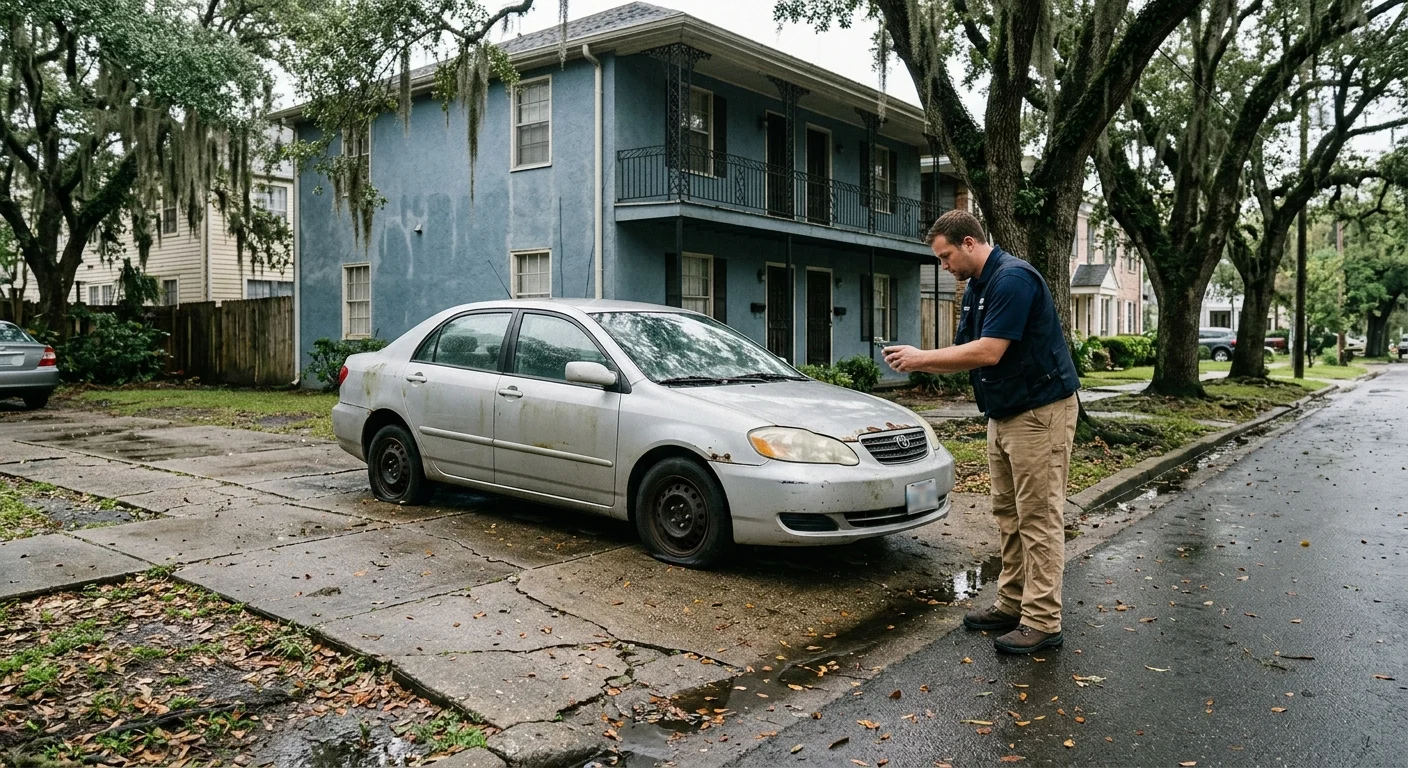
Don’t rely on appearance alone. Flat tires, weeds, storm damage, or an expired inspection sticker may suggest neglect. They don’t establish who owns the car or who can authorize its removal.
If ownership or management authority is disputed, pause before arranging service. Ask the matched operator what documentation they require. A property attorney may also need to review the lease or management agreement.
A junk car and an abandoned street vehicle aren’t the same
First, locate the entire vehicle relative to the property line. A car inside a rental lot follows a private-property path. A car parked at the curb is on a public street, even if it blocks access or sits beside the rental.
New Orleans defines several kinds of abandoned vehicles. The definition includes an inoperable vehicle left unattended on public property for more than three days. It also includes a vehicle left on private property without the owner’s or occupant’s consent for more than 24 hours.
That City definition doesn’t turn Quick Tow into an enforcement agency. Reports involving public streets go through 311. Our guide to abandoned vehicle removal in New Orleans explains how that reporting route differs from arranging private service.
Avoid moving a street vehicle into a driveway to make it a private-property matter. Instead, document where it sits and report it through the proper public channel. If it creates an immediate traffic danger, contact emergency authorities.
For a vehicle fully inside an apartment or rental parking area, the property owner or authorized manager can discuss the situation with a licensed operator. That operator still needs to determine whether the proposed removal meets Louisiana’s private-property towing rules.
Location matters beyond the city line. A Metairie apartment lot isn’t handled as a New Orleans public-street report. The same distinction applies in Kenner, Gretna, Terrytown, and other parts of Jefferson Parish. Confirm the municipality and parish before choosing a reporting path.
Authorization must be confirmed before removal
Louisiana places conditions on nonconsensual towing from parking areas. Under R.S. 32:1736, the tow needs law-enforcement authorization or a proper removal tag. The statute also says tagging isn’t required when the property owner or authorized representative signs the billing invoice before the tow, or when compliant signage is in place.
A removal tag must carry specific details. Those include the date, time, authorized towing company, and the property representative’s printed name and signature. It must be conspicuous without damaging the vehicle.
The statute also says the property owner’s authorized representative can’t be the tow truck owner or operator. That keeps the towing company from creating its own permission.
Where a property owner uses towing signs under a towing contract, signs must be visible at entrances and exits. Covered parking areas or individual spaces must also be marked. The towing company’s name, address, and phone number must appear in lettering at least two inches high.
The written towing contract must define the parking rules and reasons for towing. Copies must be kept at the property owner’s office, the towing company’s office, and in the tow truck. It must also include contact information, dates, and signatures.
Read more about these requirements in our guide to Louisiana private-property towing law. You can also review the state framework in the Louisiana Towing and Storage Act.
No general tenant-notice period for this exact rental-property situation could be confirmed in the approved claims ledger. Don’t invent one. Check the lease, ask the licensed operator what procedure applies, and seek legal advice when possession or authority is contested.
Our private-property towing service can connect you with an independent operator. The operator, not Quick Tow, decides whether the required authorization is present.
Gather ownership and vehicle information
Clear records help the operator understand the request. Start with the rental address, parish, property type, and exact parking location. Note whether the car is behind a gate, under a carport, beside a building, or partly on a public street.
Photograph the vehicle from several safe angles. Include its position within the lot and any existing parking signs. Capture visible damage, flat tires, weeds, and blocked access without opening the vehicle or entering it.
Write down the visible plate, state, make, model, color, and vehicle identification number if it can be read safely from outside. Don’t guess at missing characters. Tell the operator when a plate or VIN can’t be confirmed.
Keep copies of relevant property records. These may include:
- The lease and parking addendum
- The property management agreement
- Written parking policies
- Existing towing contracts
- Messages sent to the known vehicle owner
- Photos showing dates and vehicle location
- The name of the person requesting removal
If the titled owner has agreed to junk the vehicle, collect that confirmation before calling. The owner may need to address title, plate, and Louisiana Office of Motor Vehicles steps separately. Our guide to junking a car in Louisiana explains those owner-side tasks.
Louisiana’s online Notice of Vehicle Transfer is voluntary, and OMV states no filing deadline. Filing flags the record, but the sale isn’t complete until the buyer applies for a new title. A landlord’s property records don’t replace the titled owner’s transfer documents.
Tell the operator about access limits. Narrow driveways, low tree branches, locked gates, soft ground, and closely parked vehicles can affect the equipment decision. Don’t move other people’s cars or dismantle the unwanted vehicle to create access.
What the matched operator must determine
The matched operator first needs to classify the request. A voluntary tow approved by the vehicle owner isn’t the same as a nonconsensual private-property tow. Moving a car away from the property also differs from selling or dismantling it.
For a nonconsensual tow, the operator must examine the authorization path. That may involve law enforcement, a removal tag, a signed billing invoice, or compliant property signage. The operator also needs to review any towing contract and confirm that the caller can act for the property.
Fees for nonconsensual private-property towing must follow Louisiana Public Service Commission rules. Those fees must be uniform. The current LPSC schedule sets maximum rates, but it isn’t Quick Tow’s price list and doesn’t govern an owner-requested consensual tow.
The operator must also assess the vehicle itself. A weathered sedan on pavement may need different equipment than a car settled into soft ground after heavy rain. Locked wheels, missing tires, collision damage, low clearance, and blocked access all matter.
The final destination must be clear before movement. Depending on the owner’s authority and plans, that might be an approved storage location, repair facility, or licensed dismantler. Quick Tow doesn’t own a yard, choose a disposal site, or transfer vehicle ownership.
When you call, give the facts without labeling the car more strongly than the records support. Say who controls the property, where the vehicle sits, who appears to own it, and what documentation exists. Quick Tow will share the request with an independent, licensed local operator. You’ll contract with and pay that operator directly.
When to call us
Call when an unwanted vehicle needs a licensed towing professional and you’ve identified who controls the parking area. Call (504) 474-5530. We match you with a licensed local operator who quotes before the truck rolls. The line takes calls 24/7.