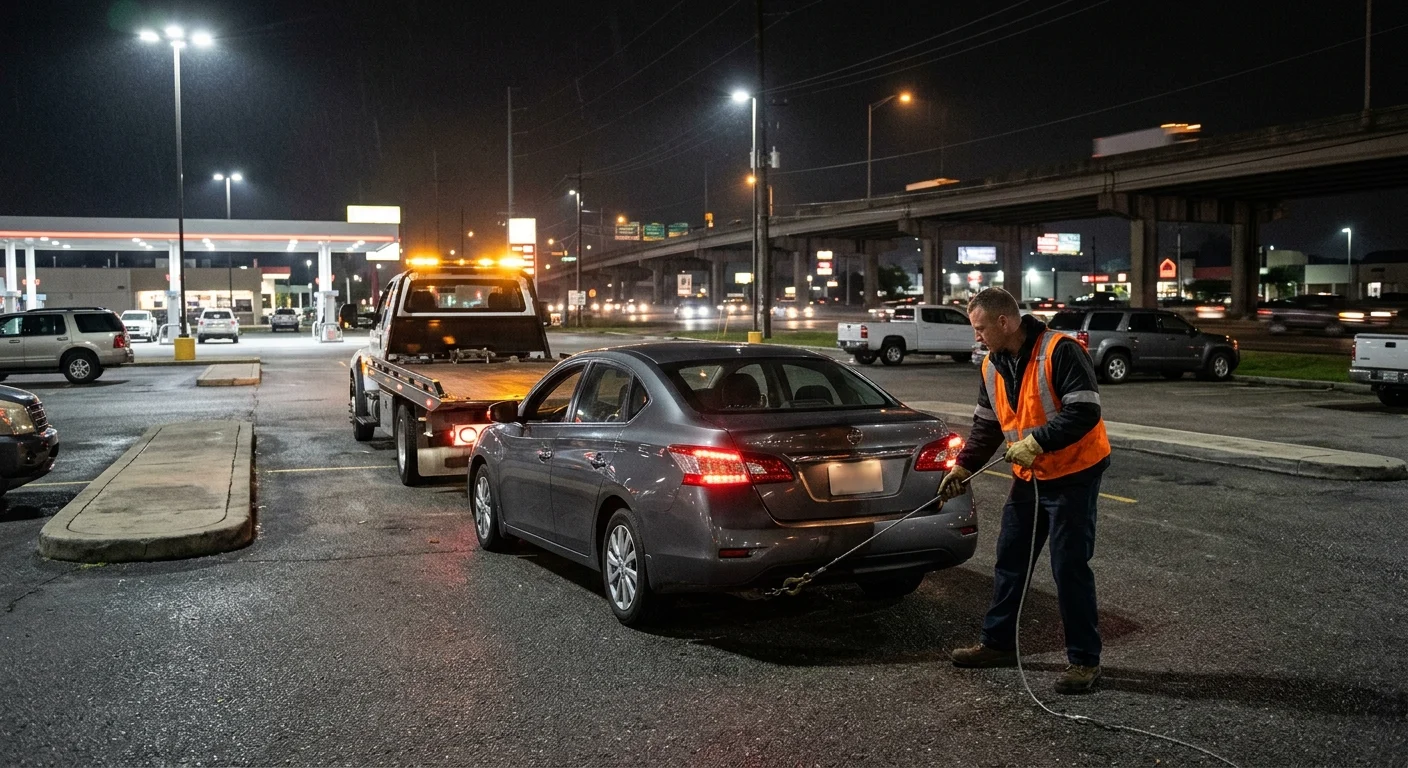
Marrero sits in Jefferson Parish on the West Bank, along the Westbank Expressway. If you need 24-hour towing in Marrero, the Quick Tow line takes calls 24/7. That is call-taking, not an arrival time. See the Marrero towing hub. We match callers with licensed, independent local operators and do not perform the tow.
The line takes calls 24/7
Car trouble doesn’t follow business hours. It can happen after a late shift, during a weekend errand, or before sunrise. Our line takes calls 24 hours a day, including weekends and holidays.
When you call, we collect the basic details of your situation. That includes your location, vehicle type, current condition, and preferred destination. We then work to match your request with an independent local operator.
The operator controls its own availability, equipment, pricing, and service terms. Quick Tow doesn’t own trucks, employ tow drivers, or operate a storage yard. You contract with and pay the operator directly.
Being available by phone isn’t an arrival-time promise. Road conditions, active jobs, bridge traffic, weather, and the equipment required can all affect an operator’s availability. Ask the matched operator directly about the current situation before accepting service.
Our emergency towing service can help connect drivers dealing with disabled cars, collision damage, or vehicles that won’t move safely. Tell us immediately if the car is blocking traffic, sitting on an elevated roadway, or stopped somewhere without a safe shoulder.
Calls to the line are recorded. Callers hear a recording notice before recording begins. Messages may also be recorded and transcribed so the call can be returned.
What to report from the Westbank Expressway
Location details matter on the Westbank Expressway. A map pin alone may not show whether you’re on an elevated lane, a ramp, or a surface street below it. Describe the roadway before explaining the mechanical problem.
Start with your direction of travel. Then give the nearest exit, ramp, cross street, or visible landmark. Barataria Boulevard is a useful reference when you’re near that part of the corridor. Say whether the car is on the shoulder, in a travel lane, or inside a nearby parking area.
Next, describe the vehicle and its condition. The operator needs the make, model, approximate size, and drive type if you know it. Report any collision damage, locked steering, missing wheel, flat tire, leaking fluid, or wheels that won’t roll.
Be specific about the immediate surroundings. Mention a narrow shoulder, concrete barrier, standing water, low clearance, or heavy moving traffic. Those details help the operator decide what equipment may fit the job. They also prevent confusion about which level or side of the expressway you’re on.
If the vehicle is exposed to moving traffic, contact local authorities first. They control lane safety and traffic management. Don’t walk across active expressway lanes to meet a truck or reach a different pickup point.
Check Louisiana 511 for current incidents, closures, and traffic conditions. Share any closure affecting access to your location. Don’t promise yourself a route based only on normal traffic patterns.
How the river affects your towing destination
Marrero is in Jefferson Parish on the West Bank. Your towing destination may remain in Marrero, Harvey, or Gretna. An east-bank repair shop may require crossing the Mississippi River on the Crescent City Connection.
That choice matters before the vehicle is hooked up. Give the operator the complete destination address, not only a shop name. Confirm that the shop accepts the vehicle and can receive an after-hours drop if the doors are closed.
A closer West Bank destination may be more practical if you haven’t chosen a repair shop. However, the nearest facility isn’t automatically the right one. Your mechanic, dealership, insurer, or vehicle warranty may affect where you want the car delivered. Verify those details yourself before authorizing the tow.
Bridge conditions can also change the available route. A closure, crash, or traffic restriction on the Crescent City Connection may require a different plan. Check current road information and discuss the destination with the operator. Don’t rely on a normal crossing time as an arrival or completion estimate.
If a public agency ordered the tow, ask that agency who controls the destination. A police-arranged tow is not always handled like a tow you request yourself. Jefferson Parish impound questions for unincorporated areas go through the Jefferson Parish Sheriff’s Office at (504) 363-5500, not the City of New Orleans Claiborne lot. Confirm the yard and how to pay with JPSO or the agency that ordered the tow. The Louisiana Public Service Commission regulates maximum rates for nonconsensual towing. A customer-requested tow follows the independent operator’s own terms.
Keep the destination decision separate from the urgency of leaving the roadside. Confirm where the vehicle is going, who will receive it, and where the keys should be left. That avoids a second tow caused by a closed gate or incorrect address.
When roadside help may avoid a tow
Not every disabled car needs to leave on a truck. A straightforward battery, tire, or fuel problem may be suitable for roadside assistance. The condition of the car and the roadside environment still determine what’s safe.
Louisiana DOTD’s Motorist Assistance Patrol provides free minor help on designated routes. MAP is a fixed-schedule patrol, not a service drivers can call out to their location.
Its listed services include jump-starting a battery, changing a flat tire, and providing about one gallon of emergency fuel. Patrol staff may also add water to a radiator, protect a scene, or move a disabled vehicle from a travel lane. MAP doesn’t tow a vehicle away for repairs.
DOTD lists daytime US-90B coverage from the I-10 and US-90B split to Westwood. Daytime patrol hours are 5:30 a.m. to 7:30 p.m. Nighttime coverage runs from 7:30 p.m. to 5:30 a.m. and reaches from the split to Barataria Boulevard.
Those limits create real gaps around Marrero and the wider West Bank. If MAP isn’t already present, contact local law enforcement when the vehicle threatens traffic safety. A matched roadside operator may handle a simple problem in a safe location.
A tow is more appropriate when the car can’t roll, has collision damage, keeps overheating, or can’t be driven safely. Don’t keep driving simply because an engine restarts. Continuing with damaged steering, brakes, tires, or cooling components can make the situation worse.
What to confirm with the matched operator
Before accepting service, confirm the operator’s company name and the exact vehicle location. Repeat your direction of travel, roadway level, nearest exit, and destination. Small location errors can send a truck to the wrong side of the expressway.
Explain anything that changes the equipment needed. That includes all-wheel drive, very low ground clearance, collision damage, locked wheels, a parking garage, or a vehicle stuck off pavement. Let the operator decide whether a flatbed, wheel-lift, or recovery equipment fits the job.
Ask how the operator will calculate the charge. Quick Tow doesn’t set operator prices or collect payment for the tow. Confirm the base service, distance, payment methods, and any condition that could change the total before authorizing work.
Customer-requested towing and nonconsensual towing aren’t the same transaction. Louisiana’s regulated maximums apply to nonconsensual towing, not a tow you request and accept directly. Our guide to towing costs in New Orleans explains why those charge types shouldn’t be mixed together.
Also confirm the drop-off plan. Ask whether you can ride with the operator, since passenger policies vary. Verify who will receive the keys and whether the destination gate will be open. If the vehicle contains valuables, remove them when it’s safe and permitted.
Keep the operator’s invoice and contact information. Ask for an itemized breakdown if any charge is unclear. Any question about the physical work, damage handling, or service warranty belongs with the independent operator performing the tow.
When to call us
A licensed towing pro is the right call when the car can’t be moved safely, roadside help won’t solve the problem, or collision damage has left it disabled. Call (504) 474-5530. We match you with a licensed local operator who quotes before the truck rolls.