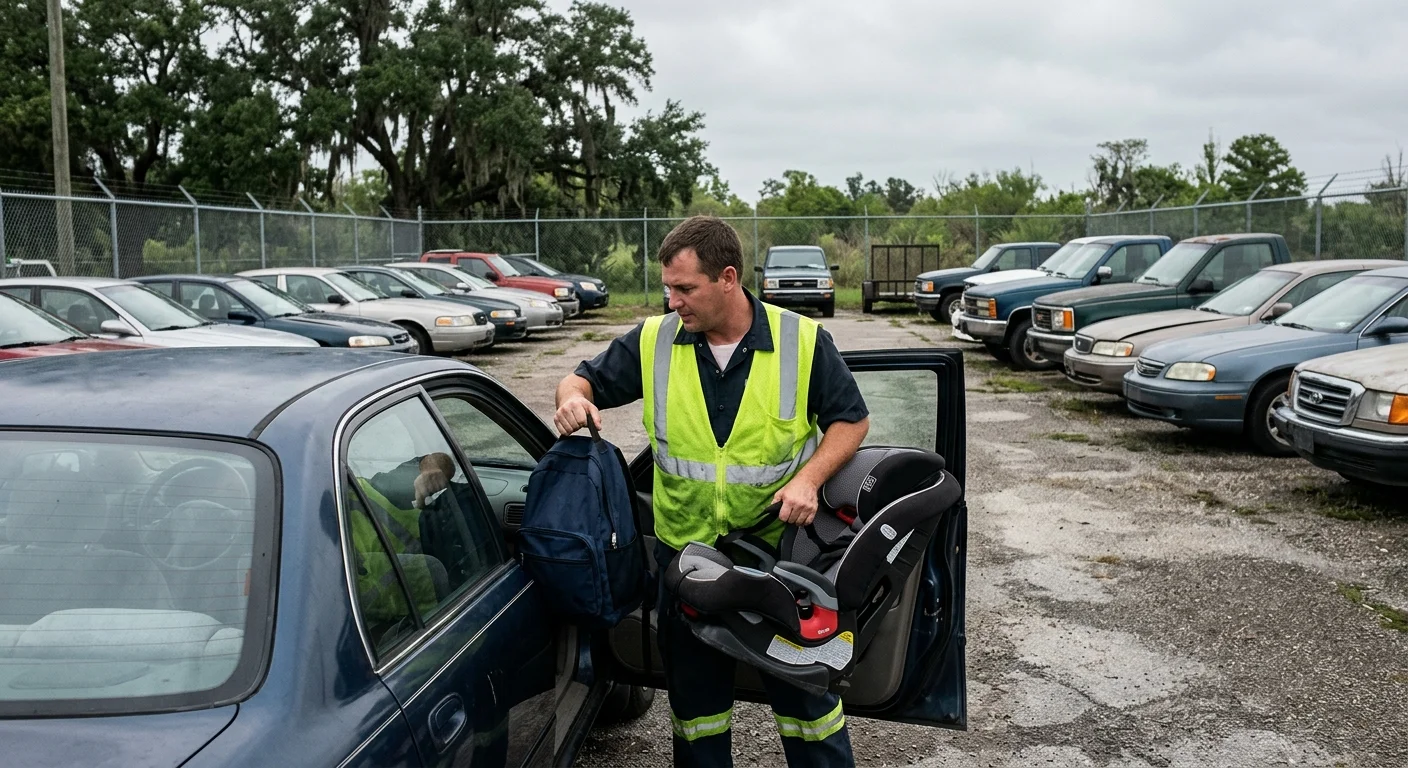
Louisiana does not grant a 24-hour belongings right. Senate Bill 263, which would have required release of non-affixed property within one hour, did not pass. Bring ID, proof of ownership, and go during the yard’s posted hours. The confirmed LPSC rule is a fee cap: no retrieval fee during normal business hours, and no more than $64.50 after hours. For a City tow, start at Find My Towed Vehicle and our find-your-towed-car guide. We do not publish City storage or boot dollars.
Can I get my belongings from my towed car, and what it costs
Louisiana’s confirmed rule focuses on the fee charged for retrieving vehicle contents. During normal business hours, a towing or storage company can’t charge a retrieval fee. Outside those hours, the retrieval fee can’t exceed $64.50.
That limit appears in Section II.F.2 of the current Louisiana Public Service Commission towing schedule. The cited schedule took effect April 1, 2026. LPSC rates adjust every April 1, so check the current schedule after that date each year.
The rule doesn’t establish a broad right to enter the storage lot whenever you choose. It also doesn’t require the yard to release property within a certain period. Those gaps matter when a yard refuses access or sets a specific pickup procedure.
Treat belongings retrieval and vehicle release as two separate requests. Removing a backpack doesn’t necessarily mean you’re paying to release the car. Make that distinction clear when speaking with the storage facility.
Ask the yard whether it allows supervised access during normal business hours. Confirm which records it wants you to bring. If someone other than the registered owner is collecting the items, ask what authorization the yard requires.
A private-property tow can also involve different people than a City impound. The property owner, towing operator, and storage facility may each play a role. Our guide to private-property towing explains how that type of removal begins.
What normal business hours means in Louisiana
For this fee rule, normal business hours have a fixed legal meaning. R.S. 32:1734 defines them as 8:00 a.m. through 5:00 p.m., Monday through Friday, excluding legal holidays.
Those hours determine when a storage company can charge for retrieving contents. They aren’t necessarily the same as every hour shown on the yard’s website or gate. A facility may publish longer operating hours while handling belongings only through a particular office.
Call before making the trip. Ask these questions plainly:
- When can I retrieve belongings without releasing the vehicle?
- Where should I report when I arrive?
- What proof should I bring?
- Will an employee supervise access?
- Is any retrieval fee being charged?
Describe the property you need. A list such as “backpack, child seat, medication, and work tools” is clearer than “everything inside.” Ask how the facility handles an item attached to the vehicle instead of assuming it counts as ordinary contents.
At the counter, repeat that you’re requesting belongings, not vehicle release. Louisiana defines a gate fee as a charge for releasing a vehicle outside normal business hours. That isn’t automatically the same thing as a personal-property retrieval fee.
If the facility requests payment during normal business hours, ask for the charge in writing. Request an itemized invoice and the rule supporting it. LPSC-regulated invoices must be itemized and provide the Commission’s complaint information. You may request a copy without paying the invoice first.
The one-hour release rule people cite does not exist here
Some Louisiana drivers have heard that a tow yard must release personal property within one hour. That isn’t current Louisiana law.
Senate Bill 263 was introduced during Louisiana’s 2026 Regular Session by Senator Owen. It would have required the release of non-affixed personal property within one hour after identification and proof of ownership during business hours. The proposed release would have been free unless a police hold applied.
The bill didn’t pass. Its last recorded action was consideration by the Senate Transportation, Highways and Public Works Committee on April 1, 2026. It never passed the Senate. It didn’t reach the House or the Governor, and it has no Act number.
That failed proposal may explain why the one-hour claim appears online. Bill language can remain searchable even when it never becomes law. A summary that calls it a “new Louisiana law” is wrong.
Don’t rely on Senate Bill 263 when speaking with a yard. The enforceable statewide rule is narrower. It prevents a retrieval charge during normal business hours and caps an after-hours charge at $64.50.
We couldn’t confirm a broader Louisiana statute guaranteeing access to every stored vehicle. We also couldn’t confirm a universal deadline for releasing belongings. If a yard or agency claims that another rule applies, ask for the current statute, order, or written policy. Then confirm it with the LPSC or the public agency that ordered the tow.
At the City’s Claiborne Avenue pound
A City of New Orleans impound requires a more specific plan. The City’s release and payment lot is at 400 N. Claiborne Avenue, under the expressway near Conti Street.
The City lists a vehicle release window of 7:30 a.m. through 10:00 p.m., seven days a week. It separately lists the Cashiering Office as open from 8:00 a.m. through 6:00 p.m., Monday through Friday. Those listings describe different functions, so they aren’t necessarily contradictory.
The City’s July 2026 announcement directs impound payments to 400 N. Claiborne Ave even when a vehicle is stored at 10200 Almonaster Ave. Vehicles held longer than 24 hours may be moved to Almonaster. Confirm pickup location with the City before you travel. Do not assume every car is collected at Claiborne.
Check the City’s Find My Towed Vehicle page and call the Parking Division using the number published there. Confirm that day’s hours and ask when belongings can be retrieved. The City page doesn’t confirm a separate personal-property access schedule.
Before driving to Claiborne Avenue, verify that the City actually has the car. Our guide to finding a towed car in New Orleans walks through that first step.
Ask whether your belongings appointment falls within the general release window or the Cashiering Office hours. Also ask what identification and vehicle records the City wants to see. We couldn’t confirm those requirements for a belongings-only visit from the approved City source.
Outstanding parking citations that are at least 90 days old must be paid before the City releases the vehicle. That is a condition for releasing the car. The source doesn’t say whether those citations prevent a separate belongings visit, so confirm that point directly.
A vehicle towed from Metairie or Kenner isn’t a City of New Orleans impound. A Westbank tow may also involve Orleans or Jefferson Parish, depending on the exact location. Confirm the holding facility before heading toward Claiborne Avenue.
If the yard still says no
Start by asking exactly what the yard is refusing. Access to belongings, release of the vehicle, and release outside business hours are different requests. A clear answer helps you choose the right next step.
Ask for the reason in writing. If the employee mentions a police or agency restriction, ask which agency imposed it. Contact that agency and request its instructions. Don’t assume the storage facility can remove a restriction set by someone else.
If timing is the issue, request access during Louisiana’s defined normal business hours. Record the date and time of your request. Keep the facility’s response, invoice, and any written policy it gives you.
For a fee dispute, compare the charge with the current LPSC schedule. The confirmed rules are straightforward:
- No contents-retrieval fee during normal business hours.
- An after-hours retrieval fee can’t exceed $64.50.
- The invoice must itemize the charges.
- You can request an invoice copy before paying.
Every regulated invoice must include the LPSC complaint address. A complainant doesn’t have to pay an invoice first to have standing. If a written complaint concerns excessive charges and the charges are later found excessive, storage fees stop accruing from the complaint date.
That protection concerns charges. It doesn’t create the broader property-access right that Louisiana lawmakers considered but didn’t enact.
If medication or another urgently needed item remains inside, explain the situation clearly. Ask the facility or ordering agency what procedure applies. We couldn’t confirm a special Louisiana access rule for urgent personal items, so don’t claim one when requesting help.
Never climb a fence, force a door, or enter a restricted storage area. Once the car is released, it may still be undrivable. Our emergency towing referral service can connect you with an independent operator for that separate move.
When to call us
If the released car can’t be driven safely, a licensed towing operator can move it from the storage lot. The line takes calls 24/7. Call (504) 474-5530. We match you with a licensed local operator who quotes before the truck rolls.