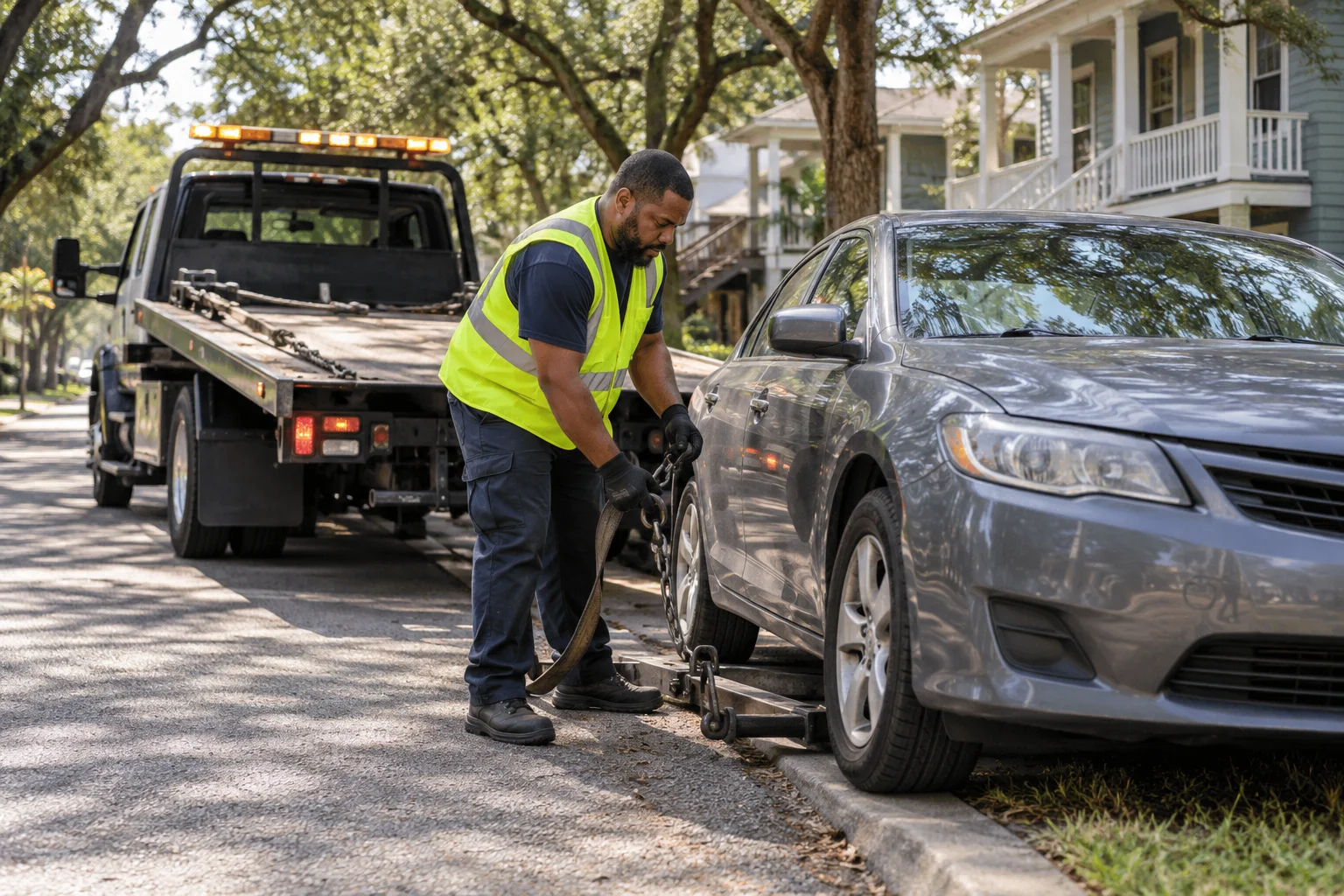
A car breakdown in Broadmoor, New Orleans starts with one decision: can roadside help solve the immediate problem, or does the car need a tow? The answer depends on the car’s condition, its exact block, and where you want it taken.
Start with the car’s condition and exact block
First, note what happened before the car stopped. Did the engine shut off without warning? Did a tire go flat? Did you hear scraping, feel the steering change, or see a dashboard warning?
Those details help an operator bring the right equipment. They also help separate a roadside job from a transport job.
Report the car’s exact position, not just “Broadmoor.” Give the street, nearest cross street, and direction it faces. Mention whether it’s parked at the curb, inside a lot, in a driveway, or blocking a travel lane. If you’re near Napoleon Avenue or South Broad Street, say which side of the intersection you’re on.
Then describe the vehicle. Include its make, model, color, and general size. Tell the operator if it has all-wheel drive, very low ground clearance, damaged wheels, or a transmission that won’t shift into neutral. Mention any trailer, loaded cargo, or unusual modification.
Take clear photos when it’s safe to do so. A wide photo can show the car’s position and available working space. A closer photo can show a damaged tire, wheel, or body panel. Don’t photograph private documents or leave readable personal information in the frame.
If standing water played any part in the breakdown, don’t treat it like a normal no-start. Use our guide on what to do when your car floods in New Orleans instead of attempting roadside repairs.
Broadmoor streets and nearby corridors need clear landmarks
Broadmoor includes broad avenues, residential blocks, intersections, and properties with limited working space. A street name alone may not tell an operator exactly where the disabled car sits.
Napoleon Avenue can place you on a wide corridor, while a nearby side street presents a different setup. South Broad Street and Claiborne Avenue also carry traffic through multiple parts of New Orleans. Give the nearest cross street and a visible landmark that won’t move, such as a building entrance or corner.
Avoid vague descriptions like “near Uptown” or “a few blocks from Broad.” Broadmoor and nearby Uptown are distinct search areas, even when a driver crosses between them during one trip. Our separate guide covers a car breakdown in Uptown when that better matches your location.
A phone map pin helps, but it shouldn’t replace a written location. Map pins can land behind a building, on the wrong side of a divided street, or near an alley entrance. Send the pin, then add the street and cross street in plain language.
If the eventual route may involve I-10 or another major corridor, check Louisiana 511 for current closures, incidents, and traffic conditions. That information can help you choose a practical repair destination before the vehicle moves.
Good location details reduce confusion. They also help the matched operator understand whether the job involves curb access, a parking lot, a narrow driveway, or an active corridor.
When roadside help may fit
Roadside help may fit when the vehicle is otherwise intact and the problem has a limited on-site solution. Common examples include a dead battery, a locked car, an empty fuel tank, or a flat tire with a usable spare.
A battery jump may fit when the battery appears to be the only issue. If the car starts but won’t stay running, the problem may require further diagnosis and transport. Tell the operator what the lights and dashboard did before the engine stopped.
A tire change may fit when the spare, wheel, and lifting points are usable. A shredded tire, damaged wheel, missing spare, or unstable parking position can change that choice. Describe the damage rather than assuming a tire change will work.
Lockout help may fit when the keys are inside an undamaged vehicle. Tell the operator if a child, vulnerable adult, or animal is inside so the situation can be treated as an emergency.
Fuel delivery may help when the car simply ran out of fuel. A repeated stall after adding fuel points to a different problem. Don’t keep guessing about the cause if the vehicle still won’t operate normally.
Our roadside assistance service covers the matching process for these kinds of calls. Quick Tow New Orleans doesn’t perform roadside work. We take the call and connect drivers with independent, licensed local operators.
Before requesting help, explain every visible symptom. Roadside assistance is the better choice only when the issue can be handled without transporting the vehicle.
When the car may need transport
A tow may be the better choice when the car can’t move normally or shouldn’t continue to its destination under its own power. Steering trouble, brake trouble, collision damage, a wheel sitting at an unusual angle, or repeated stalling all point away from a simple roadside fix.
Transport may also be needed when the car won’t shift into neutral. Tell the operator before equipment is assigned. The same applies to all-wheel-drive vehicles, low-clearance cars, and vehicles with damaged suspension parts.
Don’t assume a car is ready for a standard hookup because it still rolls. A damaged tire can leave the wheel exposed. A broken axle or suspension component can change how the vehicle must be loaded. Fluid beneath the car is another detail the operator needs before moving it.
Location matters here too. A disabled car parked along Napoleon Avenue presents a different access question than one inside a Broadmoor driveway. Share whether another vehicle, gate, curb, tree, or tight turn limits access.
Use emergency towing when the vehicle needs transport rather than an on-site service. “Emergency” describes the towing need, not a promised arrival window. Quick Tow matches the caller with an independent operator covering the area.
If you’re uncertain, describe the symptoms without choosing the equipment yourself. The licensed operator can determine what fits the vehicle and its position. A precise description is more useful than asking for a specific truck based only on appearance.
You’ll also want to decide where the car should go. That choice affects the request and prevents an avoidable destination change after loading.
Choose an Orleans destination before it moves
Pick a destination before the operator moves the car. This may be a repair shop, tire shop, dealership, body shop, or another lawful location that has agreed to receive it.
Start with the problem. A flat tire may call for a tire shop. Collision damage may require a body shop. A no-start or repeated stall may need a mechanic with diagnostic equipment. If the vehicle has special service requirements, confirm that the destination can handle them.
Call the destination yourself when possible. Ask whether it will accept the vehicle and where a tow operator should leave it. Some properties use a service entrance, secured lot, or designated drop area. Don’t assume the public entrance is the correct delivery point.
Consider the route from Broadmoor. A shop near South Broad Street may be practical for one driver. Another may already have a trusted mechanic closer to Claiborne Avenue or Uptown. The right destination is the one prepared to receive and inspect your vehicle.
Keep the shop’s name, address, and instructions ready. Share any gate details or contact directions provided by the property. Don’t send a vehicle to a closed or secured location unless the business has confirmed its drop procedure.
The operator sets and collects the towing charge directly. Quick Tow doesn’t set operator prices or collect payment for the tow. Ask the matched operator about the charge and payment terms before authorizing transport.
Remove the items you’ll need before the car leaves. Check for keys, medication, work equipment, child seats, and personal documents. Confirm which key must travel with the vehicle and who will receive it.
When to call us
Call when a Broadmoor breakdown can’t be handled safely with basic roadside help, or when the vehicle needs transport to a repair destination. The line takes calls 24/7, and Quick Tow matches drivers with independent local operators. Call us at (504) 474-5530 and we’ll connect you with a licensed local operator.