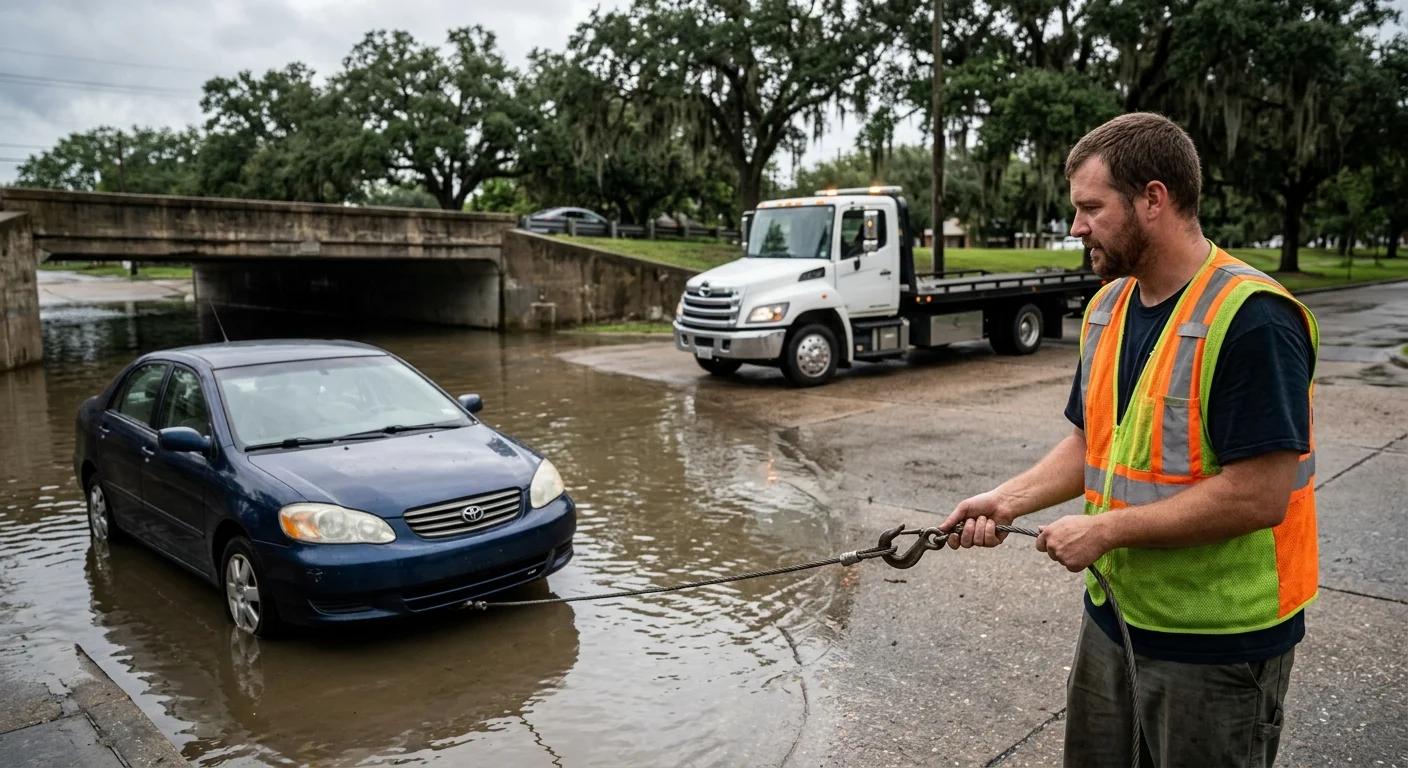
Do not start a flooded car. Electrical systems and the engine can take water. Recovery is not a standard tow. See winch-out. We do not fabricate salvage values.
Start with the water around the car
The water matters more than the car at first. The National Weather Service says it’s never safe to drive or walk into floodwater. Never go around a barrier blocking a flooded road. The road beneath the water may have collapsed.
The same guidance explains why guessing from appearance doesn’t work. Six inches of fast-moving floodwater can knock over an adult. Twelve inches of rushing water can carry away most cars. Two feet can carry away SUVs and trucks.
Those figures describe moving water, not a safe depth chart. They don’t mean shallower water is safe to enter. Water speed, pavement condition, hidden drop-offs, and vehicle position may not be visible from dry ground.
If your car stops before entering the water, leave it there. Don’t test the flooded stretch by creeping forward. If the vehicle is already surrounded, don’t step into the water to inspect a tire, attach a strap, retrieve a bag, or take a closer photo.
Make your calls from a dry location. Tell the operator whether water still surrounds the vehicle and whether it appears to be moving. Mention barricades, police activity, blocked lanes, or nearby downed objects without approaching them.
A towing referral should begin only after the scene can be described safely. Quick Tow New Orleans matches drivers with independent, licensed local operators. The operator decides whether the location is accessible and what equipment the recovery requires.
Why restarting a flooded car can change the damage
Leave a flooded vehicle off until a repair professional can assess it. A visible water mark doesn’t confirm what reached the intake, wiring, fluids, cabin, or control modules. There’s no verified universal water depth that makes a restart harmless.
Starting the engine asks several systems to work before contamination is ruled out. That can turn flood exposure into additional mechanical or electrical trouble. Repeated attempts also erase part of the vehicle’s immediate post-flood condition, which may matter to the shop or insurer reviewing it.
Don’t use the dashboard as the only test. Warning lights may appear, disappear, or remain unreadable if the electrical system is affected. A silent dashboard doesn’t prove the engine is ready to start.
Instead, record what happened without entering floodwater. Note whether the engine stopped while moving or was already parked. Tell the operator whether you attempted a restart and what happened. Include the highest exterior water mark you could see from dry ground.
Don’t guess about repair costs or whether the vehicle is a total loss. Those decisions require an inspection and, when a claim is involved, the policy and insurer’s process. Floodwater depth alone doesn’t supply an honest repair quote.
The towing decision comes first: move the car without asking it to power itself. The destination can then inspect the engine, electrical system, fluids, interior, and other affected areas before anyone tries to start it.
Underpasses and streets that need extra caution
A flooded car in New Orleans often becomes a route problem. A low point can block the direct approach even when nearby blocks look passable.
The Carrollton Avenue underpass is a useful example. If water covers the approach, don’t enter it to reach a stranded car. The same rule applies when water interrupts Claiborne Avenue in Uptown. An operator may need a different direction of approach or may need to wait until authorities reopen access.
Don’t assume a familiar street remains usable because you drove it earlier. Conditions can differ between intersections. Use Louisiana’s official 511 traveler information service to check reported closures, incidents, weather, and road conditions before choosing a route.
Metro geography also affects the recovery plan. A vehicle in Orleans Parish isn’t positioned like one in Metairie, Kenner, St. Bernard Parish, or the North Shore. Crossing Lake Pontchartrain or moving between the Eastbank and Westbank can change which open route reaches the scene.
Give the nearest cross street, not just the road name. “Carrollton Avenue” covers a long corridor. A dropped map pin, travel direction, nearby intersection, and visible landmark give the operator a clearer starting point.
Floodwater is also different from an ordinary shoulder breakdown. Our guide to breakdowns on I-10 and the Causeway covers those controlled-road situations. For a flooded street, the immediate rule remains simpler: don’t drive around barriers, and don’t walk into or near the water.
What the recovery operator needs to know
A clear first report helps the operator evaluate the scene before committing equipment. Start with the vehicle’s exact location and whether you’re safely away from the water.
Share these details:
- The nearest intersection and travel direction
- A map pin or precise parking location
- Whether water still touches or surrounds the vehicle
- Whether the water is standing or visibly moving
- Whether the car is in a travel lane, shoulder, lot, or driveway
- The vehicle’s year, make, model, and general size
- Whether the engine stopped in water or while parked
- Whether any restart was attempted
- Whether the wheels appear blocked, sunk, or turned
- Where the keys are and whether the vehicle can be unlocked
- Any visible exterior damage seen from dry ground
Photos can help when they’re taken without entering or approaching floodwater. Capture the whole vehicle, its position, the surrounding road, and the visible water line. Don’t step into the scene for a better angle.
Flood recovery isn’t always a standard hook-and-go tow. The operator may need to evaluate traction, vehicle access, surrounding hazards, and the safest pulling direction. Our accident recovery and winch-out service explains the matching process for vehicles that can’t roll out normally.
A flatbed tow may be considered when the vehicle shouldn’t roll under its own power. It isn’t a promise that every flooded location can accept a flatbed. Clearance, pavement, water, vehicle position, and access still shape the operator’s decision.
Quick Tow doesn’t own trucks or perform the recovery. We pass the details to an independent, licensed operator who evaluates the job. No honest referral service can promise an arrival window or extraction method before that evaluation.
Where the car may go after recovery
Choose the destination before the vehicle moves whenever the situation allows it. A flooded car usually needs inspection, not another start attempt in a different parking space.
The destination may be a repair facility, dealership, insurer-approved inspection location, private property, or storage facility. Confirm that the location accepts flood-exposed vehicles and can receive the car when it arrives. Don’t assume every shop has space or handles this type of inspection.
Give the towing operator the complete destination address. Confirm where the vehicle should be left and who can authorize delivery. If the destination changes, tell the operator before transport begins.
Ask the operator for its business name and the agreed destination. Also ask how the tow will be documented and how payment works. Quick Tow makes the match, but the driver contracts with and pays the independent operator directly.
A police-arranged tow may follow different rules. Under the current Louisiana Public Service Commission framework, even a tow the owner asks an officer to arrange counts as non-consensual. Those tows remain subject to the LPSC non-consensual towing schedule, including its documentation and itemized-invoice requirements.
Don’t treat regulated maximums as Quick Tow’s prices. They apply to qualifying non-consensual tows, not every customer-requested recovery. Flood conditions may also change the work required, so the operator must assess the actual scene.
Once the car reaches its destination, keep the photos, operator information, tow paperwork, and any inspection documents together. Let the repair facility or insurer determine the next step. Don’t restart the vehicle merely because the water has receded or the exterior has dried.
When to call us
Call once you’re on dry ground and the flooded vehicle needs a licensed towing professional. The line takes calls 24/7, and callers hear a recording notice before recording begins.
Call (504) 474-5530. We match you with a licensed local operator who quotes before the truck rolls.