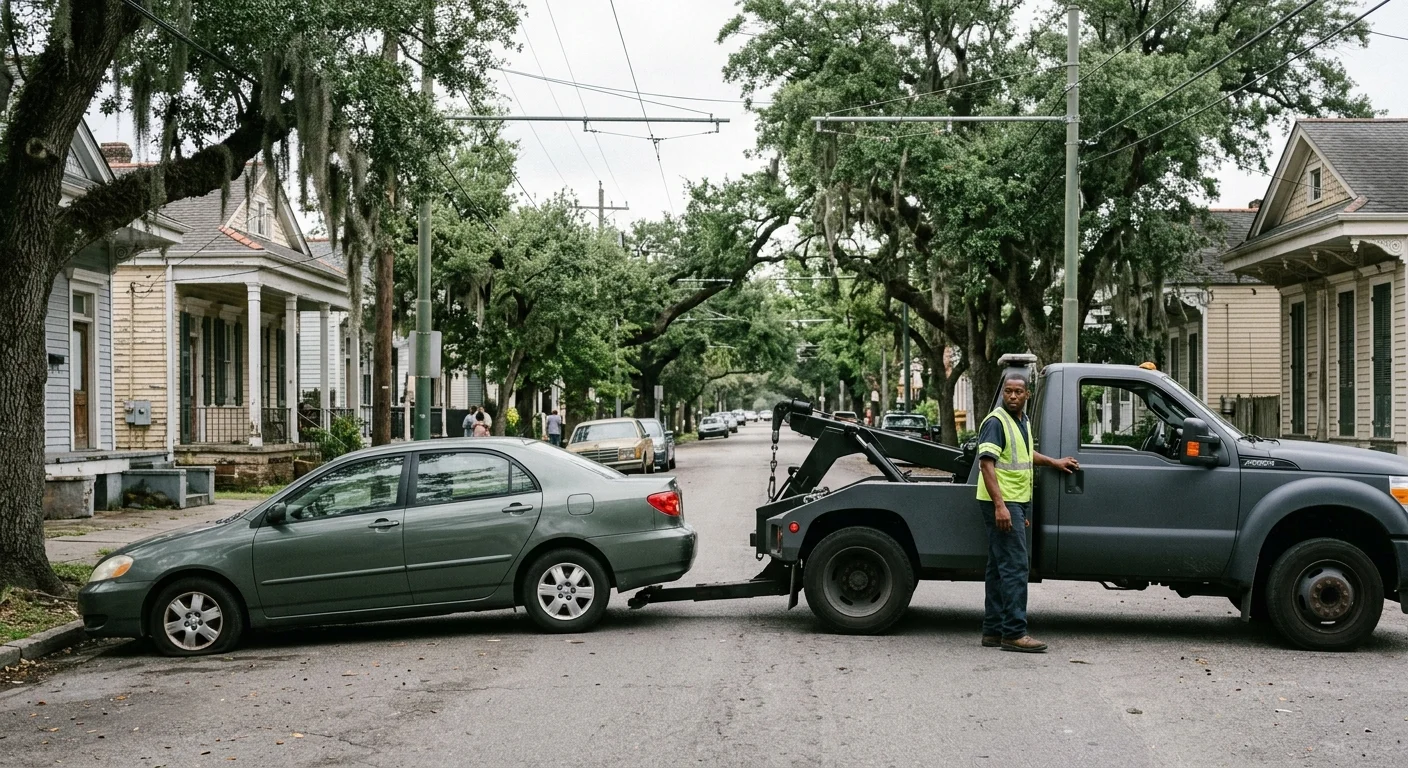
Carrollton is an Orleans Parish neighborhood along Carrollton Avenue and Claiborne. A breakdown on a Riverbend block is not the same as one at the Carrollton Avenue underpass. Use the Carrollton city hub. We match you with a licensed operator who quotes before the truck rolls. Ranked competitors for this query mixed in Mandeville operators, so this page is the Carrollton answer, not a Northshore speed claim.
Start with your exact block or cross street
“Carrollton” alone doesn’t give an operator enough detail. Start with the street, nearest cross street, and direction you were traveling. Say whether the car is on Carrollton Avenue, a nearby neighborhood street, or an I-10 entrance or exit.
Describe the car’s exact position. It may be parallel parked at a curb, inside a parking area, beside the streetcar corridor, or stopped near active traffic. Mention tight curb access, nearby parked cars, a median, or anything blocking a direct approach.
The operator also needs basic vehicle information. Give the make, model, approximate model year, and whether it’s a car, truck, motorcycle, or larger vehicle. Mention visible damage, a flat wheel, locked steering, or wheels that won’t roll. Those details help the matched operator decide which equipment may fit the job.
If you can reach the curb without entering traffic, photograph the vehicle’s position, wheels, and dashboard. These images can clarify what happened before the car moves. They can also show whether there’s enough room around it for loading.
Don’t guess at an address when you’re stressed. Check the map pin on your phone and compare it with the nearest cross street. On the streetcar corridor, tell the operator which side of Carrollton Avenue you’re on. Mention the tracks and overhead wires as location details without assuming what loading method will work.
If the vehicle is creating an immediate danger, contact local law enforcement. Call 911 in an emergency. Location comes first because every later decision depends on it.
Carrollton Avenue and I-10 create different conditions
A disabled car beside a Carrollton neighborhood curb is mainly an access problem. The matched operator needs to know about parked cars, narrow staging space, and the direction the vehicle faces. A car near I-10 presents a different situation because moving traffic may surround it.
For an interstate problem, identify the highway, travel direction, and nearest entrance or exit. Say whether the vehicle is completely outside the travel lanes. Don’t describe your location only as “near Carrollton.” The operator needs to distinguish an interstate shoulder from the streets below the interchange.
Louisiana DOTD’s Motorist Assistance Patrol covers parts of I-10 and all of I-610 on a fixed schedule. MAP isn’t a call-out towing service. Its free help can include a tire change, a battery jump, emergency fuel, scene protection, or moving a disabled vehicle from a travel lane. If MAP isn’t already present, DOTD directs stranded motorists to local law enforcement, or 911 during an emergency.
Check 511 Louisiana for current incidents, closures, and traffic conditions. That information can help you explain what’s happening around the vehicle. It doesn’t replace an emergency call when someone is in danger.
A tow may still be necessary when the car must leave the corridor for repair. Our guide for a breakdown on I-10 or the Causeway covers those higher-speed settings in more detail.
Along Carrollton Avenue’s streetcar corridor, describe the actual scene instead of assuming restrictions. Tell the matched operator about tracks, medians, curb position, and nearby traffic. The operator can then choose an approach based on the vehicle and available space.
A roadside service may avoid a tow
Not every disabled car needs to be transported. Some Carrollton towing services also handle roadside problems, but the right service depends on the symptoms. A clear description keeps a simple roadside request from becoming a mismatched tow call.
Start with what happened immediately before the car stopped. Say whether the engine cranks, the dashboard lights appear, or a tire is visibly flat. Mention whether the keys are locked inside, the shifter moves, or the vehicle has fuel. Don’t diagnose the mechanical cause unless you know it.
A battery jump may help when the battery is discharged. A tire change may work when there’s a usable spare and the vehicle is positioned for the job. Lockout help may solve a key problem. Emergency fuel may be enough when an empty tank is the only issue. Our roadside assistance guide explains the types of help a matched operator may provide.
A tow is more likely when the car has collision damage, won’t roll, lacks a usable spare, or needs diagnosis at a repair facility. An operator may also recommend towing after inspecting a problem that sounded minor by phone. The operator, not Quick Tow New Orleans, performs that assessment and physical work.
Don’t keep trying to drive a vehicle through standing floodwater. National Weather Service guidance says it’s never safe to drive into floodwater. If water covers your intended route, turn around and choose another path.
Tell the matched operator what you’ve already tried. Repeated start attempts, an unsuccessful jump, or a temporary tire repair may change the next step. Good details help separate roadside help from a job that requires licensed towing equipment.
Choose the destination before the car moves
Decide where the car should go before the operator loads it. Common choices include a repair shop, dealership, home, or another location where the vehicle can be accepted. The correct destination depends on the problem and what will happen after delivery.
Call the repair facility first when possible. Confirm that it accepts the vehicle type and can receive it at that time. Ask where a tow operator should leave the car and how keys should be handled. Don’t assume an unattended drop is allowed.
The destination matters even when the car is only traveling within Carrollton. A shop across the neighborhood creates a different route from one across Orleans Parish. Starting without a confirmed destination can lead to extra movement or storage arrangements that weren’t part of your plan.
For a vehicle that can’t continue safely, emergency towing connects the situation with a licensed local operator. Quick Tow New Orleans doesn’t own the truck, set the operator’s route, or choose the repair facility. You contract with and pay the independent operator directly.
Ask the operator how the selected destination affects the charge before authorizing service. Don’t confuse a customer-requested tow with a police-arranged, non-consensual tow. Louisiana Public Service Commission maximums apply to non-consensual towing, not a voluntary tow you arrange yourself.
Our guide to towing costs in New Orleans explains that distinction and the questions to ask. It also helps separate an operator’s price from City impound charges or state-regulated maximums.
If you haven’t selected a shop, say so during the call. The operator can explain available delivery terms, but you remain responsible for choosing and approving the destination.
What to confirm with the matched operator
Before authorizing the tow, repeat the location, vehicle details, and destination. Small corrections are easier before the truck is committed to a loading position. Confirm that the operator understands whether the vehicle is on a neighborhood street, along the streetcar corridor, or near I-10.
Ask what service the operator expects to perform. It could be roadside assistance, a standard tow, or recovery from a difficult position. Don’t assume the same equipment works for every vehicle. Low clearance, wheel damage, locked steering, and collision damage may change the loading plan.
Confirm these details directly with the independent operator:
- The vehicle being moved, including its condition and driveline details
- The pickup point and the car’s position at that location
- The approved destination and any receiving instructions
- The planned service and loading method
- The charges, payment methods, and any storage possibility
- How the keys and vehicle will be released at delivery
Ask for the operator’s terms before work begins. Quick Tow New Orleans doesn’t set operator prices, collect payment, or warrant an operator’s work. The matched operator is responsible for explaining the service and charges.
For a police-arranged non-consensual tow, Louisiana rules require an itemized invoice. The invoice must separate the applicable charges, and the driver doesn’t have to pay first to receive a copy. Those rules shouldn’t be presented as the price or terms of a voluntary Carrollton tow.
Keep photographs and written messages connected with the job. Note where the vehicle is being taken and who will receive it. If circumstances change, such as a repair shop declining the vehicle, discuss the new destination before the car moves elsewhere.
Clear confirmation protects everyone from avoidable confusion. It also keeps a stressful Carrollton breakdown focused on the next practical step.
When to call us
Call when roadside help won’t solve the problem or the vehicle needs licensed towing equipment. The line takes calls 24/7. Call (504) 474-5530. We match you with a licensed local operator who quotes before the truck rolls.