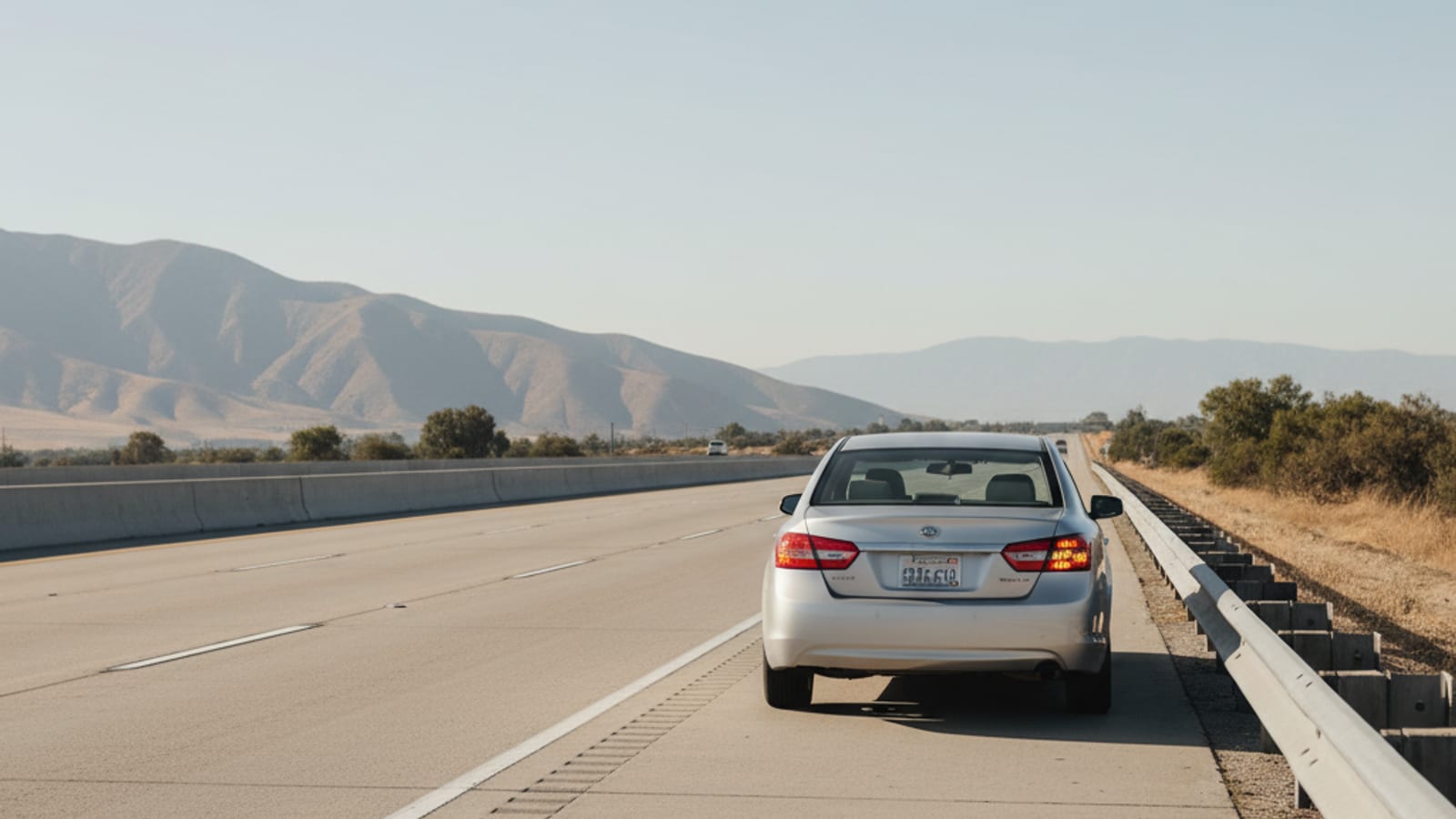
Get as far right as you can, onto the shoulder if there is one, and put your hazards on. If you are in a live travel lane, stay belted unless a responder tells you to move. If you have reached a shoulder, exit on the passenger side away from traffic. If you are in immediate danger, call 911. Louisiana’s Motorist Assistance Patrol (MAP) is a free DOTD patrol on set roads and hours. It is not a number you call out. If MAP is not already there, call local police, or 911 in an emergency.
What MAP actually covers, and when
MAP is a Louisiana DOTD program, and in the New Orleans area it runs on a defined set of roads and hours, not the whole metro around the clock.
Daytime coverage (5:30 a.m. to 7:30 p.m., seven days a week) runs I-10 from US-61 in Ascension Parish to Michoud Blvd, all of I-610, I-55 from I-10 to Manchac, and US-90B from the I-10 split to Westwood. Nighttime coverage (7:30 p.m. to 5:30 a.m.) narrows to I-10 from US-51 at LaPlace to Morrison Road, all of I-610, and a shorter stretch of US-90B.
On scene, MAP may change a flat using your own spare, provide about a gallon of emergency fuel, jump a dead battery, fill a radiator with water, let you make a local phone call, protect the scene, and clear a disabled vehicle from a travel lane. What it will not do is tow your car away for repair. It does not offer a 15-minute repair list. If your car needs to go somewhere for a real repair, or your breakdown falls outside MAP’s routes or hours, that’s a private tow. Once you’re safely off the live lane, call (504) 474-5530. We match you with a licensed local operator. The operator quotes the job before the truck rolls.
Where I-10 actually gets people, through the metro
I-10 through New Orleans isn’t a simple straight shot, and where you break down changes what happens next.
Through downtown, the Pontchartrain Expressway carries I-10 on an elevated stretch with limited shoulder space. Near Metairie Cemetery, the roadway dips so a rail line can pass overhead, a known low-lying, flood-prone pinch point. A stall here backs up fast because there’s little room for other traffic to get around it.
East of downtown, the High Rise carries I-10 over the Industrial Canal with little usable shoulder and no nearby alternate crossing. If your car starts acting up as you approach it, get off at the exit before it if you possibly can.
I-610, the bypass around downtown, has limited room to maneuver if something goes wrong. Check 511la.org or dial 511 for live incidents rather than relying on an old volume or length figure.
None of these corridors were built with a modern breakdown lane in mind, and that changes what “pull over safely” even means here compared to a highway with a wide paved shoulder.
Broke down on the Causeway? That’s a different situation
The Lake Pontchartrain Causeway isn’t part of the interstate system, and it isn’t covered by DOTD’s MAP patrol. It has its own 24/7 police force, the Causeway Police Department, run by the Greater New Orleans Expressway Commission. If you’re stranded on the bridge, call *27 or (504) 835-3116.
The Causeway carries roughly 40,000 vehicles a day across 24 miles of open water, and Causeway Police respond to more than 3,000 breakdowns and assistance calls a year, with an average response time under 4 minutes. There’s no continuous shoulder. Instead, Crossovers are spaced roughly every 3.5 miles, with Safety Bays halfway between each pair.
Try to reach a Crossover or a Safety Bay. If you cannot, the Greater New Orleans Expressway Commission says to drive as close to the right railing as you can, then exit carefully and stand behind the vehicle on the right-side curb, facing oncoming traffic. Wave approaching traffic into the left lane. Call Causeway Police at *27 or (504) 835-3116. Do not stand in the travel lane. Source: Causeway emergency PDF at thecauseway.us.
Once Causeway Police have you safe at a crossover or safety bay, that’s when a call to us gets your car the rest of the way off the bridge.
If your car stalls in floodwater, don’t restart it
New Orleans floods on an ordinary summer afternoon, not just during a hurricane. The Carrollton Avenue underpass and Claiborne Avenue in Uptown are both known repeat trouble spots where the city’s drainage system, run by the Sewerage and Water Board, gets overwhelmed by a normal thunderstorm. SWBNO runs 24 drainage pumping stations with 120 pumps, plus 12 smaller stations built specifically to activate at flood-prone underpasses, but a hard summer storm can still outpace them in the moment.
If your engine stalls while you’re in standing water, do not try to restart it. Water pulled into the engine through the intake can cause catastrophic internal damage the instant you crank it over, turning a simple tow into a full engine replacement. Get to higher ground if the water is still rising, and call for a tow once you and everyone in the car are safe. This isn’t a hypothetical: the National Weather Service’s own report on Hurricane Ida documented a fatality in Orleans Parish involving a driver who entered floodwater at an I-10 underpass. Standing water on a New Orleans street is never worth driving through to save a few minutes.
Check 511la.org before you’re in the middle of it
511la.org is Louisiana DOTD’s official traffic service, with real-time speeds, closures, incidents, construction updates, weather, and camera feeds statewide, reachable by phone at 511 or online. It’s worth checking before any drive through the metro, especially around the Causeway, the High Rise, or downtown.
If you’re evacuating for a hurricane and your car won’t cooperate
When a storm forces a mandatory evacuation, Louisiana can activate contraflow, reversing the normal westbound lanes of I-10 to send traffic eastbound toward the I-12/I-59 junction near Slidell. It’s a last-resort, state-activated measure, not an everyday tool, and when it runs, it’s a metro-wide, days-long surge in traffic and breakdowns. Check your battery and tires before you’re in that lane, not during it. If your car gives out while you’re evacuating, get to the shoulder if you can and call for help immediately. Traffic in an evacuation doesn’t stop for a disabled vehicle the way it might on a normal day.
For more on what to do the moment your car won’t start or overheats, see our guides on a car that won’t start and a vehicle after overheating, or check our roadside assistance and flat tire services.
Frequently asked questions
Can I call Louisiana’s Motorist Assistance Patrol for help?
Not directly. MAP works a fixed patrol schedule on specific roads and hours, it isn’t a call-out service. If you’re stranded and MAP isn’t already on scene, call local law enforcement, or 911 in an emergency.
What does MAP do for free?
A flat tire change using your own spare, about a gallon of emergency fuel, a jump start, radiator water, a local phone call, scene protection, and clearing a disabled vehicle from a travel lane. It does not tow the car away for repair.
Does MAP cover the Lake Pontchartrain Causeway?
No. The Causeway runs its own 24/7 police force, the Causeway Police Department. Call *27 or (504) 835-3116 if you’re stranded on the bridge.
What do I do if my car fails on the Causeway?
Try to reach a Crossover or Safety Bay. If you can’t, the Greater New Orleans Expressway Commission directs you to drive as close to the right railing as you can. Then exit carefully and stand behind the vehicle on the right-side curb, facing oncoming traffic. While you wait, wave approaching traffic into the left lane and call Causeway Police at *27 or (504) 835-3116. Do not stand in the travel lane.
My car stalled in standing water. Should I try to restart it?
No. Restarting an engine that pulled in water through the intake can cause serious internal damage. Get to higher ground if water is rising, then call for a tow once everyone is safe.
Where can I check real-time road conditions before I drive?
511la.org, Louisiana DOTD’s official traffic service, covers real-time speeds, incidents, closures, and camera feeds statewide, including the New Orleans metro.