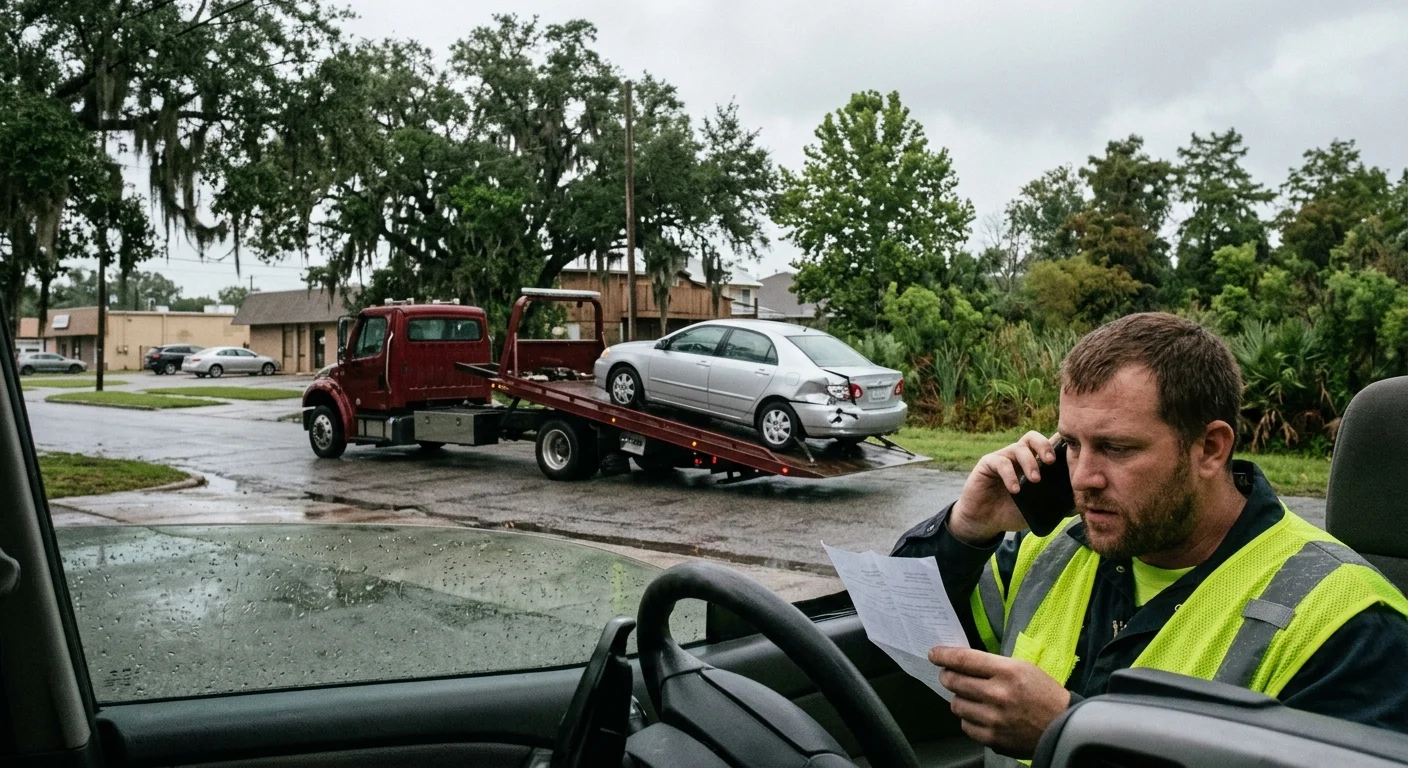
Coverage depends on the policy: a roadside endorsement versus an accident claim, and who ordered the tow. Louisiana does not mandate towing, collision, or roadside coverage. Only liability is compulsory. Our published $95 light-duty hookup is a private hookup baseline the insurer may or may not reimburse. Quick Tow does not hold a towing license and does not file the claim.
What Louisiana actually requires you to carry
Louisiana requires drivers to carry liability insurance under R.S. 32:861. The minimum limits come from R.S. 32:900(B)(2). They are commonly shortened to 15/30/25.
That means $15,000 for bodily injury to one person. The limit is $30,000 for bodily injury in one accident. The property damage limit is $25,000. Those limits have applied to policies issued since January 1, 2010.
These are liability requirements. They don’t create a towing benefit for your own disabled car. Louisiana also doesn’t require collision, towing, or roadside-assistance coverage.
That distinction matters during an already stressful stop. You might be disabled on I-10 near the Pontchartrain Expressway. Your car might be stuck after heavy rain near the Carrollton Avenue underpass. You could also have collision damage on Veterans Memorial Boulevard in Metairie.
Your insurance card proves you have a policy. It doesn’t prove that any of those towing situations are covered. The answer depends on the coverage and endorsements attached to that policy.
Don’t treat the required 15/30/25 limits as a towing allowance. Those numbers serve a different purpose. A tow reimbursement, if available, comes from an optional policy term or separate roadside plan.
The practical answer is simple. Louisiana law tells you what liability insurance you must carry. Your insurance contract tells you whether a tow bill is covered.
Does insurance cover towing, or does your policy decide
A policy may call the optional benefit “towing and labor” or “roadside assistance.” Those labels are useful search terms, but the exact wording controls. Louisiana doesn’t impose one standard towing benefit across every policy.
Coverage can also depend on what happened. A mechanical breakdown isn’t the same event as a collision. A flooded vehicle near a New Orleans underpass presents different facts from an illegally parked car removed in the French Quarter.
Don’t guess how the insurer will classify the event. Ask directly.
Confirm whether your policy covers this specific tow. Ask whether authorization is required before the vehicle moves. Confirm whether you may select the operator or must follow another process. Ask who pays the operator and what paperwork the insurer needs.
You should also ask where the covered tow may end. The policy might name conditions, exclusions, or limits. Read those terms instead of relying on a general promise that you have “full coverage.”
If your car is disabled in traffic, safety comes first. Our emergency towing service can connect you with an independent, licensed local operator. Quick Tow New Orleans doesn’t decide whether your insurer will reimburse the charge.
A crash may require more than a standard hookup. The operator may need to recover a damaged or displaced vehicle. Read about accident recovery and winch-outs before discussing the job with the insurer.
Insurance coverage and towing charges are separate questions. For local billing context, see our guide to tow costs in New Orleans. Never assume that a regulated maximum, an operator’s charge, and your policy benefit are the same number.
How to read your own policy in five minutes
Start with the declarations page. Look for a roadside-assistance or towing-and-labor entry. If it isn’t listed, check the policy endorsements before deciding it isn’t covered.
Next, search the policy document for “tow,” “towing,” “roadside,” “disabled vehicle,” and “labor.” Read the full paragraph around each result. A heading alone won’t tell you when the benefit applies.
Use this quick checklist:
- What events activate the towing benefit?
- Does the policy require advance authorization?
- Can you choose the towing operator?
- Are there destination or distance conditions?
- Is payment made directly or handled as reimbursement?
- Which receipts, photos, or claim documents are required?
- Are storage or recovery charges treated separately?
- Does a police-arranged tow follow a different claim process?
Then call the number printed on your insurance documents. Describe the actual location and event. A breakdown in Kenner, a collision on the Westbank Expressway, and a vehicle removed from private property aren’t interchangeable situations.
Ask the representative to identify the policy provision supporting the answer. Write down the representative’s name, the time of the call, and any claim or reference number provided. If possible, request written confirmation through the insurer’s normal communication channel.
Don’t discard the towing paperwork. Ask the operator for an itemized invoice. Keep photos of the vehicle, its location, and any collision damage. Save proof of payment if you pay the operator directly.
If water reached the car, don’t label the event yourself. Tell the insurer what happened and where the vehicle was found. Let the company state how the policy treats those facts.
If police or a property owner ordered the tow, tell the insurer that too. Authorization and billing rules for that tow may differ from your optional roadside benefit. Your goal is to match the real event to the exact contract language.
The Louisiana rule that protects the tow yard, not you
R.S. 22:1292 is often misunderstood in discussions about insurance and towing. It doesn’t guarantee that an insurer will reimburse a driver’s tow bill.
The rule applies when an insurer succeeds to legal title of a vehicle. That can happen after the insurer pays a total-loss claim. Once that title condition exists, the insurer can’t use the policy to avoid the towing and storage debt tied to the insured incident.
The insurer also may not abandon a vehicle it has taken title to at a towing or storage facility without the facility’s consent. This protects the facility holding the vehicle. It isn’t an optional roadside benefit for the former owner.
Storage charges in that situation are capped at the Louisiana Public Service Commission maximum. A facility that overcharges must refund the excess. It may also face a fine of up to $100 for each day of overcharging.
Keep the sequence clear. Your own towing coverage is decided under your policy. R.S. 22:1292 addresses responsibility after the insurer has taken legal title. It doesn’t add roadside assistance to a policy that lacks it.
This distinction can matter after a serious wreck. A licensed operator may recover the vehicle first. The insurance company may later evaluate the loss and take title. Those steps don’t turn R.S. 22:1292 into a promise that every driver gets towing coverage.
Ask the insurer which policy term applies to your initial tow. If the vehicle is declared a total loss, ask how it will handle the towing facility and storage charges after title transfers.
If someone else’s tow put you here
Not every tow begins with a driver calling an operator. Police, a private-property representative, or the City may start the process. Insurance coverage still depends on the policy, while Louisiana towing rules govern parts of the bill.
Under the current LPSC order, even a tow arranged by a police officer at the vehicle owner’s or driver’s request counts as non-consensual. That classification keeps the tow within the prescribed statewide rate structure. The current LPSC schedule covers non-consensual towing, recovery, storage, and permitted fees.
For a non-consensual tow, the invoice must be itemized. It must also state the LPSC complaint address. You may obtain a copy of the invoice without paying first.
A written LPSC complaint can affect disputed storage charges. If the Commission later finds the charges excessive, storage stops accruing as of the complaint date. The Commission can order a refund of up to 200% of an overcharge. A driver doesn’t have to pay the invoice first to have standing for a complaint.
A City of New Orleans parking tow follows the City’s impound process. Use the official Find My Towed Vehicle page to locate the car and review the current City information. Don’t confuse a City impound charge with a customer-requested tow or an insurance benefit.
If another driver caused a crash, don’t assume that driver’s insurer will automatically pay your tow. No general Louisiana towing-coverage rule was confirmed for that situation. Ask the carriers handling the claim which policy or liability decision applies. Request the answer in writing.
Likewise, don’t assume your policy covers a private-property tow. Send the insurer the invoice and explain who ordered the removal. Regulation of the tow bill doesn’t create insurance coverage by itself.
When to call us
A disabled, collision-damaged, or stuck vehicle may require a licensed towing operator. The line takes calls 24/7. Call (504) 474-5530. We match you with a licensed local operator who quotes before the truck rolls.