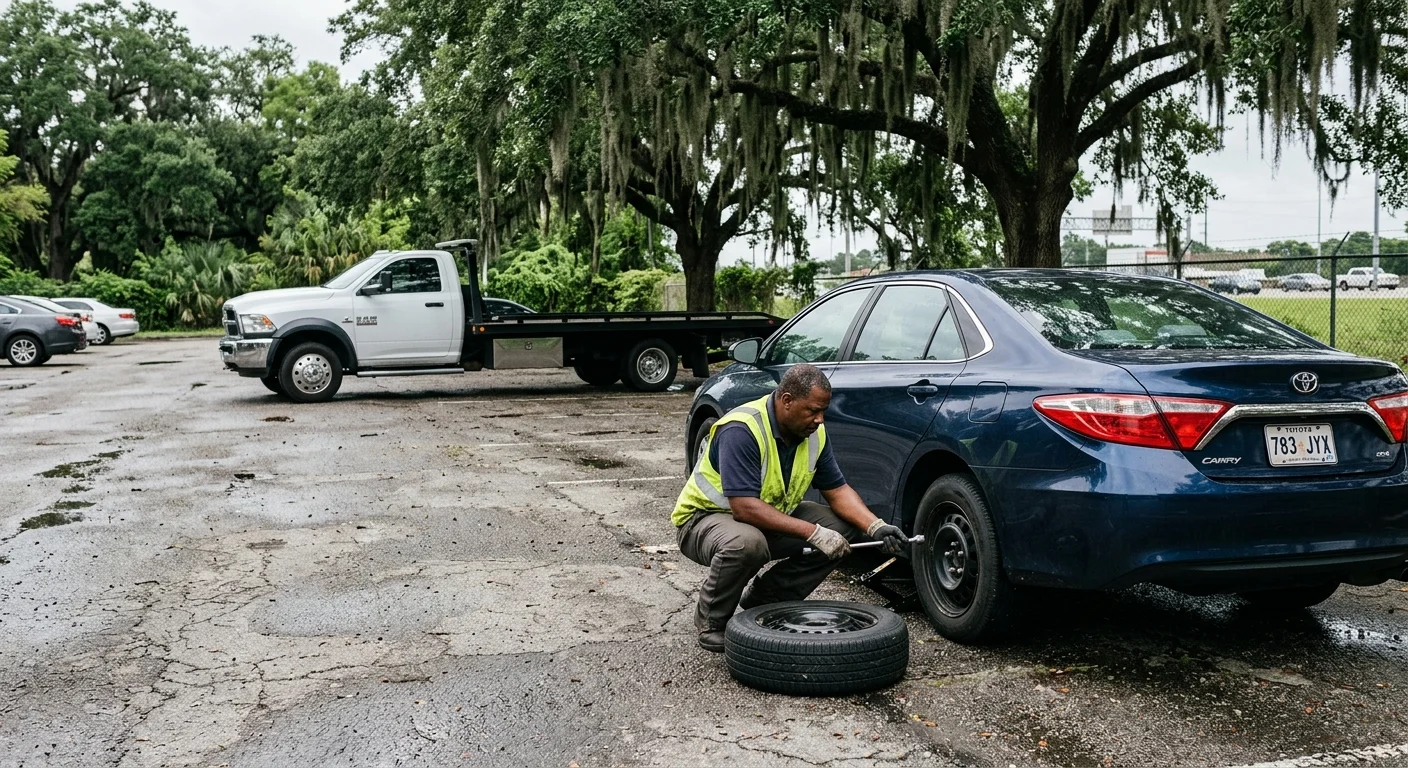
Lead with spare, lug-lock, and whether the shoulder is unsafe. Flat-tire help is a tire change when those pieces exist. A tow is the request when there is no spare, a seized lug, or you are on I-10 or the Causeway. Highway steps are in broke down on I-10 or the Causeway. Our $95 figure is a light-duty tow hookup, not a tire-change price.
Start with the tire and wheel condition
Begin with what you can see from outside the vehicle. A tire that has lost air is different from a wheel sitting at an unusual angle. Damage from a curb, road debris, or another vehicle can also extend beyond the tire.
A roadside tire change may fit when one tire is flat and the wheel assembly appears otherwise normal. The vehicle should also have a compatible, usable spare. The matched operator still needs to confirm that the spare, wheel fasteners, and vehicle condition allow the change.
Report anything that makes the problem look more involved. Useful details include a torn tire, exposed wheel, missing fasteners, or damage around the wheel opening. Mention whether two tires are flat. Also report any impact, grinding sound, or steering problem that happened before you stopped.
A spare in the trunk doesn’t settle the decision by itself. Some vehicles carry repair equipment instead of a spare. Others may have a spare but no wheel-lock key. If you aren’t sure what the vehicle carries, say that during the call.
Photos can help describe the problem. Take a full view of the affected side and a closer wheel photo, when the location allows it. The goal isn’t to diagnose the vehicle. It’s to give the operator enough information to decide whether tire service or towing equipment fits the job.
When a roadside tire change may fit
Roadside help is usually the first option when the problem appears limited to one tire. A compatible spare must be available, and the wheel area shouldn’t show signs of a larger impact. Tell the matcher about the spare rather than assuming it’s ready for use.
Location matters too. A paved neighborhood lot in Kenner or Metairie presents a different situation from an interstate travel lane. A parking lot may give the operator room to assess the wheel. A shoulder or bridge approach requires more location detail before service can be selected.
Our roadside assistance service connects drivers with independent local operators. The matched operator decides whether a tire change is suitable after reviewing the vehicle and scene. If you’re comparing membership, insurance, and direct-pay options, read our guide to affordable roadside assistance in New Orleans.
Louisiana also has a free public-help layer on covered highways. The DOTD Motorist Assistance Patrol can change a flat tire when a patrol is already on scene. MAP follows fixed routes and schedules. It isn’t a service that drivers can summon for a private call-out.
MAP can move a disabled vehicle from a travel lane and provide minor help. It doesn’t tow a vehicle away for repair. When MAP isn’t present, DOTD directs stranded motorists to contact local law enforcement, or emergency services when the situation is an emergency.
When wheel damage can change the decision
A damaged wheel doesn’t automatically mean the vehicle needs towing. The key question is whether the damage stops at the removable tire and wheel assembly. A usable spare may still solve that limited problem after an operator checks the vehicle.
The decision changes when an impact may have affected more than the wheel. Report a wheel that sits at an odd angle, damaged fasteners, fluid near the wheel, or bodywork touching the tire. Also mention whether the vehicle stopped rolling or steering normally before it was parked.
Those details can point toward a tow instead of a roadside change. They may also affect which towing method the operator selects. Quick Tow doesn’t choose equipment or perform the tow. The licensed independent operator makes that call after reviewing the vehicle.
Use emergency towing when the vehicle can’t be made movable through a straightforward tire change. That includes cases where no compatible spare is available or the operator finds additional damage. Describe the impact and wheel position before the operator is matched.
If towing is recommended, ask the operator how charges will be calculated before accepting the work. A flat tire alone doesn’t establish the final bill. Our New Orleans towing cost guide explains the difference between customer-requested towing, City impounds, and Louisiana-regulated non-consensual rates.
Location matters on bridges and interstate shoulders
A flat tire in a parking lot isn’t the same request as one on I-10. The road, direction, nearest exit, and exact stopping place all matter. Give the route details before discussing the tire.
DOTD’s New Orleans MAP network covers parts of I-10, I-610, I-55, and US-90B on fixed schedules. Coverage changes by corridor and time. Check 511 Louisiana for official traffic, closure, incident, construction, weather, ferry, and movable-bridge information.
The Lake Pontchartrain Causeway has its own system. Causeway Police patrol the bridge around the clock. Drivers stranded there should contact Causeway Police and follow their direction. The Greater New Orleans Expressway Commission publishes bridge information, police contacts, and fog procedures.
The correct location also helps distinguish different parts of the metro. Metairie and Kenner are in Jefferson Parish. A West Bank location needs the municipality and parish when known. A North Shore breakdown places the vehicle across Lake Pontchartrain from New Orleans.
Report whether the vehicle is in a travel lane, on a shoulder, near an exit, or inside a lot. Mention standing water, debris, or traffic restrictions visible at the scene. These facts help match the request without making assumptions about access.
Don’t describe the location only as “New Orleans.” On long corridors, the route and direction are more useful than a neighborhood guess. A highway marker, exit name, bridge segment, or nearby business can narrow the location.
What to report before an operator is matched
A clear first report helps separate a roadside tire change from towing. You don’t need to diagnose the problem. Share what happened, what you can see, and what the vehicle carries.
Include these details:
- The vehicle’s year, make, model, and approximate size.
- The affected wheel and whether more than one tire is flat.
- Any visible tire tear, exposed wheel, or unusual wheel angle.
- Whether the vehicle struck a curb, debris, pothole, or another vehicle.
- Whether a spare is present and appears intended for that vehicle.
- Whether the vehicle has a wheel-lock key, if known.
- The road, direction, nearest exit, and exact stopping position.
- Whether the vehicle is in a lot, shoulder, bridge area, or travel lane.
- Any steering, braking, grinding, or rolling problem before stopping.
- Any standing water, scattered debris, or access restriction nearby.
Say when a detail is unknown. “I don’t know whether there’s a spare” is more useful than guessing. The operator can then plan around the uncertainty.
Quick Tow New Orleans takes the calls and matches drivers with licensed, independent local operators. The line takes calls 24/7, including holidays. Calls are recorded after the caller hears a recording notice.
The operator performs the tire change or tow and sets the service terms. You’ll contract with and pay that operator directly. Confirm the work, charges, and payment method with the operator before service begins.
When to call us
Call when the vehicle has no usable spare, shows possible wheel-area damage, or can’t be handled through a basic tire change. The line takes calls 24/7 for roadside and towing referrals. Call (504) 474-5530. We match you with a licensed local operator who quotes before the truck rolls.