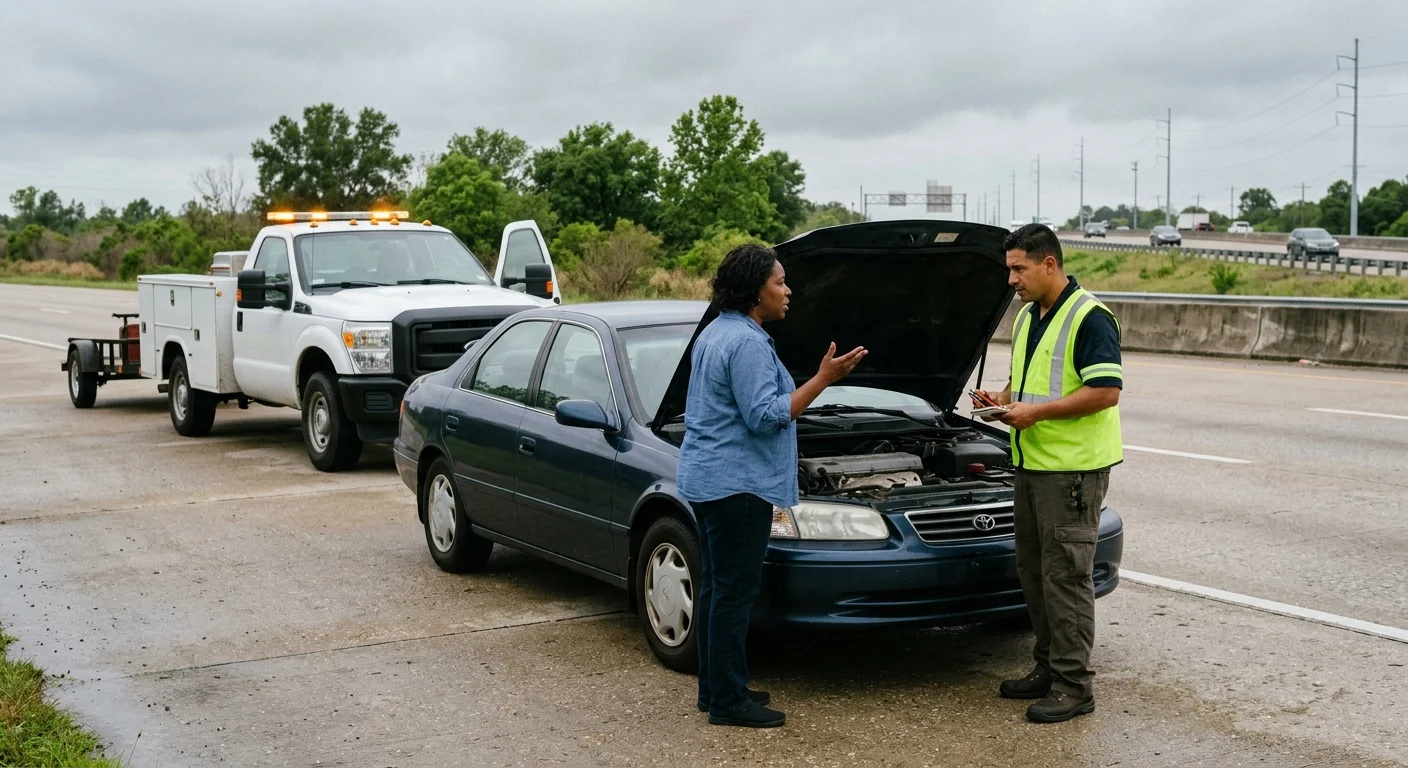
Lead with fuel type, whether the location is safe to sit, and when a tow is required (flood, mechanical, no restart). Fuel delivery is a small emergency fill, not a published dollar figure. Ask the operator how many gallons and how fuel is billed.
Start with the car’s location and condition
Location changes the request before anyone discusses the vehicle. A car sitting in a broad parking area presents a different job from one stopped along I-10. A shoulder on I-610, US-90B, or the Lake Pontchartrain Causeway needs precise location details.
Tell the call line whether the car is fully outside the travel lanes. Give the road name, direction of travel, and nearest exit. Include a mile marker, business name, or recognizable landmark when available. On the Causeway, say whether you’re traveling north or south. Those details help identify the correct zone and service situation.
Next, describe the car’s condition without guessing at the diagnosis. Say what the fuel gauge showed before the engine stopped. Mention any warning lights, unusual sounds, smoke, visible fluid, collision damage, or recent repair issue. Tell the operator whether the engine cranks, clicks, or does nothing when you try the key.
The metro also affects the match. An Orleans Parish street call isn’t the same route as a stop in Metairie or Kenner. West Bank requests may involve US-90B, while North Shore calls can involve a crossing over Lake Pontchartrain. St. Bernard Parish adds another direction and road network. Exact information helps the referral line connect you with an independent operator covering that area.
Fuel delivery may fit a simple empty-tank request
Roadside help after running out of gas may be enough when the problem is clear. The gauge showed empty, the engine stopped without another incident, and the vehicle had been running normally. In that situation, ask whether a matched operator offers fuel delivery at your location.
Don’t assume every independent operator carries fuel or provides that service. Availability depends on the operator covering the zone. Quick Tow New Orleans matches callers with licensed local roadside and towing operators, but it doesn’t perform the service or set the operator’s terms. The operator should confirm what service is available.
Louisiana DOTD also runs the Motorist Assistance Patrol on defined highway routes and schedules. MAP can provide about a gallon of emergency fuel when a patrol is already on scene. It’s a fixed-schedule patrol, not a service motorists call out to their location. Its help is limited to covered corridors and patrol periods.
For a customer-requested option, start with the roadside assistance service page. It explains how matching works for common roadside problems. The guide to affordable roadside assistance in New Orleans also helps compare a smaller roadside request with a full tow. Keep the first request simple: explain that the gauge showed empty and ask whether fuel delivery fits.
A restart problem can change the service needed
Adding fuel doesn’t confirm that the car will restart. The empty reading may be accurate while another problem is also present. The battery may not turn the engine, a warning may remain on the dashboard, or the original cause may still be uncertain. The operator needs the symptoms, not a diagnosis from the driver.
If fuel was delivered and the engine still won’t start, update the service request. Explain exactly what happens when you turn the key or press the start button. A cranking engine, a single click, dim dashboard lights, and no response are different descriptions. Don’t combine them into “the car is dead” if you can provide more detail.
Wrong fuel, collision damage, visible fluid, smoke, or a car stuck in an unusual position also changes the call. State those facts before an operator is matched. A standard roadside request may no longer fit. The vehicle may need transport to a repair facility or another destination chosen with the operator.
That is when emergency towing may be the clearer request. Towing can move the vehicle when a roadside service doesn’t resolve the problem. It also avoids treating an uncertain no-start as a guaranteed empty-tank fix. The operator can confirm the equipment needed after hearing the vehicle type, condition, and location.
A similar choice appears with tire trouble. The guide to flat-tire roadside help or towing shows how location and vehicle condition can change a seemingly simple roadside call.
Bridge and interstate locations need exact details
A breakdown on a controlled-access road isn’t described like a parking-lot stop. The operator needs the highway, direction, nearest exit, and the vehicle’s position. Report whether the car is on a shoulder, near a ramp, or still affecting a travel lane. If it’s in a travel lane, contact local law enforcement.
DOTD’s MAP coverage illustrates why the exact road segment matters. Daytime New Orleans-area coverage includes I-10 from US-61 in Ascension Parish to Michoud Boulevard, all of I-610, I-55 from I-10 to Manchac, and US-90B from the I-10 split to Westwood. Overnight coverage narrows to specified parts of I-10 and US-90B while continuing across I-610.
MAP may clear a disabled vehicle from a travel lane or provide minor roadside help. It doesn’t tow a vehicle away for repairs. Before assuming a patrol covers your location, check current incidents and road conditions through 511 Louisiana.
The Causeway has its own process. Causeway Police patrol the bridge around the clock, and stranded motorists should contact that agency. The bridge has Crossovers and Safety Bays, plus special procedures during fog restrictions. Follow the current directions from Causeway Police and the Greater New Orleans Expressway Commission.
Parish and route details also guide the referral. I-10 passes through several jurisdictions across the metro. US-90B connects central New Orleans with the West Bank. A North Shore request may involve a long lake crossing. Don’t shorten the location to “New Orleans” when the vehicle is actually in Jefferson Parish, St. Bernard Parish, or across Lake Pontchartrain.
What to confirm before an operator is matched
A clear request helps separate fuel delivery from towing. Gather the details you can observe without trying to diagnose the vehicle.
- Give the vehicle’s exact location and direction of travel.
- Identify the year, make, model, and vehicle type.
- Describe what the fuel gauge showed before the stop.
- Say whether the engine cranks, clicks, or stays silent.
- Report warning messages, damage, smoke, or visible fluid.
- Name the destination if you already know a tow is needed.
Tell the line whether anyone has already added fuel. If so, explain what happened during the restart attempt. Also mention whether the vehicle can shift into neutral, whether a wheel is damaged, or whether parking clearance limits access. These details may affect the operator and equipment selected.
Confirm the service directly with the independent operator. Ask whether fuel delivery is available for that location. If towing is needed, confirm the destination and the operator’s payment terms before service begins. Quick Tow doesn’t own trucks, employ tow drivers, set operator prices, or warrant an operator’s work. The driver contracts with and pays the matched operator directly.
Keep your description factual. “The gauge showed empty, and the engine cranks but won’t start” is more useful than insisting the vehicle only needs gas. That distinction gives the operator a better picture before accepting the request.
When to call us
Call when a known empty tank may fit fuel delivery, or when a failed restart means you may need a licensed towing operator. The line takes calls 24/7 and matches drivers with independent local operators. Call (504) 474-5530. We match you with a licensed local operator who quotes before the truck rolls.