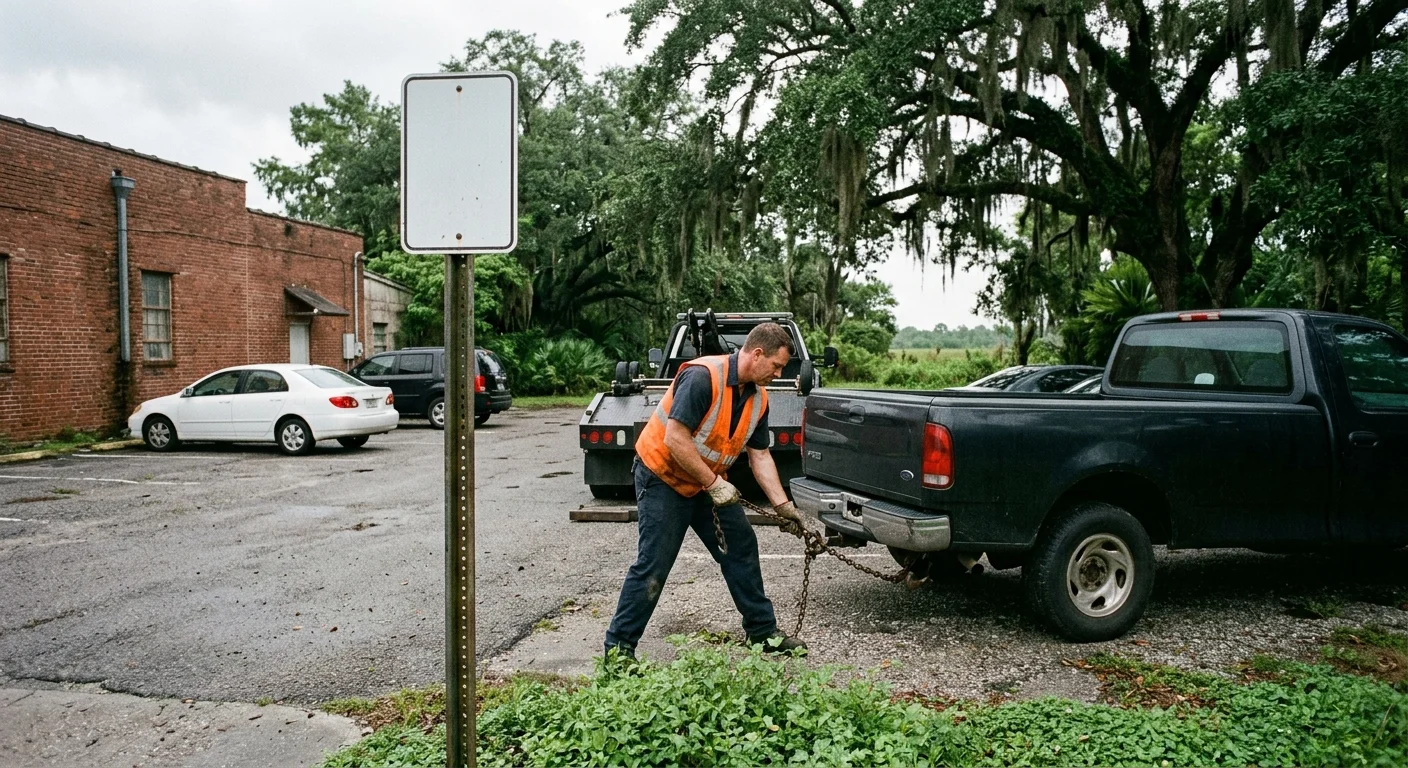
R.S. 32:1736 requires entrance and exit signs naming the towing company, address, and phone in lettering no less than two inches high, plus law-enforcement authorization or a proper tag unless the statute’s contract and signage exceptions apply. The property owner’s authorized representative may not be the tow truck owner or operator. See car blocking a driveway and junk car on rental property. LPSC nonconsensual maxima are not a private consensual quote. We do not publish City storage or boot figures.
The sign Louisiana private property towing law requires
Louisiana R.S. 32:1736 requires property owners to post towing signs at entrances and exits. Each sign must name the towing company and show its address and phone number. That information must appear in lettering at least two inches high.
Check every entrance and exit when a vehicle disappears from a private lot. A sign near one driveway doesn’t answer whether the other access points were posted. Photograph each entrance, each exit, and the full sign face. Keep wide photos showing where every sign stood.
Don’t assume the sign needs details that Louisiana’s confirmed rule doesn’t list. The approved law establishes the company name, address, phone number, and letter size. It doesn’t confirm a required color, typeface, mounting height, or exact towing warning. Ask the Louisiana Public Service Commission before treating one of those details as mandatory.
The statewide rule matters in very different parts of the metro. It covers private parking areas in New Orleans, Metairie, Kenner, Gretna, and Slidell. The road network and parish may change, but R.S. 32:1736 remains the starting point.
A property owner considering private property towing should verify every entrance and exit before arranging removal. The Louisiana Towing and Storage Act provides the larger statewide framework. Local property rules may add another layer, so confirm those separately with the city or parish.
Who can authorize the tow, and who cannot
The sign isn’t the only issue. Under R.S. 32:1736, an operator can’t perform a non-consensual tow from a parking area unless law enforcement authorizes it or the vehicle is properly tagged for removal.
That creates two distinct authorization paths. One involves a law enforcement agency. The other depends on proper tagging. Tagging details vary from lot to lot, and they’re worth pinning down in writing. If they decide a dispute, request the service contract and ask the relevant agency or LPSC what applied.
Louisiana also bars a clear conflict of interest. The property owner’s authorized representative can’t be the tow truck’s owner or operator. One person can’t act as both the property’s representative and the operator performing the removal.
Document who authorized the tow. Save photographs of any tag and write down when you first saw it. Keep parking permits, payment confirmations, lease terms, and messages from property management. Those records can help establish whether the vehicle was authorized to park.
Don’t confuse a private-lot removal with a City of New Orleans impound. City parking enforcement follows its own process. Our guide to finding your towed car in New Orleans explains that separate situation.
A tow you request for your disabled vehicle is also different. That’s a consensual service, like the connection described on our emergency towing referral page. Private-property towing law focuses on removal that the vehicle owner or driver didn’t arrange.
What the operator has to hand you
A private-property tow must produce a useful billing record. R.S. 32:1736 requires an itemized invoice showing the service date and time, the operator’s name, and every fee. It must also identify the law enforcement agency when one was involved.
Read the invoice line by line. A single unexplained total doesn’t show whether the amount came from towing, storage, a gate fee, or another regulated item. Ask for a copy before leaving. LPSC rules say you don’t have to pay first just to receive that invoice copy.
Keep the original invoice and photograph it. Thermal receipts can fade. Save card slips, cash receipts, emails, and any release documents with it. Match the vehicle description and service time against your own records.
The operator must also make certain records available to law enforcement or an LPSC officer upon request. Those records include billing invoices, service contracts, and the property owner’s contact information. That rule doesn’t promise the driver direct access to every contract. It gives enforcement officers a way to inspect the arrangement.
The invoice should also state the LPSC complaint address. The approved address is P.O. Box 91154, Baton Rouge, LA 70821, and the invoice should identify lpsc.louisiana.gov.
Missing information matters because Louisiana’s rates are prescribed. Without an itemized bill, you can’t reliably compare each charge with the current schedule. Record the gap, request a corrected invoice, and preserve whatever the operator originally provided.
The flat rate is set by the state, not by the lot
Louisiana sets maximum statewide rates for non-consensual towing. Private-property owners and tow operators don’t create their own unrestricted fee schedules. R.S. 32:1736 requires uniform fees set under LPSC rules.
The current private-property flat rates took effect April 1, 2026:
- Light Duty, 10,000 pounds or less: $152.50.
- Light Duty requiring documented repositioning equipment, a fold-down light bar, or an extra operator: $186.00.
- Medium Duty, 10,001 through 26,000 pounds: $335.00.
- Heavy Duty, 26,001 pounds or more: $430.50.
The higher Light Duty amount requires documentation showing why the extra equipment or operator was needed. It isn’t an automatic upgrade for every vehicle.
The flat towing rate may not be the entire bill. Current storage caps are $34.00 per calendar day outside, $40.50 covered, and $61.50 for an oversize vehicle. The gate fee is capped at $64.50. Retrieving belongings during normal business hours carries no fee. Retrieval outside normal hours may cost up to $64.50.
A company also can’t bill separately for ordinary equipment that Louisiana requires on its truck. That includes common tools, chains, hooks, warning devices, brooms, and required oil-absorbing material.
Check the current LPSC rate schedule against the service date. The Commission adjusts the schedule every April 1 using the Producer Price Index. A figure that was correct last year may now be wrong.
Booting is a separate law with a separate sign
A wheel boot isn’t governed by the towing sign alone. Louisiana R.S. 32:1741 sets separate requirements for booting businesses and their signs.
A booting sign must be at least 18 inches wide and 24 inches tall. Its lettering must be at least two inches high. The sign must name the booting company, provide its phone number, state the removal fee, and include the warning, “Unauthorized vehicles will be booted at owner’s expense.”
The company’s posted phone number must be staffed by a live operator 24 hours a day. After someone calls, boot-removal personnel have 90 minutes to arrive. If they don’t arrive within that period, the company can’t charge a boot-removal fee or any other amount.
An improper-parking boot also requires photographic proof clearly showing the violation. Ask to see that evidence and save a copy if it’s provided. Take your own photographs before the boot comes off, including the vehicle, parking space, permit, markings, and nearby signs.
Boot-removal personnel must accept cash, credit cards, and debit cards. A driver may request an administrative hearing within 10 days to contest the boot or its fee. Don’t confuse that hearing with the separate process for a vehicle stored after a public-agency tow.
Where a boot hearing request goes depends on who placed the boot. Ask the booting company where to send the hearing request, then confirm that direction with the responsible agency before the deadline.
If you were charged over the cap
Start with evidence. Photograph the signs, entrances, exits, parking space, vehicle tag, and any boot. Keep the invoice, payment record, parking permit, and messages from the property owner. Write down dates and times while they’re still clear.
Compare every line on the invoice with the schedule effective on the tow date. Check the vehicle’s weight class before applying a Light, Medium, or Heavy Duty cap. If the operator used the $186.00 Light Duty rate, request the documentation supporting the extra equipment or operator.
A written complaint may be filed with the Louisiana Public Service Commission or a district commissioner’s office. If the charges are later found excessive, storage fees stop accruing as of the complaint date. Filing alone doesn’t establish that finding, so keep every delivery and receipt record.
You don’t need to pay the invoice first to have standing before the Commission. The LPSC can order a refund of up to 200 percent of an overcharge. Louisiana law also gives an overcharged vehicle owner a right of action for the excess, storage costs, attorney’s fees, and court costs.
Violating R.S. 32:1736 can be an offense under R.S. 14:68.4. It can also cost the operator its license. Those consequences concern the operator, not Quick Tow New Orleans, which is a referral service and performs no tow.
Which court or filing procedure fits depends on the dispute. Ask the LPSC about its complaint process. Speak with a Louisiana attorney if you’re considering a separate lawsuit.
When to call us
Removing a vehicle from private property requires proper authorization and a licensed towing operator. The line takes calls 24/7. Call (504) 474-5530. We match you with a licensed local operator who quotes before the truck rolls.