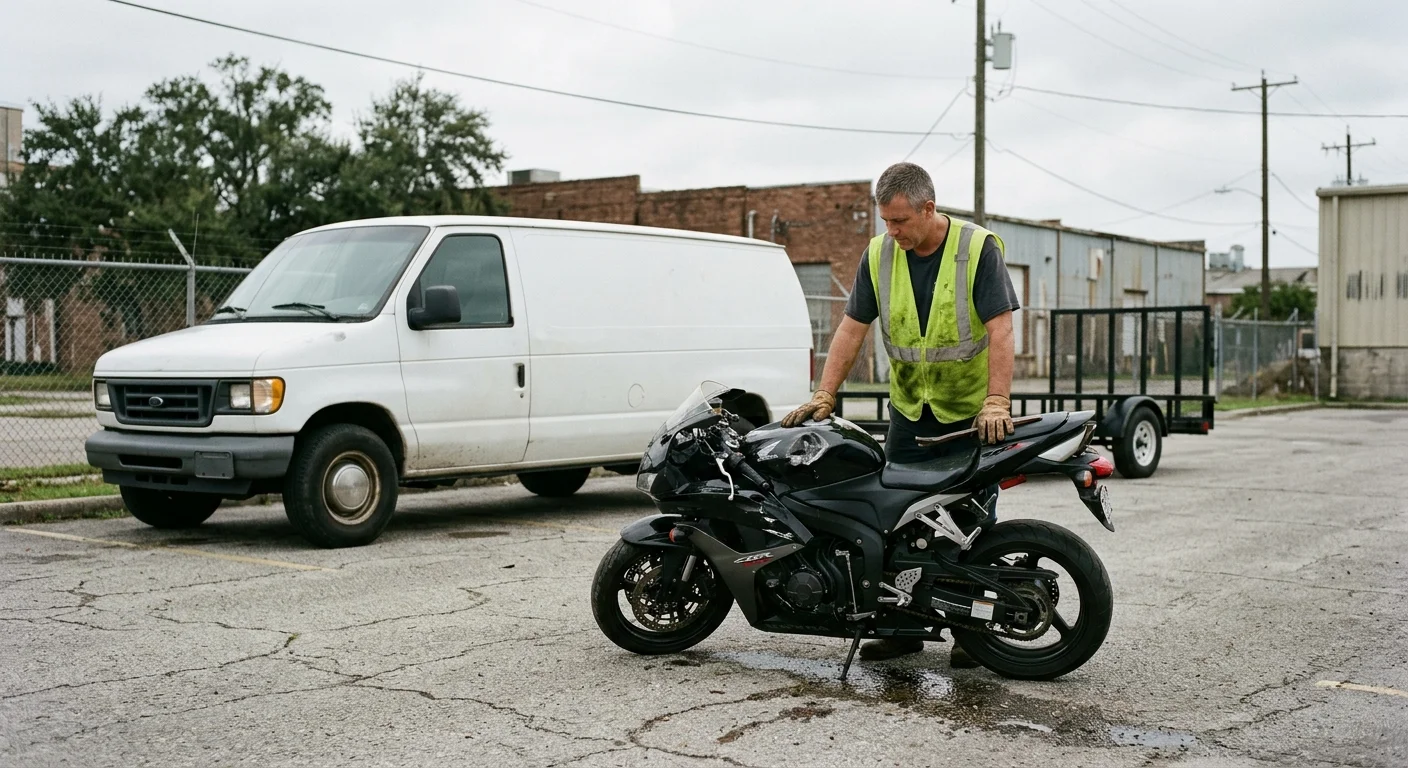
Lead with leaks, bent forks, and the destination shop. Method is in how motorcycle towing works and motorcycle towing. No unsourced rates.
That assessment matters whether the bike rests beside I-10 or inside a Metairie storage yard. Don’t assume a motorcycle can be loaded like an undamaged bike.
Start with the bike’s position and visible damage
Begin with where the motorcycle sits now. Tell the matched operator whether it’s upright, on its side, against a barrier, or off the pavement. Mention nearby traffic, soft ground, curbs, parking structures, and narrow access points.
Location changes the assessment. A bike in a quiet Kenner parking lot presents different access than one near I-610. The Westbank Expressway, the Lake Pontchartrain Causeway, and neighborhood streets also create different scene conditions.
Follow police directions at an active crash scene. Don’t enter moving traffic to inspect the motorcycle. If the bike is on the Causeway, use the contact and safety information published by the Greater New Orleans Expressway Commission. You can also check 511 Louisiana for current incidents and closures.
Describe only what you can see safely. Useful details include:
- Whether the bike is standing or lying down
- Which side contacted the pavement
- Whether either wheel looks bent or out of line
- Whether the handlebars appear damaged
- Whether body panels or luggage are loose
- Whether fluid is visible beneath the bike
- Whether debris remains around it
- Whether the key is available
Don’t lift, straighten, start, or roll the motorcycle to test it. Leave those decisions to the independent operator assessing the scene.
Our motorcycle towing service connects riders with licensed local operators. Quick Tow New Orleans owns no transport equipment and performs no physical towing.
Wheel damage changes the loading assessment
Wheel condition is one of the first details to report. A motorcycle that rolls normally presents a different job from one with a damaged, locked, or displaced wheel.
Look from a safe position. Tell the operator if a wheel appears misshapen, the tire has separated from the rim, or the front wheel points differently from the handlebars. Also mention visible damage around the forks, swingarm, brake area, or chain. You don’t need to diagnose the cause.
The operator should decide whether the bike can roll. That decision affects the equipment, access, and loading method selected for the job. A caller’s description helps, but photos often provide clearer context. Send wide views of the whole motorcycle and closer views of visible damage if the operator requests them.
Don’t try to free a wheel or reposition damaged steering parts. Crash forces can affect components that still look connected. The motorcycle owner’s manual may also include model-specific transport restrictions. Share that information with the operator when it’s available.
Standard roadside trouble is different. A motorcycle with a dead battery or mechanical no-start may have intact wheels and steering. Our guide to roadside help or towing for a motorcycle that won’t start explains that decision.
After a crash, visible damage becomes part of the transport assessment. The operator needs the condition of the whole bike, not only whether its engine runs.
A crash scene and a stored bike need different details
A live crash scene has traffic control, debris, police instructions, and limited access. A stored motorcycle usually offers more time to document damage and confirm release requirements.
For a roadside crash, report the route, travel direction, nearest exit, and exact resting place. “I-10 eastbound near the Carrollton Avenue exit” is more useful than “near downtown.” On US-90B, note whether the motorcycle is on the elevated roadway, a ramp, or a nearby surface street.
Tell the operator whether police, fire personnel, or another towing company controls the scene. The matched operator must know whether direct access is available. Quick Tow can make a referral, but it can’t override law enforcement or scene-control decisions.
Some crashes require more than routine transport. A motorcycle below a shoulder, trapped against a barrier, or mixed with crash debris may need an accident-recovery assessment. Read how accident recovery and winch-out referrals differ from ordinary towing.
For a stored bike, confirm the full address and the person controlling access. Ask the storage location what identification, ownership documents, payment, or release authorization it requires. Those conditions come from the facility, not Quick Tow.
Also report stairs, gates, low clearances, loose gravel, or blocked access. If the motorcycle is at a repair shop, confirm where the operator may collect it. A clear description prevents the transport request from being treated like a normal curbside pickup.
Choose the destination before transport
A damaged motorcycle needs a confirmed destination before it moves. The right destination may be a motorcycle repair shop, dealership, storage location, insurer-selected facility, or another place authorized by the owner.
Call the destination first. Confirm that it accepts crash-damaged motorcycles and can receive this specific bike. Ask where the operator should enter and where the motorcycle should be left. Don’t assume a general auto body shop handles motorcycles.
Insurance may influence the destination, but coverage depends on the policy. Quick Tow doesn’t decide coverage or direct an insurance claim. The rider, insurer, and chosen facility should settle those details before transport when circumstances allow.
Distance also matters across metro New Orleans. A crash in Orleans Parish might lead to a shop in Metairie. A North Shore rider may need transport between Slidell or Mandeville and the south shore. A Westbank crash could involve a destination in Gretna, Harvey, or central New Orleans.
Those trips cross different road networks. Give the operator the complete destination address, not only the business name. Mention any access instructions supplied by the receiving facility.
If police or an insurer already selected a storage facility, say so during the call. Don’t request a second destination until you know whether the bike has been released. Our guide to how motorcycle towing works explains the basic information an operator needs before transport begins.
Choosing the destination early reduces confusion between crash recovery, temporary storage, and repair transport. Those are separate decisions, even when they involve the same motorcycle.
What to confirm with the matched operator
Give the operator a complete picture before accepting the transport arrangement. Start with the motorcycle’s year, make, model, and approximate size. Mention sidecars, hard luggage, custom bodywork, or other attached equipment.
Then confirm the condition you can observe:
- The motorcycle’s current position
- Damage to either wheel or tire
- Visible steering or suspension damage
- Loose panels, luggage, or crash debris
- Whether the key is present
- Whether police control the scene
- Whether the destination has accepted the bike
- Any model-specific guidance from the owner’s materials
Ask the operator how the reported damage affects the planned transport. The independent operator chooses the equipment and loading approach. Quick Tow doesn’t direct that work or warrant its result.
Confirm who will pay the operator and how payment works. Quick Tow doesn’t set operator prices or collect towing charges. Ask the operator for the applicable charges before authorizing the job. A crash recovery may involve different work from transporting an upright motorcycle with intact wheels.
You should also confirm what documentation the operator provides. Keep photos of the motorcycle’s visible condition and any paperwork connected with the crash, storage, or transport. Don’t sign an incomplete document.
Finally, make sure the operator has the correct pickup and destination addresses. New Orleans, Metairie, Kenner, Gretna, and Slidell aren’t interchangeable descriptions. Parish lines, bridge crossings, and controlled crash scenes can all affect how the job must be arranged.
When to call us
Call when a crash-damaged motorcycle needs assessment and professional transport in metro New Orleans. The line takes calls 24/7, and Quick Tow matches riders with independent local towing operators.
Call (504) 474-5530. We match you with a licensed local operator who quotes before the truck rolls.