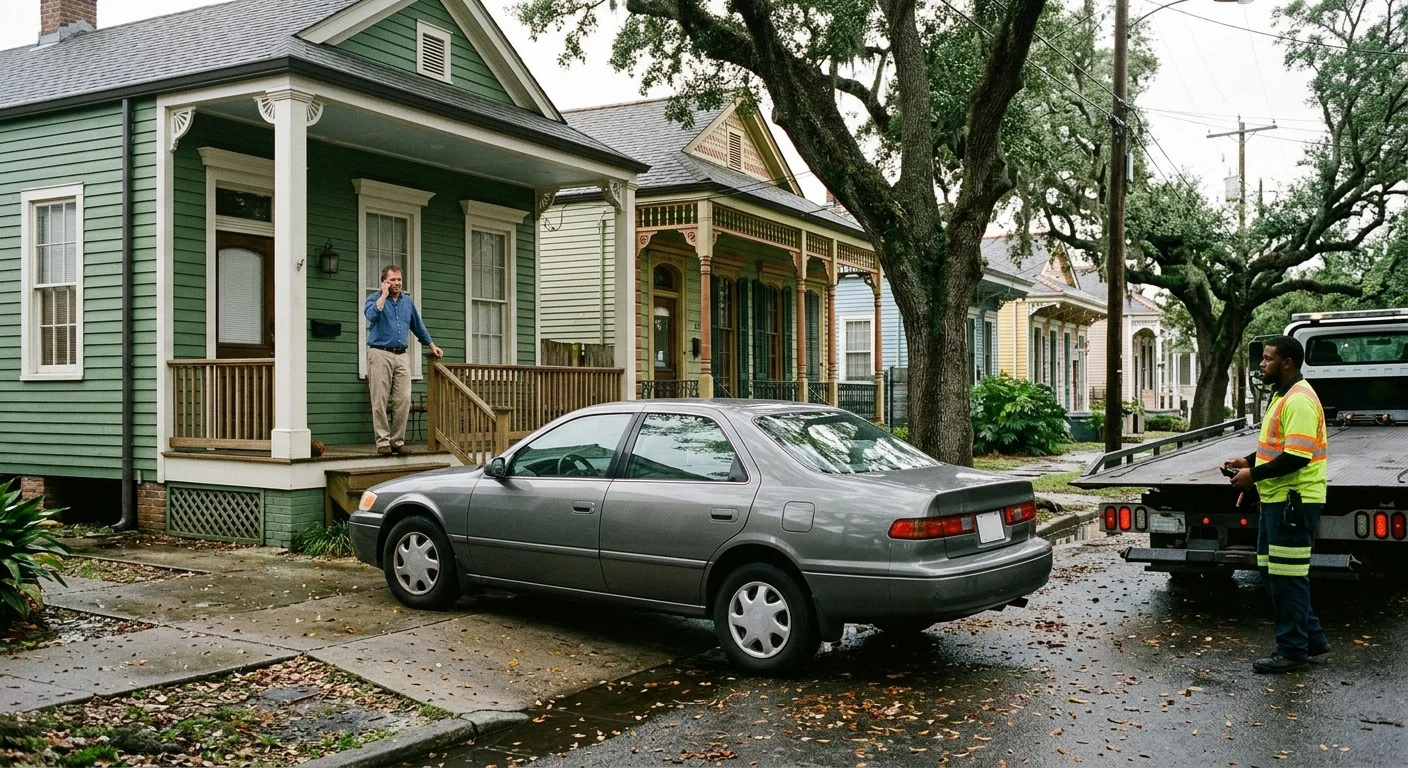
Three paths. If the car is in the public street, call NOPD or 311. If it is on your driveway, private-property rules apply. If it is on a neighbor’s lot, that owner or occupant controls consent. See Louisiana private-property towing law. We do not invent HOA timelines or City storage fees.
A blocked driveway isn’t a roadside tow
Roadside towing normally begins with the vehicle owner requesting help. A blocked driveway presents a different issue. The person calling may own the property, but they usually don’t own the vehicle.
That makes the requested removal nonconsensual from the driver’s perspective. Quick Tow New Orleans can’t authorize that removal. We can connect you with an independent, licensed operator, but the operator must decide whether the required authorization exists.
Start by looking at the vehicle’s position. A car can block the driveway while remaining entirely along the public curb. It might also extend across the sidewalk or onto the driveway itself. Don’t describe it as being on private property unless you know that’s accurate.
The distinction matters across New Orleans. A curb obstruction inside the city may require direction from a public agency. A vehicle sitting within a private parking area follows a different process. An operator can’t treat those situations as interchangeable.
Don’t move, push, unlock, or enter the vehicle yourself. Don’t attach a chain or ask another driver to pull it away. Those actions can damage the car and create a safety problem.
For a vehicle clearly inside a qualifying private parking area, read about private property towing in New Orleans. If it remains on the street, contact the appropriate public agency before arranging anything. Explain the exact position instead of simply requesting a tow.
Who can request a private-property tow
The safest caller is the property owner or someone clearly authorized by that owner. A tenant, neighbor, guest, or contractor shouldn’t assume they can approve a nonconsensual removal.
Even an owner’s request doesn’t automatically make every tow lawful. Louisiana’s confirmed private-property rules apply to defined parking areas. Those include areas serving businesses, apartment complexes, institutions, and similar properties. The approved legal sources don’t confirm that every part of those rules extends unchanged to a single-family driveway.
That gap matters. Don’t rely on a broad internet statement claiming any homeowner can immediately tow any vehicle. The specific driveway rule couldn’t be confirmed from the approved Louisiana sources. Ask the matched operator what authority and documentation are needed for that location.
If you manage an apartment building, shop, or shared lot, be ready to explain your role. The operator may need confirmation that you represent the owner. Louisiana law also says an authorized property representative can’t be the tow truck owner or operator.
Quick Tow New Orleans is a matching service. It doesn’t own trucks, operate a storage yard, or decide whether a car may be removed. The homeowner or property representative contracts with and pays the independent operator directly.
If the operator can’t verify the authority, expect the operator to decline the job. That protects the property owner, vehicle owner, and operator. Our guide to Louisiana private-property towing law explains the broader rules without treating every residential driveway as the same type of parking area.
What signs or authorization may matter
Louisiana’s confirmed rules provide several authorization paths for nonconsensual towing from covered parking areas. A tow may be authorized by a law enforcement agency. A vehicle may also be properly tagged for removal.
The tagging rule is specific. The tag must be highly visible and placed without damaging the vehicle. It must contain the date, time, authorized towing company, and the property representative’s printed name and signature.
Tagging isn’t required in every covered situation. The law identifies alternatives when the property owner or authorized representative signs the billing invoice before removal. Compliant towing signs can also affect the process.
For properties using towing signs, entrances and exits must carry clear warnings. Areas or individual spaces subject to towing must also be marked. When the owner has a towing-company contract, the entrance and exit signs must identify that company by name, address, and phone number. The required lettering is at least two inches high.
Those requirements come from Louisiana’s private-property towing statute. They shouldn’t be stretched into a definite rule for every residential driveway. A sign beside a house also doesn’t prove that every other authorization requirement has been met.
If your building has an existing towing contract, use the company named on its compliant signs. A different operator may not have authority under that arrangement. Ask the property manager before making another call.
Louisiana regulates towing and storage through the Louisiana Towing and Storage Act. Charges for covered nonconsensual towing are subject to the Louisiana Public Service Commission schedule. Ask for an itemized invoice, but don’t confuse regulated maximums with Quick Tow’s pricing.
What information to gather before calling
A clear record helps the operator or public agency understand the situation. Take wide photos showing the car, driveway entrance, curb, sidewalk, and street. Include enough background to show how access is blocked.
Then gather these details:
- The exact New Orleans address
- Whether the vehicle is on the street, sidewalk, or private property
- Its color, make, body style, and visible plate information
- When you first noticed it
- Whether anyone nearby appears connected to it
- Your relationship to the property
- Any posted towing signs or existing towing contract
Photograph the scene before leaving a note or speaking with the driver. Don’t open the vehicle, cover its plate, or place anything under its wipers that could cause damage. Stay on your property or another safe location while documenting it.
Mention any immediate access issue. A blocked family car is different from an obstruction preventing a resident with limited mobility from leaving. A blocked shared driveway also affects more people than one assigned parking space. Describe the facts without claiming an emergency that doesn’t exist.
If the car is occupied, don’t stand behind it or argue through the window. The driver may reverse without seeing you. Keep children and pets away from the driveway until the situation is resolved.
Give the same factual description to each person you contact. Saying “the rear bumper crosses the driveway opening” is more useful than saying “the car is on my property.” Accurate details help the operator determine whether the job fits its legal authority.
When to contact the property owner or public agency
If the driver is nearby and the situation feels safe, a calm request may solve the problem. An unfamiliar vehicle may belong to a visitor, delivery driver, contractor, or nearby resident. Don’t confront anyone who appears impaired, angry, or threatening.
For an apartment, condominium, rental, or shared driveway, contact the property owner or manager first. They may already have an authorized towing process. They can also confirm whether you’re allowed to request removal.
If the vehicle remains on a public street or curb, contact New Orleans 311 for guidance. Explain that it’s blocking driveway access and state whether it’s occupied. Ask which city agency can evaluate the obstruction. Don’t represent the vehicle as abandoned merely because the driver isn’t visible.
New Orleans uses a specific definition for an abandoned vehicle. One covered situation is a vehicle left on private property without the owner’s or occupant’s consent for more than 24 hours. Abandoned-vehicle reports go through 311, which is available by phone 24/7.
A freshly parked car blocking access may not meet that time-based definition. Our guide to abandoned vehicle removal in New Orleans explains the city process and the separate Louisiana framework.
Addresses outside Orleans Parish follow different local channels. New Orleans 311 isn’t the starting point for a property in Jefferson Parish, St. Bernard Parish, or across Lake Pontchartrain. Confirm the parish and municipality before contacting an agency. If there’s an active threat, collision, medical emergency, or immediate danger, call 911 instead.
When to call us
Call when the vehicle appears to be on private property and you can establish your authority over that property. The line takes calls 24/7, but the independent operator must confirm whether removal is permitted.
Call (504) 474-5530. We match you with a licensed local operator who quotes before the truck rolls.