Safety or missing equipment is a lawful refusal. An illegal overcharge is not. Keep the LPSC complaint path: P.O. Box 91154, Baton Rouge, LA 70821 / lpsc.louisiana.gov. The $192 per hour extra-truck figure is LPSC documented recovery, not a Quick Tow menu. This brand does not hold a towing license.
Louisiana tow laws start with weight class
Louisiana’s Public Service Commission divides vehicles into three towing classes. Light Duty covers vehicles weighing 10,000 pounds or less. Medium Duty runs from 10,001 through 26,000 pounds. Heavy Duty begins at 26,001 pounds.
These classes control the prescribed rate category for non-consensual towing. They also tell the operator that a pickup, loaded box truck, bus, or tractor-trailer shouldn’t be treated as the same call.
Weight class alone doesn’t tell you a specific truck is rated for a specific load. Ask the operator to confirm that its equipment fits the vehicle and its current condition. Don’t guess the weight when a commercial vehicle carries cargo or pulls a trailer.
Provide the year, make, model, and vehicle type. Mention attached trailers, equipment, passengers, shifted loads, and visible damage. Share a weight figure only when it comes from the vehicle or its paperwork.
A commercial vehicle may need a heavy-duty towing operator instead of a light-duty truck. That difference matters before anyone attempts a hookup.
Tell the referral line whether police arranged the tow. Under the LPSC order, even a tow requested by the driver counts as non-consensual when a police officer arranges it. That puts the job under Louisiana’s prescribed non-consensual rates.
A private-property tow without authorization is not a job
Louisiana law places a clear limit on non-consensual towing from parking areas. Under R.S. 32:1736, an operator can’t perform the tow without law-enforcement authorization or the vehicle being properly tagged for removal.
That requirement covers a different situation from calling about your own disabled vehicle. It matters when an apartment manager, store, restaurant, or festival property wants somebody else’s vehicle removed.
Property owners must also post towing signs at entrances and exits. Those signs must identify the towing company, its address, and its phone number. The required lettering must be at least two inches high.
The property owner’s authorized representative can’t be the tow truck owner or operator. That conflict-of-interest rule prevents the towing company from acting as both the party ordering and performing the removal.
An operator may therefore stop the process when the tag, authorization, signage, or requesting party doesn’t fit the statute. A verbal demand from an unrelated tenant or customer doesn’t replace the confirmed authorization described by the law.
Ask who ordered the removal and whether the vehicle was properly tagged. Keep photos of the vehicle, nearby entrances, posted signs, and the parking space. The Louisiana Towing and Storage Act contains the statewide framework. Local parking rules can add another layer, so identify the parish and municipality before treating one answer as metro-wide.
Cargo, spills and hazardous loads change everything
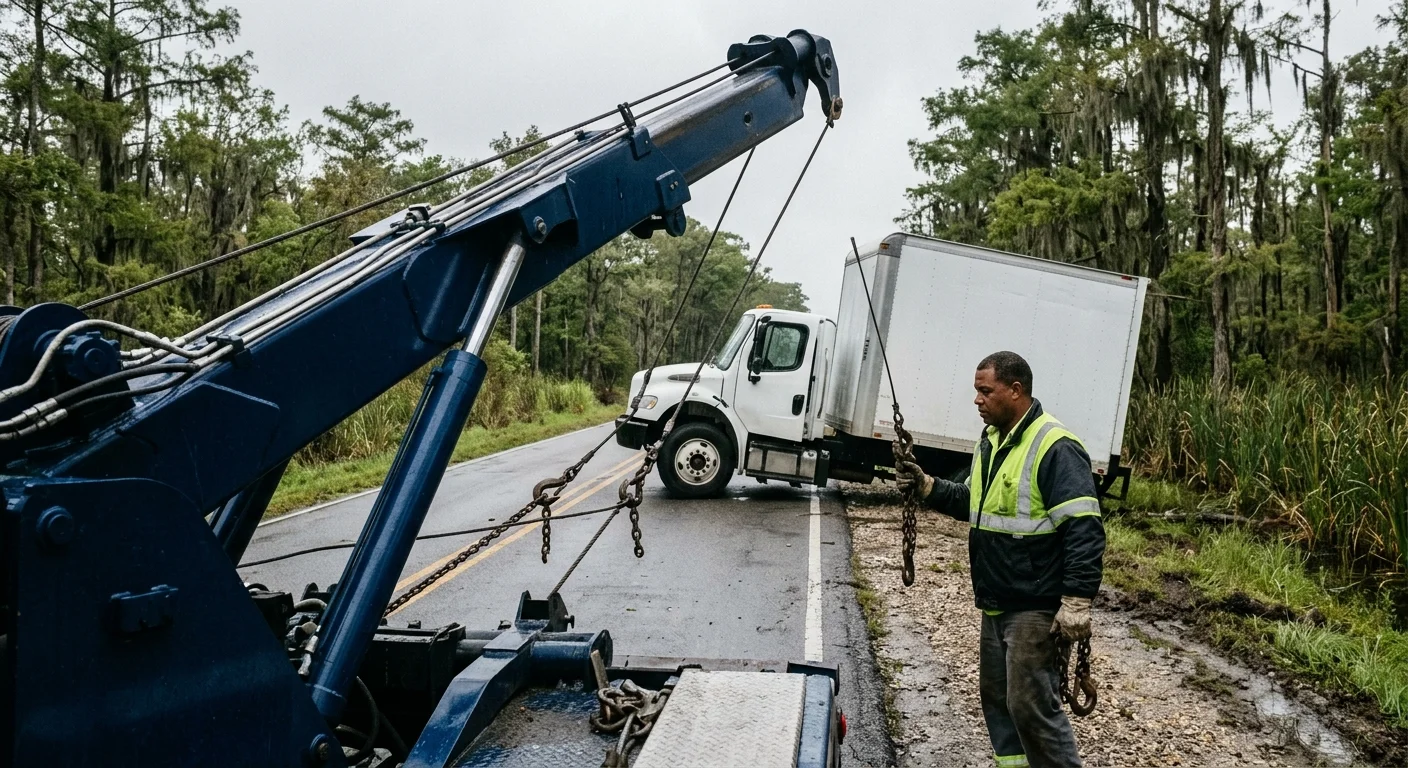
A disabled box truck can become a recovery job once cargo shifts or debris reaches the roadway. The same applies when a trailer separates, fuel leaks, or hazardous cargo becomes unsecured. Describe those conditions before an operator accepts the call.
Louisiana’s current LPSC rate schedule allows documented charges for complicated non-consensual recoveries. An extra tow truck, or a truck and trailer, may cost $192.00 per hour when used to remove cargo or oversized debris. That charge also applies when transporting specialized equipment.
The company must photograph and document the need. Its records must explain why the debris wouldn’t fit on the first truck.
Oil-absorbing material beyond the required five-gallon minimum may cost $9.00 per gallon. When hazardous-material cargo becomes unsecured, the company may add 50 percent to the towing, recovery, laborer, and supervisor rates.
A rotator may cost $299.00 per hour on top of standard recovery. It carries a two-hour minimum and requires photo or video proof. Rented or subcontracted specialized equipment is billed at the actual invoice plus 10 percent, with that invoice attached.
These rules explain why “a truck broke down” isn’t enough information. Report the cargo, leaks, debris, vehicle position, and trailer condition. If any substance is unknown, say that plainly. An operator needs the real scene description before deciding whether it has suitable equipment.
What an operator may never bill you for
The LPSC schedule doesn’t allow a non-consensual towing company to turn its required ordinary equipment into separate recovery charges. That rule covers tools, brooms, shovels, flashlights, lanterns, fire extinguishers, and warning devices.
It also covers steering-wheel clamps, slings, plates, cables, blocks, chains, hooks, and the other equipment required by LAC Title 55, Chapter 19. The truck’s required oil-absorbing materials belong in this group too.
The line between ordinary and additional material matters. The schedule permits a $9.00-per-gallon charge only for oil-absorbing material used beyond the five-gallon minimum. A bill shouldn’t disguise the required supply as a specialized add-on.
The operator must provide an itemized invoice. It must show the service date and time, operator name, itemized fees, and the law-enforcement agency when one applies. The invoice must also state the LPSC complaint address. You don’t have to pay first merely to receive a copy.
Tow companies must accept credit cards. Any pass-through processing fee must appear separately. Other documented recovery costs must remain available to the Commission, owner, and lienholder on demand.
Read the description beside each charge. “Equipment” isn’t enough when the schedule requires photographs, an outside invoice, or an explanation. A truck lacking necessary specialized equipment can decline the recovery. It can’t make ordinary required tools special by changing their label.
Weather, water and the Causeway
Metro New Orleans adds water, bridge controls, and limited shoulders to the equipment decision. A dry breakdown on I-10 isn’t the same scene as a vehicle in water or disabled during Causeway fog restrictions.
Floodwater and a restricted bridge lane are judgment calls for the operator on scene. Report visible water, vehicle position, traffic exposure, and police presence. Don’t describe a water recovery as a standard roadside hookup.
The Causeway’s published procedures say fog season runs roughly from October through March. A ranking Causeway Police officer checks visibility before authorizing restrictions.
During single-lane restrictions, the left lane closes except for vehicles that can’t reach a Crossover or Safety Bay. Crossovers sit roughly every 3.5 miles. A Safety Bay lies halfway between each pair.
A driver who breaks down during those restrictions shouldn’t stop in the open right lane. The published procedure says to reach a Crossover or Safety Bay when possible. Otherwise, pull into the closed lane against the railing, move safely behind the vehicle, flag approaching traffic, and contact Causeway Police.
Rolling-convoy restrictions place an emergency vehicle ahead of traffic. Passing and lane changes aren’t allowed. Those controls belong to Causeway Police, not the towing line.
Our guide to breaking down on I-10 or the Causeway explains the local roadside steps in more detail.
What to tell the phone operator so the right truck comes
Start with the exact location. Give the road, travel direction, closest exit, and visible landmark. On the Causeway, include your direction and whether you’ve reached a Crossover or Safety Bay.
Describe the vehicle without shortening the facts. “Loaded 24-foot box truck pulling a trailer” is more useful than “truck.” Give the year, make, model, commercial use, and verified weight information when available.
Explain how the vehicle sits. Mention a ditch, soft shoulder, standing water, rollover, broken axle, locked wheels, collision damage, detached trailer, or shifted cargo. A vehicle requiring a pull from mud or a shoulder may need a winch-out operator, not a routine hookup.
Report leaks, debris, and cargo labels. Say when the material is unknown. Don’t open, move, or identify unfamiliar cargo by guesswork.
Tell the line who arranged the tow. Police-arranged jobs can fall under Louisiana’s non-consensual rules even when the driver requested help. For a private-property removal, identify the property representative and whether the vehicle was tagged.
Photos can help show wheel position, vehicle angle, cargo movement, and surrounding access. They don’t replace an operator’s scene assessment.
Our line takes calls 24/7. For a disabled vehicle on a travel lane or exposed shoulder, request emergency towing help after contacting emergency authorities when immediate danger exists. We match drivers with independent, licensed local operators, but the selected operator decides whether its equipment fits the reported job.
When to call us
Call when a loaded, damaged, off-road, or water-exposed vehicle needs a licensed towing pro to assess the recovery. Call (504) 474-5530. We match you with a licensed local operator who quotes before the truck rolls.