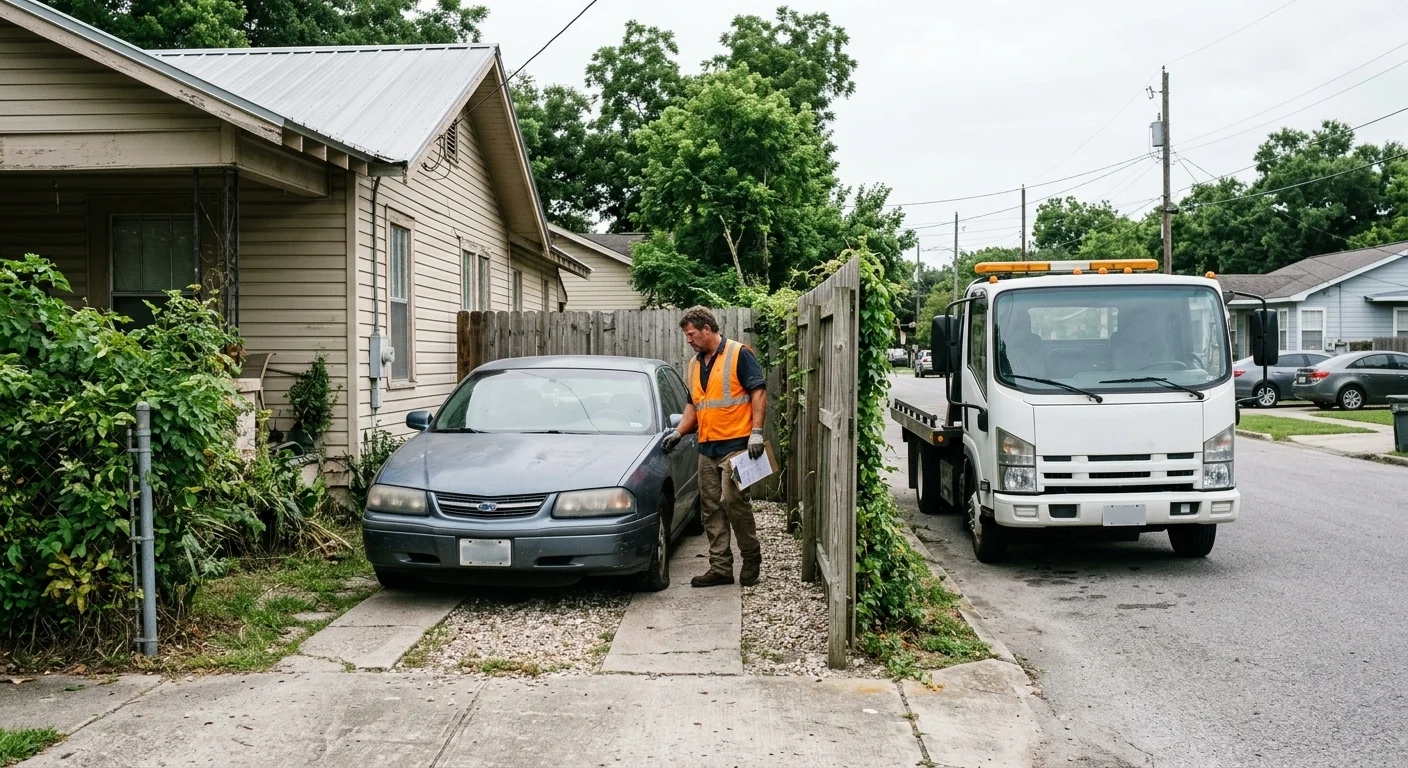
The car died nose-in on a Uptown side lot, two feet from the neighbor’s fence, with parked cars already lining the curb. That is a tight-driveway tow for your own disabled car, not a fight over someone else’s vehicle blocking the apron. A licensed operator can often still get it out, but the method depends on how the car sits, whether the wheels roll, and how much room the truck has at the street.
Start with the driveway and vehicle position
New Orleans driveways are not suburban pads. Uptown and Mid-City shotgun lots often leave a side strip barely wider than the car, with brick piers, outdoor equipment, and trash cans along the path. Bywater and Marigny iron gates pinch the apron. Metairie and Kenner slabs can look open from the street, then funnel between a fence and a raised house. Algiers Point, Gretna, and Terrytown add the same squeeze, plus West Bank curb parking that eats the approach.
The first fact to settle is how the disabled car is sitting. Nose-in toward the house is a different job than tail-out toward the street. A car cocked against a fence is different from one sitting straight. A car that rolled back onto the sidewalk apron is different from one buried past a closed gate. The truck does not always have to drive down the drive. Many recoveries start at the curb and work the car out to open pavement.
This is an owner-requested tow. You are asking a licensed operator to move your own car. That is legal, ordinary work. It is not the same as having a stranger’s car hauled off your property. If someone else is blocking the apron, use our car blocking a driveway guide instead. Louisiana’s Towing and Storage Act regulates licensed wrecker and storage businesses. It does not make it illegal for you to call for your own disabled car. Non-consensual tows from public parking areas follow a separate statute. A single-family driveway is not automatically that setting, and we do not treat it as one.
Do not try to drag the car out with a neighbor’s strap. A dead automatic left in park, or a car with a seized brake, can hop, scrape, or fold a bumper into a pier. Leave it where it sits. Take photos from the street, from the gate, and from both sides if you can do that without stepping into traffic. Those photos tell the matched operator whether they can work from the curb or whether equipment has to walk in.
Name the surface and the slope in plain words. Shell, gravel, and wet grass after a Gulf storm do not hold a truck the way a poured slab does. A raised-house lot that drops toward the street changes how a winch line pulls. You do not need a tape measure, and no page here can publish a universal clearance number that fits every lot. You do need honest detail: paved or not, uphill or downhill, and whether the car is past a gate that will not fully open.
Wheel condition affects the loading assessment
A tight driveway is only half the job. The other half is whether the car can roll. A licensed operator loads or extracts a disabled car based on the wheels, the transmission, and the drivetrain.
Tell them if the car is stuck in park and will not go to neutral. That is common on a dead automatic. It does not make the tow impossible. It does mean the operator cannot treat it like a rolling load. They may use wheel dollies, a winch onto a bed once the car is in the open, or a wheel-lift setup that picks one end and supports the other. If the shifter will not move at all, our note on a car that will not shift into neutral is the closer walkthrough of that lockup.
Say if a tire is flat, a wheel is missing, or the parking brake is frozen on. A flat on the end that has to roll can grind a rim down a shell drive. A missing wheel changes how the car can be cribbed and lifted. Seized brakes turn a short pull into a skid. None of that is a reason to yank the car yourself with a come-along. It is information the operator needs before they pick a truck.
All-wheel-drive and four-wheel-drive matter too. Rolling two wheels on the pavement while the other two are in the air can bind a transfer case on some of those setups. The operator needs to hear “AWD” or “4WD” before they choose a two-wheel lift versus a bed or dollies. They also need the body type: a low sports car, a work van, or a small SUV, because ground clearance at the apron is part of the same assessment. A steering wheel locked hard to one side is worth mentioning. It changes how the trailing end tracks through a gate.
Do not put the car in gear and bump it with another vehicle. Do not jack it in a side yard next to a pier and hope it rolls. If it will not move under its own power, leave it. The matched operator will decide whether the wheels are load-ready once they see them.
Walls, gates and parked cars can limit access
The truck does not always need to fit down the driveway. Many tight New Orleans recoveries work from the street. The operator sets up on the roadway, walks a line or a compact lift to the car, and eases the car out to where a truck can finish the hookup. That only works if the street side is usable.
Parked cars on the apron are the usual blocker in Uptown, the Marigny, and the Quarter-adjacent blocks. A neighbor’s bumper hanging across your gate can stop a wheel-lift from lining up even when the driveway itself is clear. If those cars belong to you, move them before the operator arrives. If they belong to someone else and they are fully on the public street, you do not have authority to treat them as a driveway tow. Call the owner if you can. Leave street parking to the police if it is a true blockage of a public roadway.
Gates, brick columns, and low eaves matter as much as width. A Bywater iron gate that only swings halfway turns an otherwise usable drive into a trap. A raised-house overhang or a balcony can catch a light bar even when the car itself fits. Outdoor equipment or a gas meter on the side path is easy to forget until a boom swings. Walk the path the car has to travel and name every object that sits closer than a door’s width. Lakeview and Gentilly lots rebuilt after the storms often have new fences and new outdoor equipment in the old side yard. Say so.
Overhead is a driveway issue too, not only a garage issue. Live oaks on St. Charles side streets, low service drops, and gallery brackets can all sit in the load path. If the car has a roof rack, a light bar, or a high van body, say so. A parking-garage tow has ceilings and ramps. A residential drive has trees, wires, and porches instead. The idea is the same: the operator plans the path before they pull.
If the driveway holds water after a typical New Orleans downpour, describe standing water rather than guessing depth. The National Weather Service warns that 12 inches of rushing water can carry away most cars. A driveway puddle is not that. Wet shell and a slope toward the street still change traction for both the car and the truck. Say if the surface is underwater, soft, or just damp.
A wheel-lift and flatbed need different working space
No single truck type fits every tight driveway. Anyone who promises otherwise is selling a truck, not assessing a lot.
A wheel-lift truck is usually the more compact option at the curb. It picks up one axle with a yoke and lets the other two wheels trail. That shorter working length is why wheel-lift work is also common for a parallel-parked car on a narrow block. In a driveway, the operator still needs room at the street to square up, plus a clear path for the lifted car to come out without scraping a fence or a pier. If the car will not roll, they may add dollies under the trailing wheels.
A flatbed needs more room to tilt and winch. The bed has to drop, the car has to have a straight-enough shot onto the deck, and the truck needs street space behind it for the overhang. Many Uptown and Bywater streets will not give a full bed that shot from the curb. In those cases the operator may still use a bed as the highway truck, after a smaller setup or a winch line brings the car out of the pinch. The bed is often the safer ride once the car is in the open, especially for AWD, a locked transmission, or a car that should not trail on two wheels.
Winching from the street is a recovery step, not a DIY move. The operator anchors to their truck, not to a porch column or a fence. They control the line so the car does not swing into a wall. That is trained work. A neighbor with a strap is not a substitute, and a second car pulling yours in park is how bumpers and mounts get torn.
Hook-and-chain snatch work is the old method people still describe online. It is not the default for a disabled passenger car in a residential drive. Do not ask for it. Do not try a version of it with a grappling hook. If the matched operator says the lot is too tight for the truck they brought, the honest next step is a different setup, not a harder yank.
The operator on scene makes the equipment call. Quick Tow New Orleans matches you with a licensed local operator. We do not own the truck and we do not run the recovery. What you can do is describe the space well enough that the operator who covers your block shows up with the right idea.
What to report before an operator is matched
The line takes calls around the clock at (504) 474-5530. Your call routes to the operator covering your zone. A clear report is the difference between a truck that can work from the curb and one that has to turn around.
Give the parish and the block, not just “New Orleans.” Orleans Parish side streets, Jefferson Parish slabs in Metairie and Kenner, and West Bank lots in Algiers or Terrytown do not share the same approach. Name the nearest cross street. Say if the truck will be working on a one-way, a tight Uptown block with cars on both sides, or a wider Metairie feeder.
Then walk through the lot in this order:
- Surface: concrete, shell, gravel, grass, or brick
- Slope: toward the street, toward the house, or mostly flat
- Gate: none, open, or a width you can describe in car-widths, not invented inches
- Vehicle position: nose-in, tail-out, angled, past the gate, or on the apron
- Wheel condition: rolls, stuck in park, flat, missing wheel, parking brake on
- Drivetrain: FWD, RWD, AWD, or 4WD if you know it
- Obstacles: fence, pier, outdoor equipment, parked cars, low wire, tree limb
- Destination: home shop, dealer, or another address in the metro
Photos from the street looking in, from the house looking out, and of each wheel help more than a speech. Do not stand in the roadway to take them. Do not crawl under the car.
Stay with the car if it is safe. If you have to leave, say where the keys are and whether the operator can reach a gate code. Calls are recorded, and you will hear a recording notice. Leave a callback number that actually rings.
This is still your car and your driveway. You are hiring a consented tow, not fighting a city impound. City lots and nola.gov’s find-my-towed-vehicle page are for cars the City already took. That is not this job.
When to call us
Call when the car will not roll out under its own power, the driveway is too tight to risk a neighbor’s strap, or the wheels, gate, or slope make a DIY shove unsafe. Call us at (504) 474-5530 and we’ll connect you with a licensed local operator.