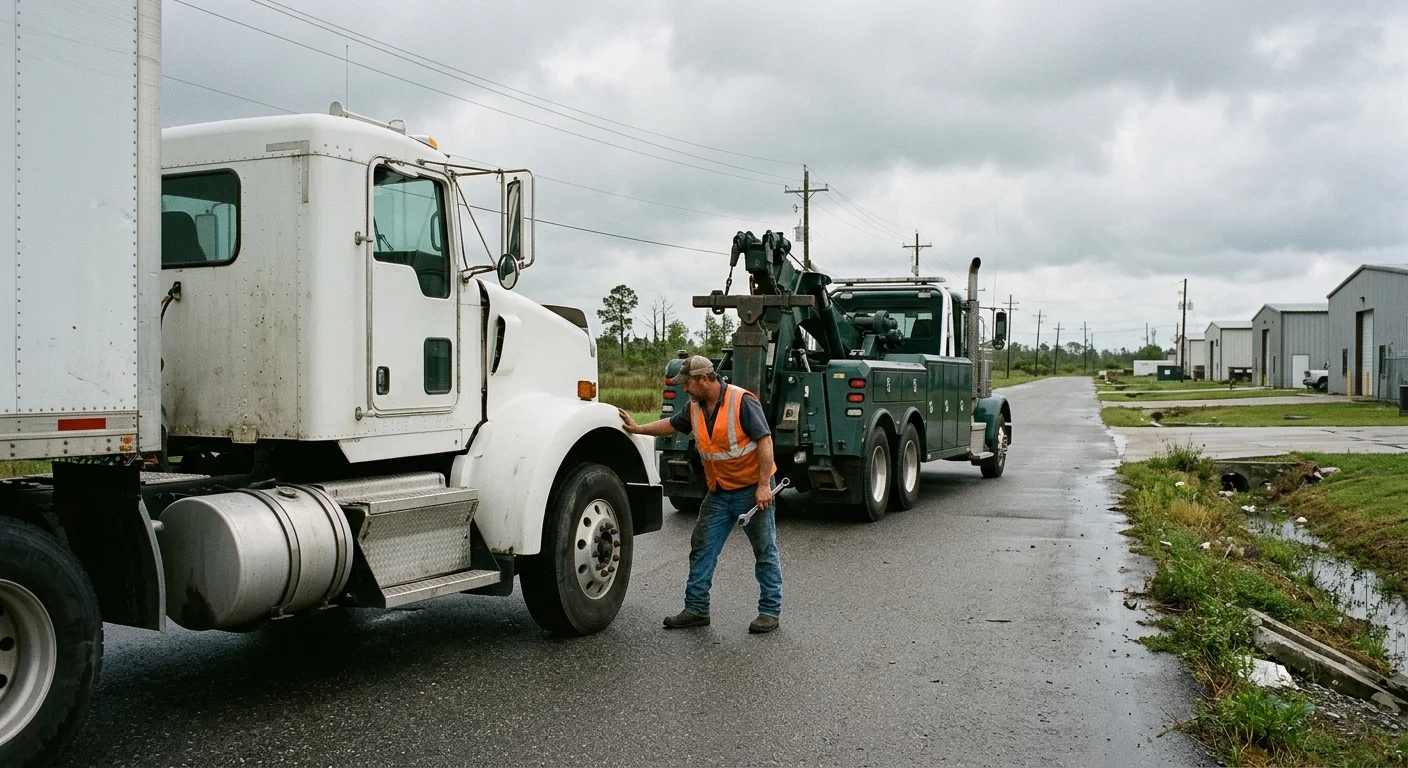
A loaded tractor sitting dead on the I-10 shoulder is not a car problem. The tractor, the trailer, and what’s in the box decide whether a licensed operator can work on the unit where it sits or has to move it under heavy-duty towing. Quick Tow New Orleans matches you with that operator. We don’t run the wrecker, and we don’t set the operator’s price.
Start with the tractor, trailer and load
Read the metal before you guess the job. The door jamb, B-pillar, or frame rail plate lists the tractor’s GVWR and, on many units, the combination rating. The trailer has its own plate. Bills of lading, the shipper packet, and the ELD or trip sheet tell you what is actually hanging on the fifth wheel. Those documents are the spec. A round number from memory is not.
Louisiana’s Public Service Commission groups non-consensual tows by GVWR. Heavy duty starts at 26,001 lbs. Most highway tractors sit in that class on the plate even when they are bobtail. A loaded combination is still two units. If the trailer stays coupled, the operator is dealing with both. If you drop the box at a yard on Tchoupitoulas, Almonaster, or the Napoleon Avenue wharf, the tractor-only move is a different hook. Say which one you have.
Cargo changes the call as much as weight. An empty dry van on Airline Highway is not the same job as a reefer headed to a Kenner warehouse, a tank, or a flat with unsecured dunnage. Do not invent a class or a cargo rule on the phone. Read the plate and the paperwork out loud. If the plate is painted over or the trailer is a drop-and-hook you just picked up, say that too. The matched operator uses what you can confirm, not a guess about “a regular 18-wheeler.”
Parish and corridor matter because the run is not one metro. A unit on I-10 in New Orleans East, near Michoud, is a different recovery path than a unit on the Westbank Expressway in Harvey or a yard off the river in Jefferson Parish. The North Shore across Lake Pontchartrain adds the Causeway or I-10 around the lake. Name the parish, the nearest exit, and whether the tractor and trailer are still together. That is how a licensed local operator sizes the truck they bring, not a light wrecker built for a passenger car or even a box truck breakdown in New Orleans.
A no-start problem differs from wheel or crash damage
A no-crank or no-start on firm pavement is often a roadside problem first. Dead batteries, a fuel issue, and some electrical faults can be worked on the shoulder or in a lot if the unit is stable, the wheels roll, and nothing is leaking. That is still commercial work. It is not a passenger-car jump. Tell the operator the engine will not crank, cranks but will not fire, or died while rolling. Those three stories send different tools.
Wheel damage is a different fork. A steer-tire failure on I-610, a drive-axle dual that came apart, or a trailer axle that will not roll can strand a legal combination even when the engine is fine. Some of that can be a commercial tire call if the unit is on solid ground and the remaining tires can hold it. Some of it cannot. A locked brake, a seized wheel end, or a tire that has destroyed the fender or air lines usually means the unit has to move under a heavy hook, not a service truck with a bottle jack.
Crash and rollover damage is not a breakdown. Bent frame rails, a jackknife across a lane, a trailer that leaned into a canal bank, or a tractor that hit a barrier need accident recovery, not a roadside patch. If NOPD, the Jefferson Parish Sheriff’s Office, or Louisiana State Police is already on scene, say so. In Louisiana, even a tow you ask an officer to arrange counts as non-consensual under the LPSC’s own definition. That is not a shop-rate conversation. It is a regulated one, and the invoice rules are different.
Stay out of the travel lane while you sort this. Hazards on, triangles if you can set them without walking in traffic, then wait in a place you can see the unit. Do not crawl under a loaded trailer to “check” an axle. Do not try to pull a locked wheel with a pickup. The operator who takes the job will tell you when brakes, transmission, and gladhands should be touched. Until then, the useful facts are: will it start, will it roll, is anything leaking, and did it hit something.
Roadside work and heavy transport solve different problems
Roadside help keeps a unit in place and tries to make it move under its own power. Heavy transport lifts or tows a unit that will not, or should not, roll to a shop, terminal, or drop yard. Mixing those two is how fleets wait on the wrong truck.
DOTD’s Motorist Assistance Patrol is the free layer on some interstates, and it is a patrol, not a call-out. MAP can change a light-vehicle tire, add a little fuel, jump a battery, and clear a disabled vehicle from a travel lane on the routes it actually covers. Daytime coverage on I-10 runs from US-61 in Ascension Parish to Michoud Boulevard, plus all of I-610, I-55 from I-10 to Manchac, and US-90B from the I-10 split to Westwood. Night coverage shrinks: I-10 from US-51 at LaPlace to Morrison Road, all of I-610, and US-90B from the split to Barataria Boulevard. MAP does not tow a tractor-trailer to a dealer on the West Bank. If MAP is not already on your stretch, you contact local law enforcement, or 911 if it is an emergency. Check 511la.org for incidents and closures while you wait.
A licensed heavy operator is the other product. They bring the wrecker, underlift, or recovery gear rated for the plate weights you reported. They do not “just hook it like a car.” Driveline, steer tires, air suspension, and a loaded trailer all change how the unit gets picked up. If the tractor can be repaired in the lot at a Chalmette warehouse, ask for roadside first. If the shop is in Metairie and the engine will not turn, you are asking for transport. If you only need the trailer dragged off a live lane so another tractor can pick it up, say that. Dropping a trailer and towing a bobtail are two dispatches, not one vague “semi tow.”
Price talk belongs in the right bucket. A consented call you place yourself is not an LPSC-capped tow. A police-ordered or officer-arranged hook is. The current heavy-duty non-consensual towing maximum, effective for tows on or after April 1, 2026, is $430.50 per hour with a one-hour minimum, plus separate recovery, transit, storage, and add-on lines when they apply. Those figures are the Commission’s ceilings, not a quote from this line. For how those lines stack, read how heavy-duty towing rates work. Do not use a rotator “sticker price” you saw on a forum. That number is not in Louisiana’s published schedule, and it is not a figure this site can confirm.
Vehicle position can turn transport into recovery
A disabled semi on level concrete in a Port NOLA staging lot is a transport problem if it will not start. The same tractor with a trailer hanging off a soft shoulder on I-10, nosed into a drainage ditch in New Orleans East, or folded across a lane on US-90B is recovery. Position is the fork. Weight class does not change that.
Recovery means the unit is not sitting where a wrecker can back straight in and pick an axle. It may be against a barrier, down an embankment, in mud after a Gulf storm, or blocking both a travel lane and a shoulder. New Orleans regularly logs well over 80 thunderstorm days a year. Shoulder soil along the interstate and the industrial corridors gets soft fast. A winch plan, extra trucks, or a rotator is the operator’s call after they see the scene. This brand does not own that equipment and does not promise which unit shows up. Your job is to describe the ground: pavement, grass, gravel, standing water, grade, and how many lanes are pinched.
On the Causeway, do not treat it like I-10. Causeway Police Department patrols the bridge. A stranded motorist calls Causeway Police at *27 or (504) 835-3116. Fog season runs roughly October through March. If restrictions are up, the published rule is to reach a Crossover or Safety Bay, or pull into the closed lane against the railing if you cannot. Do not stop in an open right lane. The recovery that follows is coordinated with that agency, not a random wrecker backing in from the lake.
Crash scenes stay in the recovery column even when the tractor still runs. Air lines torn off, a trailer on its side, cargo on the pavement, or a jackknife in the CBD grid around the I-10 / Claiborne stack are not “hook and go.” If hazardous cargo has come unsecured, say the placard and the product name from the papers. Do not guess a chemical. The operator and any on-scene agency need the document, not a nickname for the load.
What to report before an operator is matched
Give the matcher a picture that matches the truck, not a slogan. Location first: parish, highway or street, direction, mile marker or exit, and which side. “I-10 eastbound, past the I-610 split, on the shoulder” is usable. “Somewhere in New Orleans” is not. If you are in a yard, name the gate, the cross street, and whether a heavy wrecker can enter without a low canopy or a tight dock well.
Then the combination: tractor only or tractor and trailer, trailer type, loaded or empty, and the GVWR figures from the plates. Add the problem in one line: no-start, no-roll, tire, leak, or collision. Say whether anyone is injured and whether police or MAP is already there. Say if the unit is in a live lane, on a shoulder, in a lot, or off the pavement. Say the destination if you have one: dealer, fleet shop, drop yard, or “not sure yet.” The operator cannot invent a legal drop point for you.
Do not read a CDL class off a blog, and do not ask this line to certify what your license covers. That is between you, your carrier, and the plate weights. Do not quote a maximum combination weight unless it is printed on your documents. Do not ask for a 75-ton rotator by model as if that were a menu item. Describe the disablement and the position. The licensed operator decides the gear.
If the unit is on a public interstate and you are not in immediate danger, stay with it if you can do so off the travel lane. If you cannot stay, leave a callback number on the unit and take the keys, registration, and load papers with you. The line takes calls around the clock at (504) 474-5530. Calls are recorded. Your call routes to the operator covering the zone. It does not mean a wrecker is already rolling, and it does not mean this brand holds a Louisiana towing license. The operator who accepts the job does.
When to call us
Call when a tractor, trailer, or loaded combination in metro New Orleans will not roll to a shop on its own, or when roadside work is clearly not enough: locked wheels, crash damage, a unit off the pavement, or a blocked lane on I-10, I-610, US-90B, or the West Bank. Call us at (504) 474-5530 and we’ll connect you with a licensed local operator.