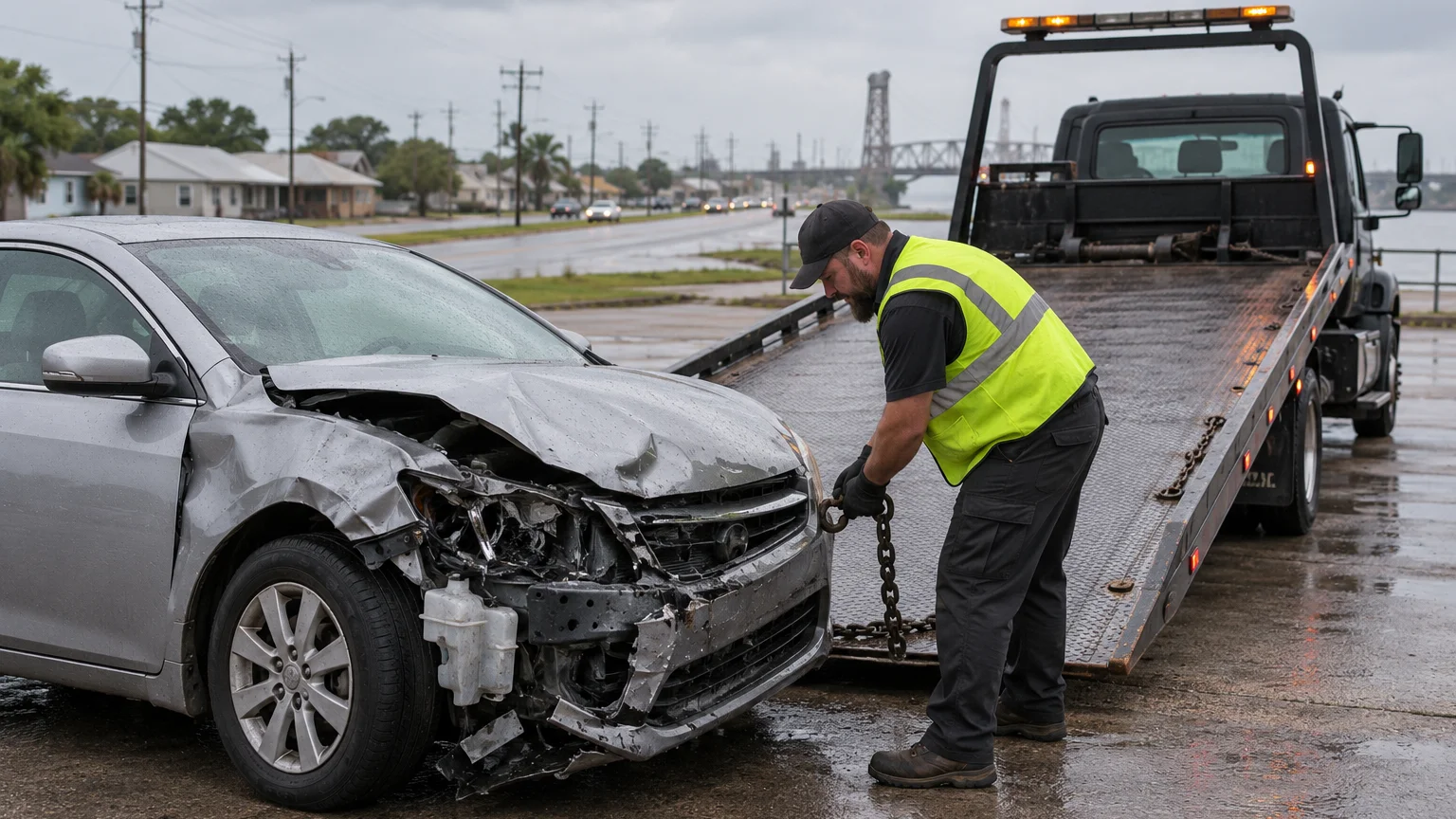
A crash in Arabi leaves two immediate towing questions. Can the vehicle roll normally, and where should it go? For accident towing in Arabi, LA, those answers help determine whether you need a standard tow or a more involved recovery.
Quick Tow New Orleans connects callers with independent, licensed local operators. The operator evaluates the vehicle, handles the physical work, and transports it to the agreed destination.
Start with the vehicle’s position and visible damage
Begin with where the vehicle rests now. A car sitting straight on firm pavement presents a different job from one against a curb, partly off the road, or turned across a shoulder. Describe the position without trying to diagnose hidden damage.
Then report what you can see from where you stand. Useful details include:
- Which wheels appear damaged or out of position
- Whether a tire is flat or separated from its wheel
- Whether body panels touch a tire
- Whether the front or rear sits unusually low
- Whether glass, trim, or bumper pieces hang from the vehicle
- Whether any fluid is visible beneath it
- Whether the airbags deployed
- Whether the keys are available
Tell the operator if the engine starts, but don’t assume that means the car can move. Steering, suspension, axle, or wheel damage may prevent an ordinary loading approach. The same applies when the transmission won’t shift into neutral.
Photos can help communicate the situation. Take wide views showing the car’s position, then capture each damaged corner and wheel. The matched operator can use those details when discussing the job. The operator still makes the final equipment and loading decisions.
Our guide to accident recovery versus a standard tow explains the basic distinction. If the car is off the pavement, lodged against something, or unable to roll freely, say that during the first call. Don’t reduce the request to “I need a tow” when the vehicle’s position tells a larger story.
St. Claude Avenue needs an exact location
“On St. Claude” isn’t precise enough for a crash in Arabi. St. Claude Avenue runs toward the Orleans Parish line, while nearby calls may also involve Judge Perez Drive or a connecting street. The operator needs the actual location, not just the best-known road nearby.
Give the street name and nearest cross street. State whether the vehicle is on the Arabi side of the Orleans Parish line. If you moved into a parking area or another paved space, describe that location instead of the original collision point.
Direction also matters. Say which way the vehicle was traveling and which side of the road now holds it. Mention a nearby business or visible landmark only when you’re certain of its name. A map pin can remove uncertainty created by similar intersections or unclear street descriptions.
Arabi and Chalmette are close, but they aren’t interchangeable labels for a pickup. Judge Perez Drive stretches through St. Bernard Parish, so “near Judge Perez” still needs a cross street or map location. If the intended destination is in Chalmette, identify that separately from the pickup point.
This level of detail helps the matched operator understand the route and scene before discussing the tow. For a disabled vehicle already in Chalmette, see our guide to towing a disabled car between Chalmette and New Orleans.
Louisiana’s 511 service publishes current incident and road information. It can help you check reported disruptions, but it doesn’t replace an exact pickup location.
Recovery and a standard tow are different requests
A standard tow generally begins when the vehicle is accessible and ready to load. Accident recovery adds another step. The operator may first need to reposition or extract the vehicle before transport can begin.
Position is usually the clearest dividing line. A car resting on firm pavement with usable wheels may need transport only. A car beyond the pavement, pressed against a fixed object, or sitting with damaged wheels may require recovery work first.
Don’t guess which service name fits. Describe what happened and what the vehicle looks like now. The licensed operator can determine whether the request involves towing, recovery, or both. Our accident recovery and winch-out service page explains the kinds of situations that can require that added work.
Vehicle size matters too. Give the year, make, model, and body type when known. Mention any trailer, cargo, or modification that changes the vehicle’s shape or weight. Also identify damage that could complicate loading, including a broken axle, locked wheel, collapsed suspension, or steering that no longer responds.
Louisiana regulates maximum charges for non-consensual towing through the Louisiana Public Service Commission. Even a tow that a driver asks a police officer to arrange falls into that category. The current rules and rate classes appear in the LPSC non-consensual towing schedule. A directly arranged consensual tow is different, so confirm who requested the tow and who will provide the invoice.
Choose a St. Bernard or Orleans destination
The tow request isn’t complete until the operator has a destination. After an Arabi crash, that destination may be in St. Bernard Parish or across the Orleans Parish line. Decide which location should receive the vehicle before transport begins, when possible.
A repair shop isn’t the only possible destination. The vehicle might need to go to a body shop, dealership, storage facility, residence, or another location selected by the responsible party. The operator must know the exact address and what kind of property it is.
Confirm that the destination can accept the vehicle. A location may have its own access rules, operating schedule, gate, parking arrangement, or instructions for damaged vehicles. Those details come from the destination, so contact it directly when they haven’t been confirmed.
Distance alone shouldn’t decide the location. A nearby destination that can’t receive the car creates another problem. A location across the parish line may make sense if it is already approved and prepared for the vehicle.
If another party is choosing the destination, get the address rather than relying on a business name. Similar names and multiple locations can cause confusion. Tell the operator about entrances, gates, tight turns, or limited space that you already know about.
For a crash-related request that still needs active coordination, our emergency towing service provides more detail about the matching process. The line takes calls around the clock, including holidays. Quick Tow New Orleans refers the call, while the independent operator handles the tow and collects payment directly.
What to confirm before the vehicle moves
A short confirmation prevents most destination and service misunderstandings. Review the pickup location, vehicle condition, requested destination, and the person authorized to make decisions about the car.
Confirm these details with the matched operator:
- The exact pickup address or map location
- The nearest cross street
- The vehicle’s year, make, model, and color
- Its position on or off the pavement
- Visible wheel, steering, suspension, and body damage
- Whether the airbags deployed
- Whether the keys are present
- The complete destination address
- Who requested or authorized the tow
- Who will meet the operator or receive the vehicle
- How the operator accepts payment
- What charges appear on the itemized invoice
If a public agency arranged the tow, say so clearly. Louisiana treats that differently from a tow arranged directly between a driver and an operator. For a non-consensual tow, the invoice must be itemized. It must identify towing, recovery, storage, fuel surcharge, and other charges separately when they apply.
Ask the operator to explain any term you don’t recognize before the vehicle moves. “Recovery,” “transit time,” and “storage” describe different parts of a job. They shouldn’t be treated as interchangeable labels.
Quick Tow New Orleans doesn’t set the operator’s price, collect payment, or warrant the work. The driver contracts with and pays the independent operator directly. That distinction matters when confirming the service and reviewing the paperwork.
Keep the pickup and destination separate in your notes. In Arabi, a crash location near St. Claude Avenue may lead to a destination in Chalmette or New Orleans. Clear addresses make that trip unambiguous.
When to call us
Call when crash damage, a disabled wheel, or the vehicle’s position requires a licensed towing professional. The line takes calls 24/7 for Arabi and the surrounding New Orleans metro.
Call us at (504) 474-5530 and we’ll connect you with a licensed local operator.