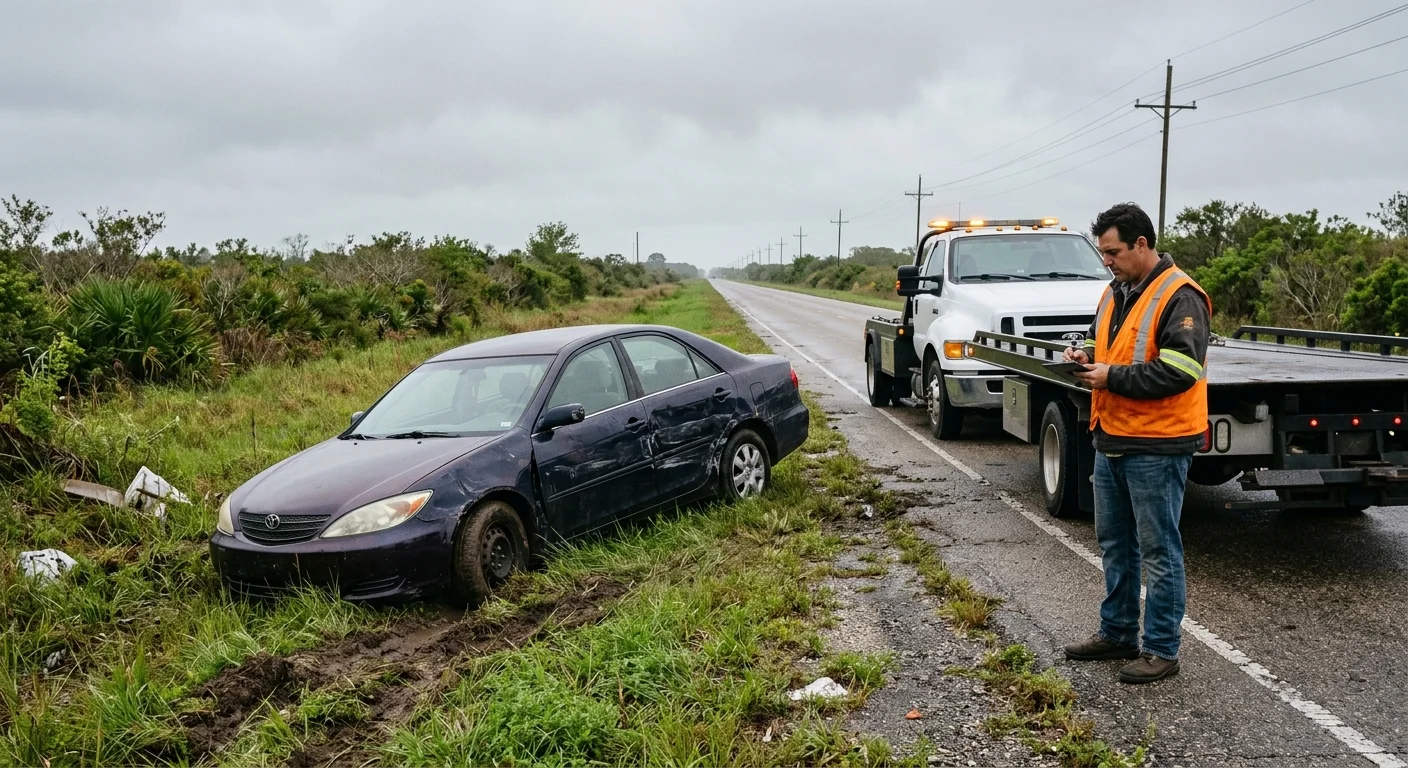
A standard tow moves a vehicle that’s already accessible for transport. Accident recovery adds the work needed to reach, reposition, or free it first. Report these scene facts first:
- Who ordered the truck: you called, or an officer arranged it.
- Exact location: street and cross street, or highway, direction, and exit.
- Position: upright on pavement, against a curb, in mud or water, or blocking a lane.
- Whether it rolls, steers, or has a detached wheel.
- Destination if you are allowed to choose one.
A police-arranged tow counts as non-consensual under the LPSC schedule, even if you asked the officer for help. Those rates are the Commission’s maxima, not a Quick Tow menu. If you called the operator yourself, you choose the destination; see who chooses the tow destination after a New Orleans crash.
A crash on an open Metairie street isn’t the same as one beside I-10. A vehicle partly beyond the pavement may need a different response than one sitting upright in a parking lot. The operator needs the actual position, damage, surface, and access conditions.
A movable vehicle may need only transport
A damaged car doesn’t automatically need accident recovery. It may need only transport if it’s upright, accessible, and positioned on firm pavement.
“Movable” doesn’t mean the car should be driven. It means the operator may be able to prepare it for transport without first extracting or repositioning it. A car might start yet have damaged steering, a flat tire, loose bodywork, or leaking fluids. Those details still need to be reported.
Consider a sedan stopped in a New Orleans parking lot after a low-speed collision. It remains within the marked space, with open access around it. The operator may treat that as a standard towing job. The crash explains why transport is needed, but the vehicle’s position doesn’t create a separate recovery problem.
The same distinction can apply on a surface street in Kenner or Gretna. If the vehicle is upright and reachable from firm pavement, the main task may be transportation. The matched operator decides how to load it after hearing the condition.
Don’t diagnose the towing method on the call. Saying “I need a standard tow” leaves out useful facts. Instead, explain that the car is upright, where it sits, and which wheels appear damaged. Mention whether it can roll, steer, or shift into neutral, if you can confirm those points without guessing.
Our emergency towing referral service connects callers with licensed local operators. The operator assesses the vehicle and selects the appropriate towing method.
Position and damage can turn it into recovery work
Recovery becomes relevant when the vehicle can’t be reached or loaded from its resting position. It may be angled beyond the pavement, resting against an object, sitting unevenly, or unable to roll because of crash damage.
That difference matters across metro New Orleans. An upright car beside a broad suburban road presents one access pattern. A car pressed near a curb on a narrow Orleans Parish street presents another. A vehicle beyond the firm shoulder near St. Bernard Parish adds ground conditions to the problem.
Wheel position also matters. Report if a wheel is folded under the car, detached, or blocked. Mention visible damage near the suspension, steering, or underside. Don’t call something minor when you can’t see beneath the vehicle.
A car can also look accessible from one angle while being blocked from another. Nearby parked vehicles, medians, guardrails, walls, and ditches affect how an operator approaches it. Give the street name, direction of travel, and nearest cross street or exit. That description is more useful than deciding the truck type.
The matched operator may determine that positioning work is needed before transport. Our accident recovery and winch-out service covers referrals for those situations. Quick Tow New Orleans doesn’t perform the recovery. We connect the caller with an independent, licensed operator who evaluates the scene.
Louisiana’s nonconsensual towing schedule lists towing and recovery as separate categories. That distinction is another reason to describe the scene accurately instead of treating every crash as a basic tow.
Debris and soft ground change the request
A vehicle’s surroundings can change the job even when the car remains upright. Broken parts, displaced cargo, wet grass, mud, and a soft pavement edge are useful facts for the operator.
Metro New Orleans has very different roadside settings. I-10, I-610, and US-90B don’t resemble residential streets in Mid-City or Metairie. The North Shore also adds longer corridors and different access points across Lake Pontchartrain. Report the actual setting instead of saying only that you’re “near New Orleans.”
Soft ground deserves a clear description. Say which wheels are off the pavement and whether the vehicle is level. Mention standing water if present, but don’t estimate its depth. A photo may help the operator understand the position if the operator requests one.
A vehicle stuck in mud without crash damage can also require positioning work. That situation overlaps with recovery, but it isn’t automatically an accident job. Our guide to deciding between a tow or winch-out for a car stuck in mud explains that narrower scenario.
Debris matters because it can affect access and the scope of recovery. Tell the operator about detached bumpers, loose panels, damaged wheels, spilled vehicle contents, or cargo around the car. Don’t move or attach anything to prepare for the tow.
Louisiana’s regulated schedule recognizes more involved recovery work and requires documentation for certain nonconsensual charges. You don’t have to classify the debris or decide which billing category applies. Report what you can see and ask the operator to explain any separate recovery charge before payment.
The destination should be discussed before movement
Recovery describes how the vehicle gets out of its position. The destination answers where it goes after that work. Those are separate decisions, and both should be discussed before movement begins.
Possible destinations include a repair shop, collision center, residence, or storage facility. The right choice depends on who controls the vehicle and what arrangements have already been made. Quick Tow New Orleans doesn’t operate a yard or select a destination for the owner.
A crash arranged through law enforcement can also differ from a tow the driver books directly. Under the LPSC order, even a tow the owner asks a police officer to arrange can count as nonconsensual. That classification affects which regulated rules apply. It doesn’t tell the operator where you personally want the car taken.
Tell the matched operator if an insurer, repair shop, or other party has already provided instructions. Confirm the full destination address and whether that location expects the vehicle. Don’t rely on a shop name alone, especially when a business has several locations.
Parish lines can matter to the trip. A vehicle recovered in Orleans Parish may be going to Jefferson Parish. A North Shore crash could involve transport across the Causeway. A Westbank vehicle may need to travel by US-90B rather than remain near the crash scene. Those details help define the transport request after the recovery portion is understood.
If you’re unsure who can choose, read our guide on who chooses the tow destination after a New Orleans crash. Settle that question before the car starts moving whenever circumstances allow.
What to report to the matched operator
Start with location. Give the road, direction, nearest cross street, exit, or recognizable landmark. “I-10 near New Orleans” covers too much ground. Say whether you’re in Orleans Parish, Jefferson Parish, St. Bernard Parish, or on the North Shore when you know.
Next, describe the vehicle and its position. Useful details include:
- Vehicle type and approximate size
- Whether it rests upright
- Which wheels remain on firm pavement
- Whether any wheel appears damaged or blocked
- Whether the car can roll, steer, or shift into neutral
- Visible damage beneath or around the vehicle
- Mud, wet ground, a ditch, curb, barrier, or tight access
- Detached parts, loose cargo, or debris nearby
- The intended destination, if already confirmed
Stick to observations. “The front wheel points sideways” is more helpful than “the axle is broken” unless a qualified person confirmed that diagnosis. “The rear wheels are in wet grass” is clearer than “it’s an easy pull.”
Mention whether another towing company, law enforcement agency, insurer, or property representative is already involved. Don’t assume that calling a second service cancels an existing arrangement. The matched operator needs enough context to identify any limits before accepting the job.
If traffic or an incident is affecting the route, 511 Louisiana provides official information on closures, incidents, and road conditions. That can help you state which direction and exit are involved. It doesn’t replace a clear description of the vehicle itself.
Photos can clarify damage, wheel position, and the pavement edge when requested. Capture the whole vehicle and its surroundings, not only the damaged panel. The operator can then decide whether this is a standard tow, recovery followed by towing, or a request that needs more information.
The line takes calls 24/7. Calls are recorded after the caller hears a recording notice.
When to call us
Call when crash damage, vehicle position, debris, or soft ground makes the job unclear. You can describe what happened without choosing the recovery equipment yourself.
Call (504) 474-5530. We match you with a licensed local operator who quotes before the truck rolls.