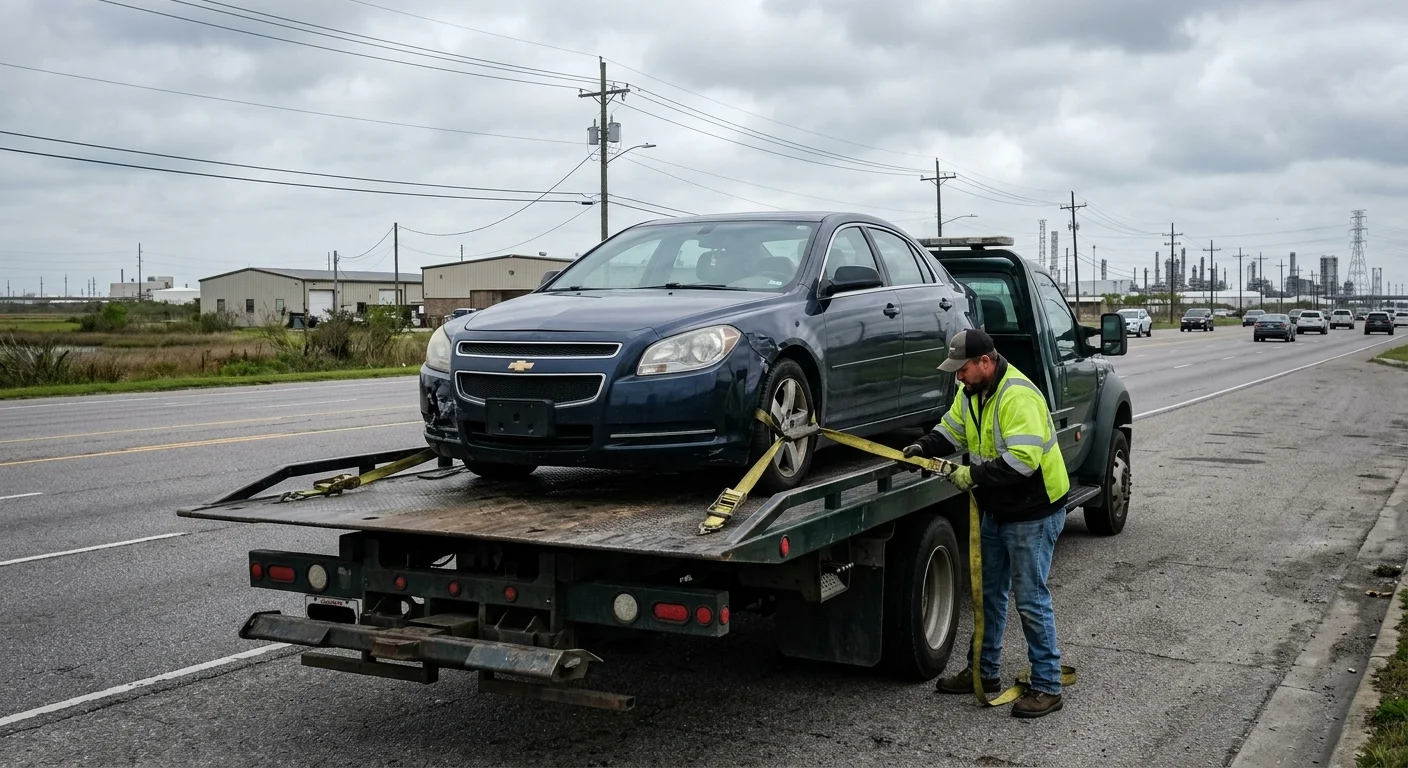
The car will not roll off Judge Perez Drive on its own. You still need it at a shop, a driveway, or a lot in Orleans Parish. Towing from Chalmette to New Orleans is a downriver, cross-parish job, and the matched operator has to accept the vehicle, the route, and the drop before anyone hooks up.
Start with the car’s condition and exact location
Give the operator the parish, the street, and what the car will and will not do. Chalmette sits in St. Bernard Parish, downriver of the Lower Ninth Ward. A pin that only says “Chalmette” is thin. Say whether you are on Judge Perez Drive, St. Bernard Highway, Paris Road, a side street off East St. Bernard Highway, or a lot in Arabi that people still call Chalmette. Meraux and Violet sit farther downriver. If that is where the car died, say so.
Condition shapes the truck. A car that rolls and steers in neutral is one load. A locked transmission, a broken axle, or a car sitting in a flooded dip is another. Tell the operator if it is all-wheel drive, lowered, or riding on a spare. Tell them if the keys work, if it is in a gated lot, and if it is blocking a lane. “It died” is not a load plan. “It died in park, it will not go into neutral, and it is nose-in on a tight lot off Paris Road” is.
If you are in a travel lane, get yourself and passengers to a safe spot first. Call 911 if anyone is hurt or the car is a traffic hazard. Louisiana’s Motorist Assistance Patrol is a fixed-schedule patrol on parts of I-10, I-610, and US-90B. It is not a call-out for Paris Road or Judge Perez. Check 511la.org for incidents on the approaches into the city.
A consented tow you request is a job you named. You are asking a licensed operator to move your disabled car. The operator on the other end of the match decides the truck. A flatbed is common when the car cannot roll. A wheel-lift can fit when it can. That call belongs on scene, with the actual vehicle in front of the actual truck.
Stay with the car if you can do it safely. Lights on, flashers going, people out of the travel lane. If you have to leave, leave a note with a callback number on the dash and take the plate number with you. The operator still needs a human who can confirm the drop.
Choose the Orleans Parish destination first
Cross-parish tows stall when the drop is vague. “New Orleans” is a parish of neighborhoods, shops, and lots. The operator needs a street address, a shop name with a phone number, or a driveway they can actually enter.
Decide the drop before the truck is rolling. A Bywater garage off St. Claude, a Mid-City shop, a Gentilly driveway, and a lot near University Medical Center at 2000 Canal Street are different endings. Hours matter. A shop that closed at 5:00 p.m. is not a drop at 8:00 p.m. Ask the destination if they take after-hours arrivals, and if they need the car on a bed or in a stall. Write down a contact on site and any gate code.
You choose the destination on a consented tow you called for. After a crash with police on scene, that can change. If an officer is arranging the wrecker, Louisiana treats that as a non-consensual tow even when you asked the officer to call one. Non-consensual work is rate-capped by the Louisiana Public Service Commission, under General Order 12-20-2024, Amended Attachment A, for tows on or after April 1, 2026. A call you place yourself to move your own car to a shop you named sits outside that cap.
If the car was already taken to a City lot, that is a City process. Confirm with the City at (504) 658-8100 and use the City’s Find My Towed Vehicle page. Release and payment run through 400 N. Claiborne Ave. Vehicles held more than 24 hours may be moved to 10200 Almonaster Ave. Confirm the pickup location with the City. A Chalmette-to-shop run and a City impound are separate jobs.
Long-distance towing in this metro often means a parish line. St. Bernard to Orleans is still a destination job. The operator has to agree the drop is in range and that the lot can take the truck. Hand them the address in writing if you can. A texted pin plus a shop name beats a neighborhood nickname.
Paris Road and St. Claude Avenue shape the route context
From Chalmette, two corridors do most of the talking. Paris Road (LA-47) is the north-south spine to the I-510 interchange and I-10 into Orleans Parish. St. Claude Avenue, as LA-46, runs the river-side path through Arabi toward the Lower Ninth Ward and Bywater. Judge Perez Drive is where a lot of Chalmette cars actually die: shopping centers, service bays, and the daily grind of St. Bernard Parish traffic.
The operator picks the path from live conditions. Fog, a stall on I-510, a backup on Judge Perez, or high water on a low street can flip the choice. You can watch the same picture on 511. You cannot dictate a route the truck cannot run. Give the nearest cross street, the side of the road, and whether a lot manager has to let the wrecker in.
Paris Road is industrial and open. St. Claude tightens once you are in the city: shorter blocks, parked cars, and lots that were never designed for a loaded flatbed. If the drop is a Bywater or Marigny shop, say so early. A truck that is happy on Paris Road may not like a narrow lot off St. Claude. The Lower Ninth sits between those two worlds. Crossing into Orleans there is still a parish-line tow, with city streets on the far side.
This run is the downriver twin of a Northshore job. There is no Causeway, no lake crossing, and no Greater New Orleans Expressway Commission fog playbook. It is low, flat ground between the river and the wetlands, with Paris Road as the tall north-south exit. After heavy rain, treat standing water as a stop. The National Weather Service’s Turn Around Don’t Drown® guidance is blunt: it takes 12 inches of rushing water to carry away most cars. Do not ask a wrecker to follow you through a flooded dip.
If MAP is already on an I-10 or I-510 shoulder, they can move a disabled vehicle out of a travel lane and offer minor help. They do not haul the car to a New Orleans shop. Once you are off those MAP routes, you are on ordinary St. Bernard and Orleans streets. That is operator territory.
A disabled-car tow differs from planned transport
A planned move is a scheduled pickup of a car that is ready to load. A disabled-car tow starts wherever the failure happened, in the condition it failed. That gap is why a search for towing from Chalmette to New Orleans is a wrecker problem, and a later, staged move can be a transport problem.
If the car still drives a few blocks, you might want to nurse it to a safer lot. Do that only if it is actually safe. An overheating engine, a shredded tire on the rim, or a transmission that will not stay in gear should sit. The operator would rather load it where it is than pull it off a worse shoulder a mile west.
Equipment follows the failure. A car that rolls and has working brakes can often take a wheel-lift. A car that will not roll, a low spoiler, an all-wheel-drive unit that should not drag, or a car you do not want on a sling is a flatbed conversation. The matched operator makes that call on scene. You can ask for a bed. Availability of a given truck is theirs to confirm.
People also search “the 80% rule for towing” and “can you double tow in Louisiana.” No Louisiana statute under those names turned up in the sources this page can cite. Treat forum shortcuts as unconfirmed. What is confirmed: the LPSC publishes maximums for non-consensual tows by duty class. Light Duty, 10,000 lbs or less, towing is $152.50 per hour with a 1.5 hour minimum, effective for tows on or after April 1, 2026. Those figures are ceilings on non-consensual work. They are not a quote for a consented Chalmette hookup.
A second car on the same truck, a dolly, or a combination load is an operator equipment decision. If you have two disabled vehicles, say so on the call.
If you are weighing a wrecker against a shipper, read tow a car or hire vehicle transport. A disabled car on Paris Road is usually a wrecker job. A running car you can stage for a later pickup can be a transport conversation. For how distance shows up on a bill, see long-distance towing prices in New Orleans. Ask the operator how they bill miles, clock time, and wait time at the drop. Get that itemized.
What to confirm before a cross-parish tow
Before anyone hooks the car, lock five things down.
One: pickup. Parish, street, nearest cross street, lot versus curb, and whether the car is in a travel lane. “Chalmette” plus a landmark is a start. A cross street on Judge Perez or a lot entrance on Paris Road is better.
Two: destination. A full Orleans Parish address, a person who will be there, and whether the lot can take the truck after hours. If the shop is on St. Claude, say so. Tight streets change the truck.
Three: condition. Roll or no roll. Neutral or not. Keys. All-wheel drive. Low bodywork. Fluids leaking. Airbags if this started as a crash.
Four: who is paying, and what kind of tow this is. Your call to move your own car is consented work between you and the operator. An officer-arranged wrecker is non-consensual and sits under the LPSC schedule. City impound fees are the City’s. The City’s Light Duty tow and impound minimum is $228.75 for the first 90 minutes, then $76.25 per additional half-hour. That is a City product. Keep it off a consented shop-run invoice.
Five: the paper. On non-consensual work, Louisiana requires an itemized invoice, and that invoice must carry the LPSC complaint address: P.O. Box 91154, Baton Rouge, LA 70821, and lpsc.louisiana.gov. For a consented job, still ask for itemized charges: hookup, mileage or time, any winch, any wait, any after-hours gate if the operator stores it. Normal business hours in the gate-fee statute, R.S. 32:1734, are 8:00 a.m. to 5:00 p.m., Monday through Friday, excluding legal holidays. A gate fee on a non-consensual release may not exceed $64.50. Retrieval of contents during those business hours carries no fee on the LPSC schedule. After hours, the retrieval cap is $64.50.
If the operator will hold the car overnight, ask where. Quick Tow New Orleans does not run a yard. Storage, if any, is the operator’s. Notice clocks and disposal rules attach when a facility is holding a car the owner has not claimed. They are a reason to keep a simple shop drop on the calendar.
Personal property: grab what you need before the load if you can do it safely. Medications, laptops, work bags. Mileage, clock time, and whether the drop is ready all change the job. Confirm them with the operator who will actually run St. Bernard into Orleans.
When to call us
Call when the car is disabled in Chalmette, Arabi, or along Paris Road and it has to reach an Orleans Parish shop, driveway, or lot. The line takes calls 24/7. Call us at (504) 474-5530 and we’ll connect you with a licensed local operator.