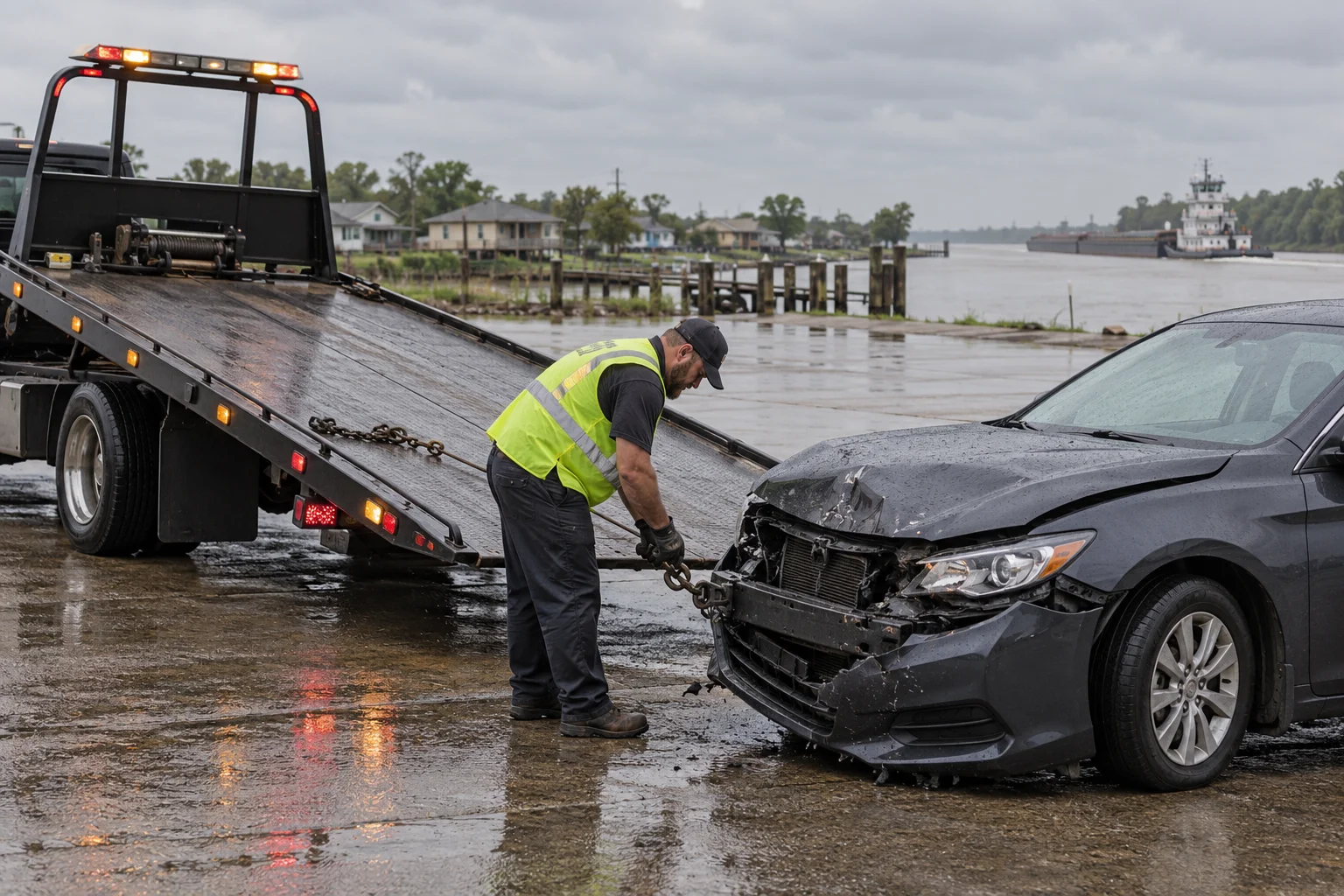
A crash in Meraux can leave your car damaged, blocked in, or off the pavement. For accident towing in Meraux, LA, the operator first needs the vehicle’s exact position, condition, and intended destination.
Those details determine whether you need a straightforward tow or a recovery job. They also help prevent a standard truck from reaching a scene that needs different equipment.
Start with the vehicle’s position and visible damage
Begin with where the vehicle rests now. A car sitting upright on firm pavement presents a different job than one against a curb, down a shoulder, or facing across traffic.
Describe the position in plain words. Tell the operator whether all four wheels remain on pavement. Mention a ditch, soft ground, broken curb, tight driveway, or nearby barrier. If the car has left the roadway, say how far it appears to be from firm pavement.
Next, report the damage you can see without handling the vehicle. Useful details include a bent wheel, loose bumper, flat tire, broken glass, or fluid beneath the car. Mention deployed airbags and doors that won’t open. Tell the operator if a wheel points at an unusual angle.
You don’t need to diagnose the mechanical problem. The operator needs a clear picture, not a repair conclusion. “The front driver-side wheel is folded inward” is more useful than “the suspension is ruined.”
Also explain whether the vehicle rolls, steers, or shifts into neutral. Don’t force any control that feels stuck. Simply report what the car does when you try it normally.
Clear photos can help the matched operator understand the scene. Capture the vehicle’s corners, wheels, surrounding pavement, and nearby obstacles. Keep the images wide enough to show the car’s position.
Our accident recovery and winch-out service connects callers with licensed, independent operators. Quick Tow New Orleans doesn’t own trucks or perform the recovery.
Judge Perez Drive needs an exact location
“Judge Perez Drive in Meraux” still covers too much ground for a useful service request. Give an exact address, nearby cross street, business entrance, or other fixed location.
Say which side of Judge Perez Drive you’re on. Include your direction of travel before the crash. If you recently passed Paris Road or were traveling between Chalmette and Violet, share that context. It helps distinguish the correct section of the downriver corridor.
Location pins can also help, but pair the pin with words. A pin may land behind a building, inside a large parcel, or on the opposite side of the road. A short description can correct that problem.
Try a location statement like this:
The car is on Judge Perez Drive in Meraux, on the Violet-bound side, beside the entrance to a business. It’s partly on pavement and partly on the shoulder.
That tells the operator much more than a community name. Add the vehicle’s color, body style, and visible position so it’s easier to identify.
If traffic conditions affect your route toward the scene or destination, 511 Louisiana provides official incident, closure, and traffic information. It doesn’t replace the exact scene details you give the operator.
Crashes closer to Chalmette may involve a different approach than incidents farther downriver toward Violet. Drivers coming from Orleans Parish also travel through a different part of the corridor. Our guide to accident towing in Arabi explains how the same questions apply farther upriver.
Recovery and transport are different requests
Recovery means getting the vehicle into a position where it can be loaded or towed. Transport means moving it from the scene to another destination. One crash may require both services.
A vehicle resting upright on open pavement may only need transport. A car in soft ground, against a barrier, or unable to roll may require recovery work before loading begins. The operator decides what equipment fits the actual position and damage.
This distinction matters when you describe the job. Saying “I need a tow” doesn’t explain that the vehicle sits below the shoulder or has a locked wheel. Saying “the rear wheels are in soft ground, and the front wheels remain on pavement” gives the operator something useful.
Access matters too. Mention narrow entrances, parked vehicles, low branches, gates, and other limits around the car. If another damaged vehicle blocks the approach, include that detail.
Don’t assume a vehicle can be pulled by whichever end looks clear. Crash damage can affect wheels, steering, body panels, and attachment points. The licensed operator should evaluate how to recover and load it.
Our guide to accident recovery versus a standard tow explains the distinction in more detail. The main point is simple: movement at the scene and transportation from the scene aren’t always the same task.
When calling, describe both needs. Explain where the vehicle sits now and where it needs to go afterward. Quick Tow New Orleans then matches the request with an independent local operator covering that zone.
Choose a St. Bernard or Orleans destination
The operator needs a destination before the vehicle moves. That destination might be a repair shop, body shop, storage facility, dealership, or another authorized property.
A nearby destination in St. Bernard Parish may keep the vehicle close to Meraux, Chalmette, or Violet. Another driver may need the car transported toward Orleans Parish. Neither choice is automatic. It depends on where the vehicle is accepted and what happens next.
Get the full destination address. A business name alone can cause confusion when several locations share similar names. Include the street address and any entrance instructions supplied by the receiving location.
Confirm that the destination can accept the damaged vehicle. Ask the receiving business where a disabled or collision-damaged car should be placed. Some properties have separate entrances or designated drop areas.
Also tell the operator if you haven’t chosen a destination. That’s better than giving a tentative address that may change after loading. The operator can discuss the available transport request directly with you, but Quick Tow New Orleans doesn’t choose a repair facility or storage location.
A route from Meraux toward Orleans Parish generally carries the vehicle back through the Chalmette and Arabi side of the corridor. A downriver destination toward Violet creates a different transport request. State the destination clearly before the move begins.
For a crash scene that still needs towing arrangements, our emergency towing referral service can connect you with a licensed operator. The line takes calls around the clock, including holidays.
What to confirm before the vehicle moves
Before loading begins, confirm the vehicle, destination, and job scope with the operator. Small misunderstandings become harder to correct once the car leaves Meraux.
Start with the vehicle description. Confirm its year, make, model, color, and plate state if available. Mention missing plates, severe body damage, or anything else that could make identification difficult.
Then review the condition you reported. Make sure the operator knows about locked wheels, steering damage, deployed airbags, fluid beneath the vehicle, or keys trapped inside. Mention whether the vehicle starts, rolls, and shifts normally. Don’t guess when you don’t know.
Confirm these practical details directly with the operator:
- The vehicle’s exact location and position
- The full delivery address
- The receiving entrance or drop instructions
- Whether you have the keys
- Whether someone will meet the vehicle
- The recovery and transport work being requested
- The operator’s charges and accepted payment method
Quick Tow New Orleans doesn’t set operator pricing. The driver contracts with and pays the independent operator directly. Ask that operator to explain the planned work and charges before the vehicle moves.
Keep the destination contact available during the transport. If the receiving business changes its instructions, pass that information to the operator directly.
It’s also helpful to photograph the vehicle before loading. Focus on the visible damage and each side of the car. These photos create a clear record of how the vehicle appeared at the Meraux scene.
The goal is a clean handoff. The operator should know what must be recovered, where it must go, and who can receive it.
When to call us
Call when a crash-damaged vehicle in Meraux needs recovery, loading, or transport to a St. Bernard or Orleans destination. The line takes calls 24/7 and matches drivers with independent towing operators.
Call us at (504) 474-5530 and we’ll connect you with a licensed local operator.