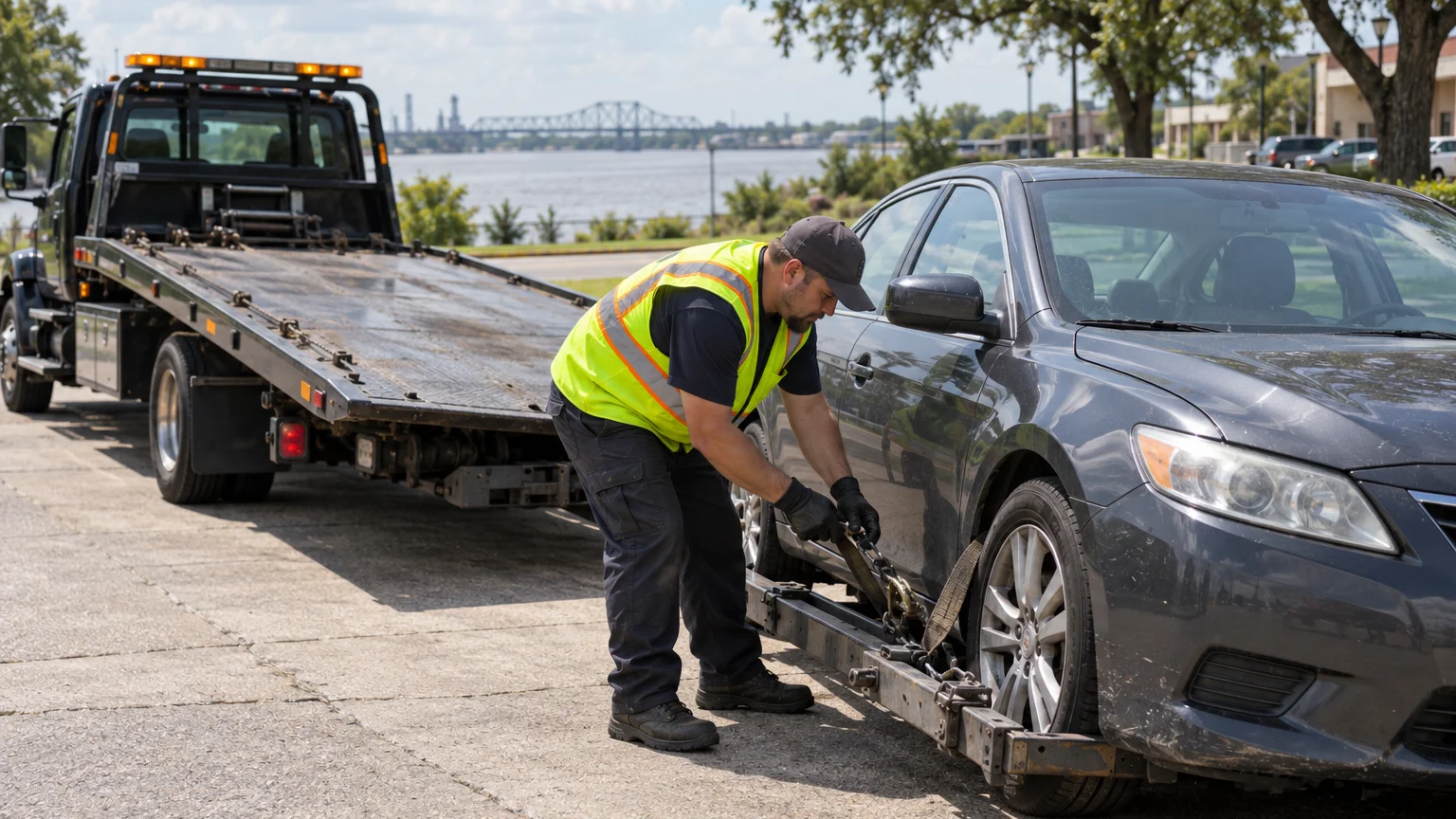
A car breakdown in Harahan, LA, starts with one urgent task: report exactly where you are. Clear location details help the matched operator understand the scene, choose suitable equipment, and discuss where the car needs to go.
Start with your exact Harahan location
Give more than “Harahan” when requesting help. Start with the road name, nearest cross street, and your direction of travel. If you’re near Jefferson Highway and Hickory Avenue, say which side of the intersection you’re on.
A business name can help, but don’t rely on it alone. Shopping centers may have several entrances or large parking areas. Share the street address when you can. Then describe where the car sits within the property, such as near a driveway, loading area, or rear parking row.
Drop a map pin from your phone if the operator accepts one. Check the pin before sending it. Phone maps sometimes place a driver behind a building or on a neighboring street. Written details give the operator another way to confirm the scene.
Also report whether the car is:
- In a travel lane
- On a shoulder
- Inside a parking lot
- In a driveway
- Behind a gate
- Under a low structure
- Parked nose-first against a wall or curb
Those details affect access and equipment selection. A car in an open lot presents a different setup from one wedged into a narrow space.
If traffic is moving around you, focus on reporting your location clearly. Check current incidents and closures through 511 Louisiana when road conditions may affect your route or destination.
Jefferson Highway and river roads need clear landmarks
Jefferson Highway runs through the Harahan area and continues toward nearby River Ridge and Elmwood. That makes vague location reports easy to misunderstand. Name the municipality and the nearest landmark instead of assuming the road name settles it.
For example, tell the operator you’re in Harahan near Hickory Avenue, not simply “on Jefferson Highway.” If you’re closer to River Ridge or Elmwood, say that plainly. A map may label a nearby area differently from the name you use in conversation.
River Road also requires careful directions. Give the nearest cross street, entrance, or visible property. State whether the car is beside the road or inside a lot. Don’t ask an operator to search the corridor for hazard lights.
Your direction of travel matters when a divided road, median, or limited driveway access separates you from the opposite side. Report the direction shown on your map if you’re uncertain. You can also describe what lies immediately ahead and behind the car.
Take note of access conditions before calling:
- Is there enough open space beside the car?
- Does a locked gate control entry?
- Is the parking surface paved, gravel, grass, or mud?
- Are low branches, signs, or overhead structures nearby?
- Can the operator approach from either direction?
Report the obstacle and let the licensed operator decide how to handle it. If your breakdown is farther east, our guide to a car breakdown in Metairie explains the same reporting process in that area.
Decide whether roadside help may fit
Not every disabled car needs to leave Harahan on a tow truck. Start by describing what happened without diagnosing the problem. The symptoms help the matched operator determine whether roadside assistance may fit or whether towing makes more sense.
Useful details include:
- The engine turns over but won’t start
- The dashboard lights come on, but the engine stays silent
- A tire is flat or visibly damaged
- The car is out of fuel
- Steam, smoke, or fluid appeared
- The steering or brakes feel wrong
- The car won’t shift into neutral
- A wheel looks bent or out of position
- The vehicle struck a curb, object, or another car
Mention any warning message exactly as it appears. A photo of the dashboard, tire, or visible damage may help.
A jump-start, tire change, or fuel delivery may address a simple problem. Those options aren’t suitable for every scene. A damaged wheel, failed steering component, serious leak, or crash damage may require towing instead.
Tell the operator the vehicle’s year, make, model, and general size. Mention all-wheel drive, very low ground clearance, modifications, missing keys, or locked steering. These details can affect loading.
DOTD’s Motorist Assistance Patrol provides limited help on covered routes and schedules, but it isn’t a call-out towing service. A stranded driver contacts local law enforcement, or 911 during an emergency, when MAP isn’t already present.
Choose an East Bank destination before the car moves
Decide where the car should go before loading begins. That destination might be your home, a repair shop, a tire shop, or another safe property that has agreed to receive it.
Harahan sits near other East Bank communities and commercial areas. A destination in Harahan, River Ridge, Elmwood, Metairie, or Kenner may involve different routes and access conditions. Give the full destination address, not only the shop name.
Call the destination before arranging the tow when possible. Confirm that it accepts your vehicle type and can receive the car when it arrives. Ask where a disabled vehicle should be left. Some properties have several entrances, separate service lanes, or locked areas.
Don’t assume a closed shop allows after-hours drop-off. That permission and any key procedure come from the property receiving the car. If no destination has been confirmed, tell the matched operator before the vehicle moves.
Consider these practical questions:
- Does the destination have space for the vehicle?
- Is the entrance accessible to towing equipment?
- Will someone need the keys?
- Does the property require approval before drop-off?
- Is the car going to the correct branch or service entrance?
Keep valuables, medication, identification, and anything needed that day with you. Photograph the car before loading, including existing body damage and each wheel. Remove loose items if they could shift during transport.
For destinations farther west, the guide to a car breakdown in Kenner covers location and drop-off details for that part of Jefferson Parish.
What to confirm with the matched operator
Quick Tow New Orleans is a referral service. We take your call and match you with an independent, licensed local operator. Quick Tow doesn’t own tow trucks, employ drivers, perform towing, set operator prices, or operate a storage yard.
Before agreeing to service, confirm the operator’s business name and contact information. Repeat the pickup and destination addresses. Make sure the operator knows the vehicle type, its condition, and any access problem you observed.
Ask which towing method and equipment the operator expects to use. You don’t need to select equipment yourself. Accurate details let the licensed professional make that decision.
Discuss charges directly with the operator before authorizing the work. Ask what the quoted amount includes and what circumstances could change it. Quick Tow doesn’t collect the operator’s payment or set the operator’s terms.
Also confirm:
- Who may authorize the tow
- Which payment methods the operator accepts
- Whether the keys are required
- Where you should wait safely
- What information appears on the invoice
- How an approved after-hours drop-off will work
Keep the operator’s invoice and photograph the vehicle at pickup and delivery. If another person owns the car, tell the operator before loading. The operator can explain what authorization or proof is needed.
For a disabled car that can’t be handled with basic roadside help, emergency towing may be the right service path. The line takes calls 24/7, including holidays. Calls are recorded after the caller hears the recording notice.
When to call us
Call when your car can’t be driven safely, roadside help doesn’t fit, or the vehicle needs transport from Harahan. Call us at (504) 474-5530 and we’ll connect you with a licensed local operator.