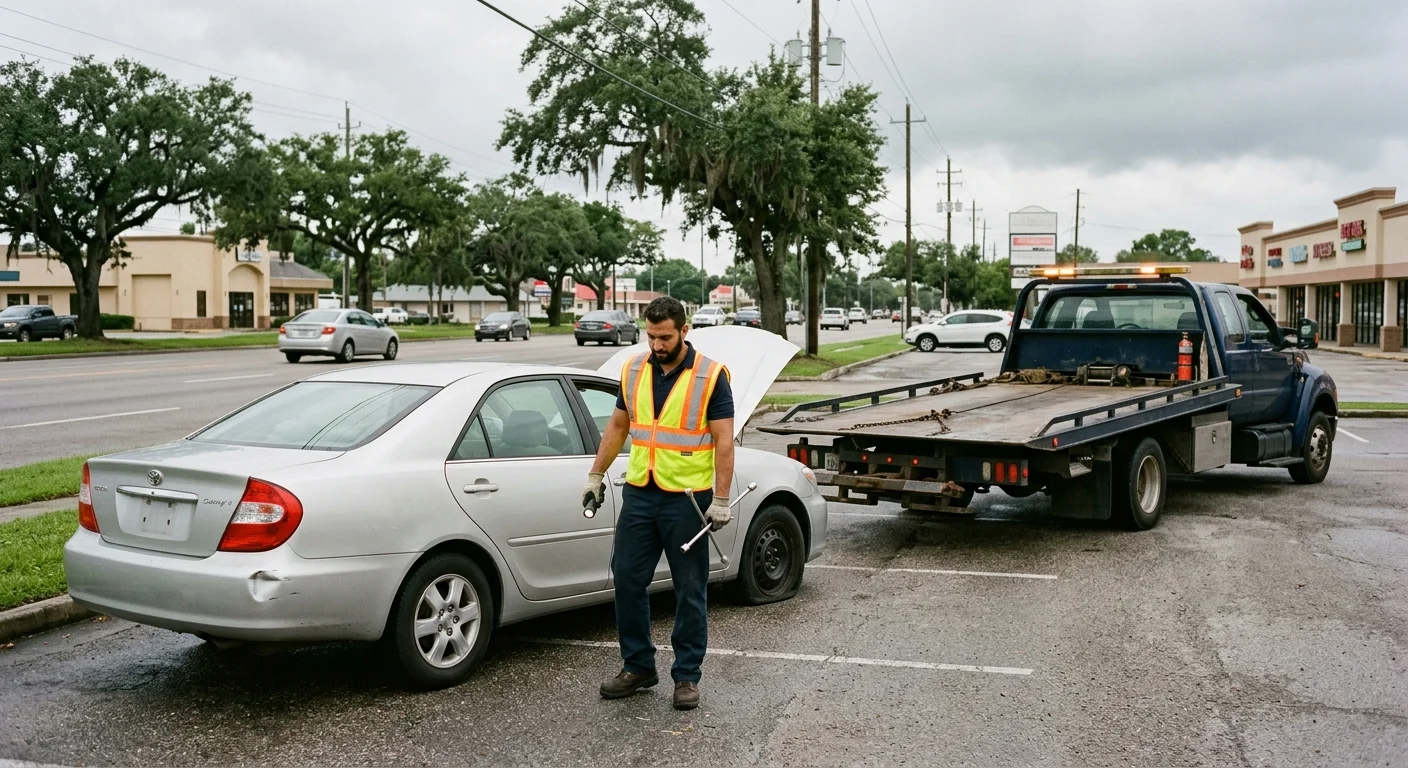
A Metairie breakdown starts with intake: Veterans, I-10, or the Causeway approach change the quote. Use the Metairie city hub. Report location, whether the car rolls, and the destination. The operator quotes before the truck rolls. This page does not replace the city-page mileage or price notes.
Start with your exact location and the car’s condition
“Metairie” isn’t enough for a pickup location. A driver on I-10 needs to give different details than someone parked near Veterans Memorial Boulevard.
Start with the road name and your direction of travel. Add the nearest exit, intersection, or visible business. If you’re near Causeway Boulevard, say whether you’re north or south of Veterans. If you’re in a parking lot, identify the entrance closest to the car. A large shopping center may have several entrances facing different streets.
Your phone’s map pin can help, but describe what you see too. Pins may land behind a building or on the wrong side of a divided road. Tell the operator whether the car is on a shoulder, exit ramp, surface street, garage, or private lot.
Next, describe the vehicle and what happened. Share its make, model, color, and approximate size. Tell the operator whether you have the keys. Note whether the car starts, shifts into neutral, steers, and rolls. Mention flat tires, collision damage, low clearance, visible fluid, or a wheel sitting at an unusual angle.
Don’t diagnose a mechanical problem you can’t identify. Describe the sound, warning light, smell, or behavior instead. A photo of the wheel, damage, and surrounding area may also help the operator assess access.
If the car is exposed to moving traffic, tell the call taker immediately. Contact emergency services first when someone is injured or traffic presents an immediate danger.
I-10 and surface streets need different location details
An I-10 breakdown can be difficult to describe from memory. Metairie interchanges and ramps can look similar when traffic is moving around you.
Give your direction first. Then explain whether you’re before or past the Causeway Boulevard exit. Say whether the car is on the right shoulder, left side, ramp, or another protected area. Don’t step into moving traffic to read a sign. Use the last exit you passed, your map, or a nearby building as a reference.
Check Louisiana 511 for reported incidents, closures, and current traffic conditions. That information can help you understand whether congestion or a closed ramp affects access. It doesn’t replace the pickup details you give the operator.
Surface-street breakdowns need another kind of description. On Veterans Memorial Boulevard, provide the nearest cross street and which side of Veterans you’re on. Around Causeway Boulevard, state whether you’re northbound or southbound. If you turned into a business lot, name the business and describe the entrance used.
Parking structures need more detail. Give the garage level, clearance signs, aisle, and nearest stairwell or elevator marker. Mention any tight turn, low ceiling, locked gate, or ticket-controlled exit. The operator decides what equipment can enter.
Keep your phone available after the request. The matched operator may need clarification about a driveway, entrance, or shoulder. Clear location details reduce confusion between I-10, its frontage areas, and nearby Metairie streets.
Decide whether roadside help could solve the problem
Not every disabled car needs transport. A dead battery, flat tire, empty fuel tank, or lockout may call for roadside assistance instead.
Describe what happened before selecting the service. A single click when turning the key differs from an engine that cranks but won’t start. A flat tire may be a roadside job when the car has a usable spare. Wheel damage, missing parts, or more than one damaged tire can change that decision.
Tell the call taker if the engine stopped while driving. Mention smoke, a burning smell, leaking fluid, overheating, collision damage, or steering trouble. Don’t keep testing a vehicle when its condition is unclear. Give the operator the symptoms and let the operator determine what service fits.
The Louisiana Department of Transportation and Development also runs the Motorist Assistance Patrol on scheduled routes, including covered portions of I-10. MAP isn’t a call-out towing service. When already on scene, its patrol can provide limited free help such as a battery jump, flat-tire change, emergency fuel, or assistance clearing a disabled vehicle from a travel lane. A stranded driver should contact local law enforcement when MAP isn’t present.
MAP doesn’t transport a car to a repair shop. If the vehicle remains disabled, you’ll still need an operator who can move it. Our emergency towing service explains how Quick Tow matches Metairie drivers with licensed independent operators. Quick Tow performs no roadside or towing work itself.
Choose an East Bank destination before the car moves
Choose the drop-off point before confirming the tow. “A shop in Metairie” leaves too much undecided once the vehicle is loaded.
Start with the type of repair needed. A tire shop, collision center, dealership, and general mechanic handle different problems. If you already have a shop, confirm its street address and where it accepts disabled vehicles. Ask the shop about access when its front office is closed.
Metairie offers many East Bank options near Veterans Memorial Boulevard, Causeway Boulevard, and the I-10 corridor. A destination in Kenner, New Orleans, or another parish changes the route. A West Bank destination adds a river crossing. A North Shore destination requires a much longer transport decision. Give the exact destination when requesting the match.
If you’re undecided, call the repair facility before the vehicle moves. Confirm that it works on your vehicle and accepts unattended drop-offs. Ask where the operator should leave the keys. Don’t assume a locked lot, dealership, or apartment garage will accept the car.
Home can be a practical destination when you need time to choose a repair shop. Confirm that the driveway or parking area can receive the vehicle. Tell the operator about gates, narrow access, steep approaches, or property restrictions.
Price depends on the operator and the actual job. Quick Tow doesn’t set or collect operator charges. Our guide to towing costs in New Orleans explains the difference between customer-arranged towing, regulated non-consensual towing, and City impound charges.
Confirm the job with the matched operator
Before agreeing to the tow, repeat the pickup location, vehicle details, and destination. Small errors can send the wrong information into the job.
Confirm the operator’s company name and contact details. Ask what equipment the operator plans to use. Restate anything affecting access, including garage clearance, locked gates, damaged wheels, missing keys, or a vehicle that won’t shift.
Discuss charges directly with the independent operator. Ask how the charge is calculated and what conditions could add to it. Confirm accepted payment methods and who will receive payment. You contract with and pay the operator directly. Quick Tow doesn’t own tow trucks, employ drivers, set operator prices, or warrant the operator’s work.
A customer-arranged tow is different from one arranged through law enforcement. Under the Louisiana Public Service Commission’s non-consensual towing schedule, even a tow the driver asks an officer to arrange is treated as non-consensual. Those jobs follow the applicable LPSC maximum-rate schedule and invoice requirements. A tow you arrange and consent to directly isn’t governed by that non-consensual rate schedule.
Ask for an itemized invoice when the job is complete. Check that the vehicle, service, destination, and listed charges match the work. If another person will meet the operator, provide that person’s name and confirm they can receive the car.
For more selection guidance, read our guide to choosing towing help in New Orleans. The same basic checks apply in Metairie: identify the operator, define the job, confirm the destination, and understand the payment terms before authorizing service.
When to call us
A breakdown needs a licensed towing pro when roadside help can’t make the car mobile or the vehicle requires transport. The line takes calls 24/7 for Metairie breakdown calls. Call (504) 474-5530. We match you with a licensed local operator who quotes before the truck rolls.