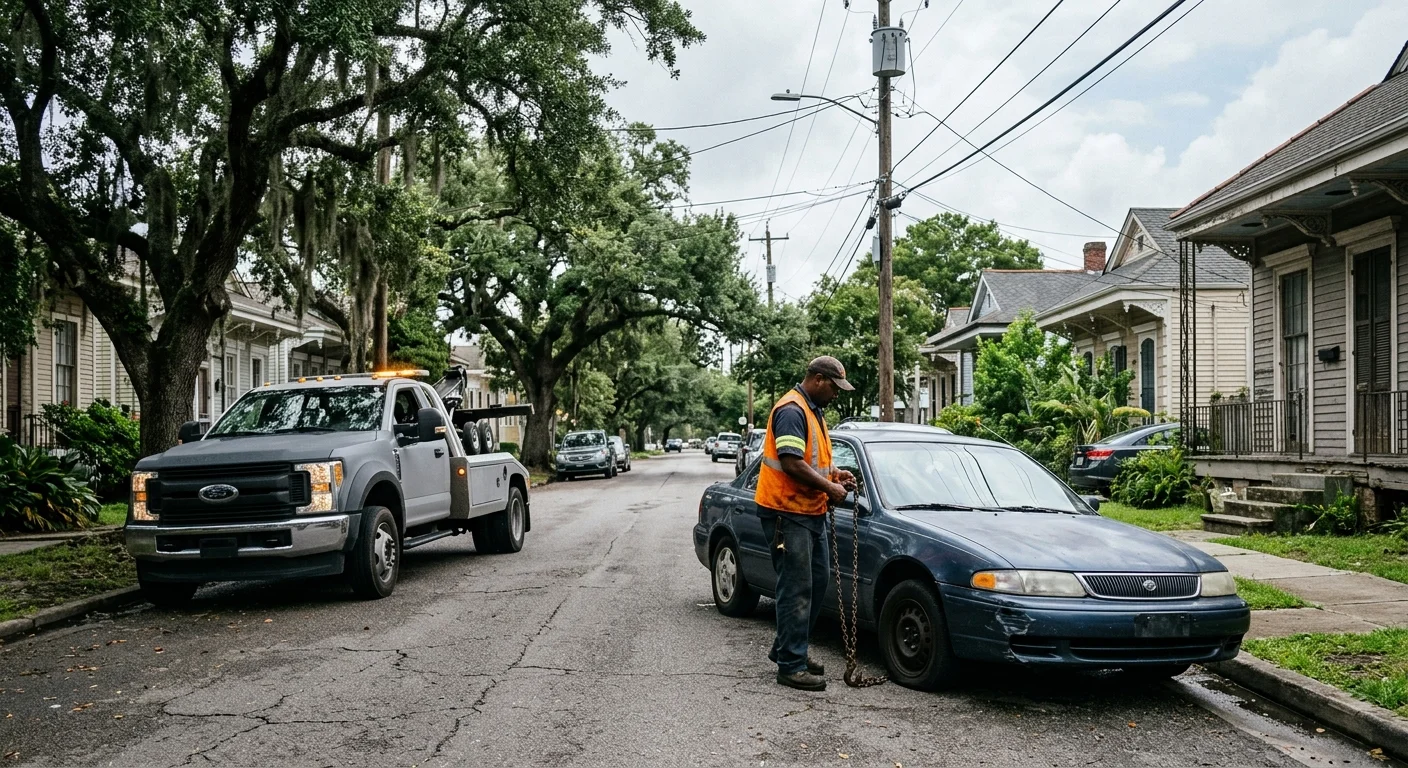
A stalled sedan on Bienville at Jefferson Davis Parkway is not the same job as a disabled car in a live I-10 lane at Canal. Mid city towing only works when you report the block, the corridor, and whether the car still rolls. Give that in Orleans Parish terms, then name the drop-off before anyone hooks up.
This is Mid-City New Orleans, not a similarly named pocket in another city. You are in Orleans Parish, between City Park, Carrollton Avenue, Canal Street, and the I-10 edge. A licensed operator we connect you with cannot find “somewhere in Mid-City.” They need the street, the cross street, and which side of the block you are on.
Start with your exact Mid-City block
Start with a street and a cross street. “Canal and Carrollton” is usable. “Mid-City” is not. Add a house number, a business name you can see, or a landmark you could walk to without guessing. The cemeteries at Canal and City Park, the Lafitte Greenway, Bayou St. John, and University Medical Center at 2000 Canal Street all read as real pins on a map. A neighborhood label does not.
Say which side of the street you are on, and which way the car is pointed. On a two-way block that matters. On a one-way like Banks or Bienville it matters more. If you are parallel parked between two other cars, say so. If you rolled into a driveway, a lot, or a neutral ground cut, say that too. The operator needs to know whether this is a curb hookup or a tighter pull.
Name the parish. Mid-City sits in Orleans Parish. Jefferson Parish starts west of the 17th Street Canal, toward Metairie. If you only say “Carrollton,” a caller can land on Carrollton Avenue in Mid-City or on the Carrollton stretch that feels like a different job. Carrollton has its own breakdown notes because the corridor changes once you leave this grid. Toward the lake, use Lakeview. Toward I-610 and Elysian Fields, use Gentilly.
Stay with the car if you can do it safely. If you cannot, leave a note on the dash with your name and callback number, and tell the operator you had to step off. Do not stand in a travel lane to “watch” the car. If the stall is on I-10 or I-610, get to a safe spot first and then talk. If people are hurt, call 911 before you call anyone else.
Have this ready before you dial: year, make, model, color, and whether you have the keys. Add whether the car shifts to neutral, whether it rolls, and whether it is all-wheel drive. That is the difference between a simple wheel-lift and a job that needs a different truck. You do not need a shop name yet. You do need a block the truck can actually reach.
Canal Street, I-10 and neighborhood streets need different details
Canal, the interstate, and a live-oak side street ask for different facts. Report the corridor you are actually on, not the one you were heading toward.
Canal Street
Canal is the commercial spine. It is wide, busy, and easy to describe if you use the numbered block or the nearest cross street: Jeff Davis, Carrollton, Broad, Galvez. Say whether you are on the downtown-bound side or the lake-bound side. Say if you are in a travel lane, against the curb, or in a lot off the street. Canal also carries the streetcar median. Do not invent a rule about the tracks. Do say if the car is sitting in a place that blocks moving traffic. That is what the operator and, if needed, the police need to hear.
UMC at 2000 Canal Street is a useful landmark on the downtown edge of this run. So is the Canal and Carrollton intersection. If you can see either one, name it.
I-10 and I-610
An interstate stall is a lane problem first. If you are in a live lane, call 911. Then report the direction, the nearest named exit or overpass, and whether you made it to a shoulder. I-10 along the Mid-City edge and I-610 along the City Park side are not interchangeable. “I-10 at Canal” and “I-610 by City Park” send a truck to different pavement.
Louisiana’s Motorist Assistance Patrol is a fixed-schedule patrol, not a call-out. If a MAP truck is not already there, you contact local law enforcement, or 911 in an emergency. MAP can change a flat, put about a gallon of fuel in, jump a battery, add water to a radiator, and clear a disabled car from a travel lane. It does not tow the car to a shop. Daytime coverage includes I-10 from US-61 in Ascension Parish to Michoud Boulevard, all of I-610, and set stretches of I-55 and US-90B, 5:30 a.m. to 7:30 p.m., seven days. Night coverage is narrower on I-10, from US-51 at LaPlace to Morrison Road, plus all of I-610. Check 511la.org for incidents while you wait in a safe spot.
If this stall is on the interstate rather than a Mid-City curb, read what to do on I-10 or the Causeway before you start walking.
Neighborhood streets
Off Canal, the grid is tighter. Live oaks, overhead wires, and cars parked on both sides change how a truck approaches. Report the cross streets, whether the block is one-way, and whether a second car would have room to pass. If you stalled in standing water, stay out of it. The National Weather Service warns that 12 inches of rushing water can carry away most cars. Do not guess a depth. If the roadway is flooded, do not drive back into it.
Decide whether roadside help may fit
Not every Mid-City stall needs a hook. A dead battery, an empty tank, or a flat with a usable spare is often roadside assistance. A car that will not roll, will not shift, is overheating, or has a broken axle needs a tow. If you are unsure, describe the symptom. Do not ask the operator to “just come take a look” without the facts. Year, make, what failed, and whether the wheels turn is enough to sort it.
MAP is the free layer, and only on the interstate stretches it actually patrols, during the hours above. It is not a Mid-City neighborhood service. It will not meet you on Banks Street or on Carrollton by City Park. On those blocks, you are choosing between roadside help and a tow.
If you have a motor club or a towing endorsement on your own policy, call that number first. Louisiana does not require insurers to sell towing coverage. Liability is compulsory. Roadside help is a contract term you either bought or you did not. State law does not create a towing-coverage rule. Your policy does.
A City impound is a different product. If NOPD or the Department of Public Works takes the car, you are not booking a consented hookup. The City’s Light Duty impound tow is $228.75 minimum for the first 90 minutes, then $76.25 per additional half-hour, effective July 27, 2026. Those are the City’s fees, not a quote from us, and not a reason to wait for a city truck on a breakdown. Leaving a disabled car on a public street can turn into an abandoned-vehicle case. An officer who finds an abandoned vehicle posts a notice on the windshield giving 24 hours to move it under R.S. 32:473.1. After that, the parish or a tow operator acting for it can take it.
If the car is already gone, skip the breakdown script. Call the City at (504) 658-8100 to ask whether it was towed, and use the City’s Find My Towed Vehicle page. We also keep a walkthrough on how to find a towed car in New Orleans. Who the City will release the car to is their call. A spouse or partner should confirm that with the Parking Division, not assume it. Outstanding parking citations 90 or more days old have to be paid in full before release.
Choose an Orleans Parish destination before the car moves
Name a drop-off before the truck moves the car. A home address in Mid-City, a shop on Canal or Tulane, or a lot you have already called is enough. “Just take it wherever” is how a breakdown turns into a storage bill you did not mean to open.
Stay inside the parish unless you mean to leave it. A Mid-City pickup with a Metairie or Westbank drop-off is a different run than a drop on Broad or Carrollton. Say the city and the parish of the destination out loud. If the shop closes before you get there, say where the car should sit instead. The operator cannot guess a night drop.
You choose the destination on a consented breakdown. That is your car and your bill. If a police officer is the one who arranges the tow, Louisiana treats that as a non-consensual tow even when you were the person who asked the officer for help. Non-consensual work is rate-capped by the Louisiana Public Service Commission. Those caps are not a quote for a job you book yourself. They are the statewide maximums for a non-consensual tow, by duty class, effective for tows on or after April 1, 2026. Read the current LPSC schedule if an officer is the one waving the truck in.
If the City already has the car, the destination is no longer yours to pick on the street. Payment and release run through 400 N. Claiborne Ave, under the expressway at Conti, 7:30 a.m. to 10:00 p.m. daily. Call (504) 658-8100 to confirm same-day hours. Vehicles stored more than 24 hours may be moved to 10200 Almonaster Ave. Confirm the pickup location with the City. Pay at Claiborne regardless of which lot is holding the vehicle.
Do not send a Mid-City breakdown to a yard you have not named. If you need the car moved off a live lane now and repaired later, pick a holding address you can reach tonight.
What to confirm with the matched operator
Quick Tow New Orleans matches you with a licensed independent operator. We do not run the truck, the yard, or the bill. Confirm the work with the person who shows up.
Say this on the call, in this order:
- You are in Mid-City, Orleans Parish, New Orleans.
- The street, the cross street, and a landmark.
- Whether you are on Canal, on I-10 or I-610, or on a neighborhood block.
- Year, make, model, color, and whether you have keys.
- What failed, and whether the car rolls or shifts to neutral.
- The exact drop-off address, including parish.
- Whether anyone is still with the car.
Then confirm the truck type. A low car, an all-wheel-drive car, or a car that will not go into neutral may need a flatbed. A car that rolls and shifts may not. Ask the operator which setup they are sending. Do not accept a vague “we’ll figure it out on scene” if you already know the transmission is locked.
On a non-consensual tow, the operator must give an itemized invoice and must accept credit cards. The invoice has to carry the LPSC complaint address. You do not have to pay first to get a copy. On a consented Mid-City hookup, you still want the destination, the truck type, and the charges in plain words before the car leaves the block. Ask where they are taking it, and repeat the address back.
If you only need a jump, a spare mounted, or a gallon of fuel, say you want roadside help, not a tow. If the car has to leave the street, say you need emergency towing to a named address. The line takes calls 24/7. Your call routes to the operator covering your zone. Calls to (504) 474-5530 are recorded.
Do not ask for an arrival window we cannot publish. Do not ask us to quote a City impound or an LPSC cap as our price. Those are other parties’ figures. Your job on the curb is the block, the corridor, the symptom, and the drop-off. That is what a tow truck in Mid-City New Orleans actually needs.
When to call us
Call when the car cannot stay on a Mid-City block, on Canal, or on the I-10 edge, and you need a licensed operator to move it to an address you name. Stay out of live lanes, report the exact cross streets, and pick the Orleans Parish drop-off before the car is hooked. Call us at (504) 474-5530 and we’ll connect you with a licensed local operator.