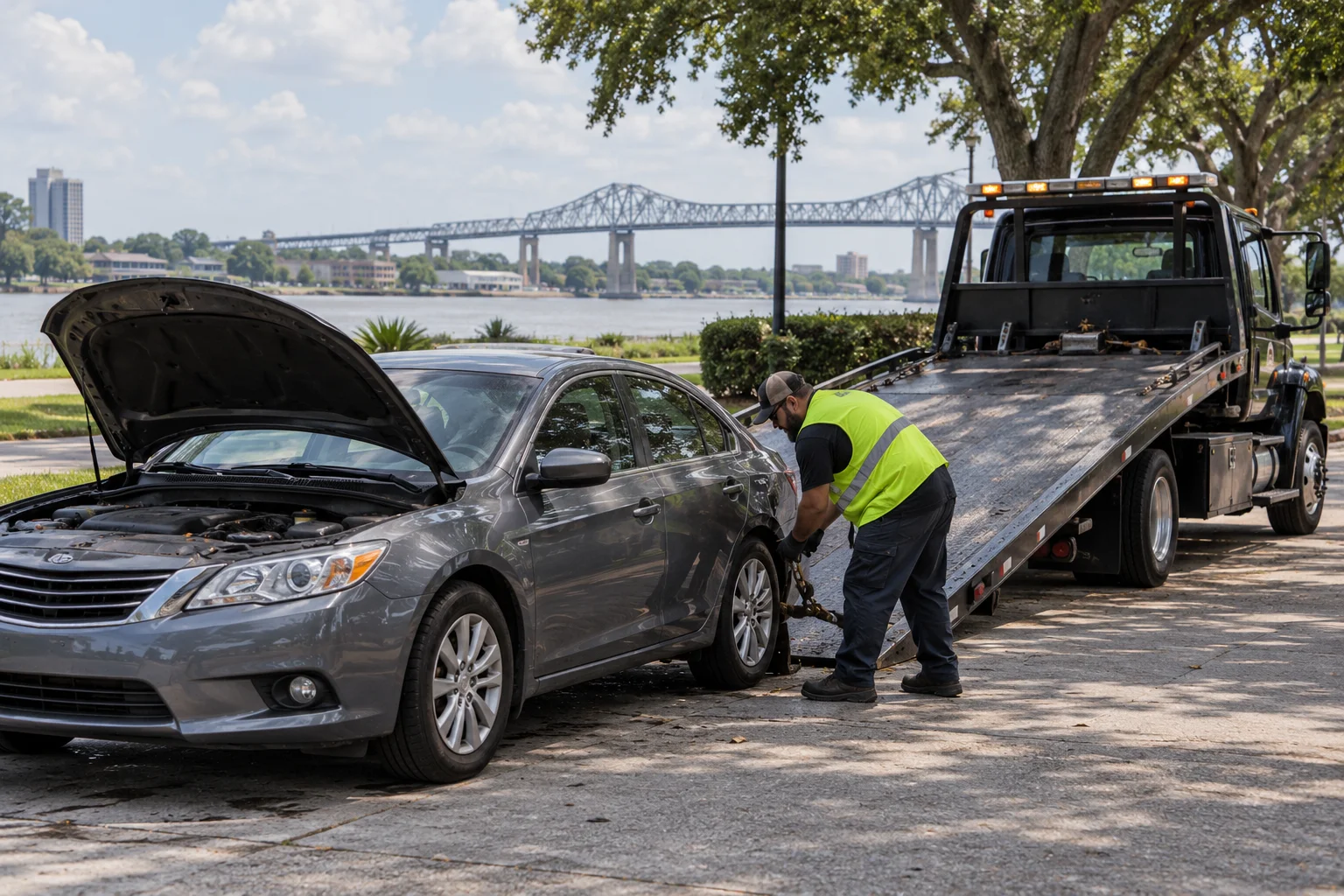
A car breakdown in River Ridge, LA, starts with one decision: describe exactly where the disabled car is. Your location, the car’s condition, and its intended destination help determine whether you need roadside help or a licensed towing operator.
When you call, report whether the car is in an active lane or creating an immediate traffic danger.
Start with your exact River Ridge location
“River Ridge” isn’t enough for an operator to find the right entrance. Start with the road name, your direction of travel, and the nearest visible landmark. Say whether you’re on Airline Drive, Jefferson Highway, Little Farms Avenue, or a smaller residential street.
Then describe where the car actually stopped. Useful details include:
- A marked parking space or loading area
- A business entrance or side lot
- A residential driveway
- A travel lane or narrow shoulder
- A gated property or apartment parking area
- A spot behind a building rather than along the street
Don’t depend on a map pin alone. Phone maps sometimes place a pin at the center of a property. That can send an operator toward the wrong driveway. Read the nearby street name and explain which entrance reaches the car.
Include the car’s year, make, model, color, and drive type if known. Tell the operator whether it’s a sedan, pickup, van, motorcycle, or larger vehicle. Mention low ground clearance, modified suspension, locked steering, or a wheel that won’t roll.
Take a few photos before calling. Capture the car, the damaged area, and the available approach. A wider photo can show curbs, parked cars, gates, and tight turns. Those details help the matched operator decide what equipment may fit.
If the breakdown happened closer to a neighboring community, our guides for a car breakdown in Harahan and a car breakdown in Kenner offer more location-specific guidance.
Airline Drive and river roads need different landmarks
River Ridge calls can sound similar while involving very different pickup settings. A breakdown along Airline Drive needs road-facing landmarks. A disabled car closer to Jefferson Highway or River Road may require a property entrance, cross street, or riverside reference.
On Airline Drive, report your direction of travel and the side of the road. Name the business or property nearest the car, but confirm what the sign actually says. If you passed an entrance before stopping, explain that too. An operator may need a different driveway to approach safely.
Near Jefferson Highway, Little Farms Avenue, or the river side of River Ridge, describe the final turn. Street addresses can cover deep lots or buildings with several access points. Say whether the car is in front, behind, or beside the building.
Don’t say you’re “near Kenner” or “toward Harahan” without another landmark. Those descriptions cover too much ground. A road name, travel direction, and property entrance are more useful.
If your planned route involves I-10, check 511 Louisiana for current incidents, closures, and traffic conditions. That information can help you choose a destination before the tow begins. Don’t assume a nearby incident explains your delay unless the official map shows it.
Louisiana DOTD’s Motorist Assistance Patrol provides minor help on covered routes during its fixed patrol schedule. It isn’t a call-out towing service, and River Ridge streets aren’t a substitute for its published highway coverage.
Decide whether roadside help may fit
Not every breakdown requires a tow. The first step is separating a minor roadside problem from a mechanical condition that makes driving unsafe.
A dead battery, flat tire, lockout, or empty fuel tank may fit roadside assistance. Tell the operator what happened before the car stopped. Dashboard warnings, unusual noises, smoke, fluid leaks, and steering changes all matter.
A jump-start may fit when the engine won’t crank and the rest of the car appears normal. It may not solve a failing charging system. If the car starts but warning lights remain, discuss that condition before driving away.
A flat tire may be manageable when there’s a usable spare and the car is on stable ground. Report missing wheel-lock keys, damaged lug nuts, multiple flat tires, or visible suspension damage. Tell the operator if the car is beside moving traffic or on unstable ground.
Report whether the car overheated, lost steering, won’t shift, has visible axle damage, or leaks fluid. Also mention when a wheel won’t turn or the car can’t be loaded normally. Describe the symptoms without diagnosing the cause. “The front-right wheel points inward” is more useful than guessing that the axle broke.
Describe any smoke or leaking fuel, and say whether fire, injury, or an immediate traffic danger is present.
For a disabled vehicle that can’t be made roadworthy where it sits, emergency towing can connect the situation with the proper towing service.
Choose an East Bank destination before the car moves
Know where the car should go before the operator loads it. That avoids making a rushed decision after the vehicle is secured.
Your destination might be a repair shop, dealership, tire shop, home driveway, or another legal parking location. Confirm that the destination accepts the vehicle and can receive it under the conditions you expect. Don’t assume a closed business allows vehicles to be left outside.
River Ridge drivers often consider destinations in River Ridge, Harahan, Kenner, or elsewhere on the East Bank. The closest place isn’t automatically the right place. A specialist may be better suited for transmission trouble, collision damage, electrical faults, or a vehicle still under a manufacturer program.
Give the destination’s full street address. Add the business name and the entrance the operator should use. If the drop-off area has a gate, low clearance, tight driveway, or limited space, mention that before movement begins.
Ask the destination how keys should be handled. Some facilities use a secure drop box. Others require direct check-in. Don’t leave keys in an unconfirmed location or assume the tow operator can choose one for you.
If you haven’t selected a shop, ask whether the vehicle can remain legally where it stopped while you call nearby facilities. That depends on the specific property and safety conditions. Quick Tow New Orleans doesn’t run a storage yard, and the independent operator sets any available destination or storage options.
Remove medication, identification, electronics, and other essentials before the car leaves, when it’s safe and permitted. Check the cabin and trunk so nothing important travels unintentionally.
What to confirm with the matched operator
Quick Tow New Orleans is a referral service. We take the call and match drivers with independent, licensed local tow and roadside operators. The matched operator performs the work, sets the price, and receives payment directly.
Before agreeing to service, confirm the operator’s name and the service being provided. Describe the vehicle again, including drive type and visible damage. Ask whether the reported condition changes the loading method or equipment needed.
Confirm these points directly with the operator:
- The pickup location and best entrance
- The intended drop-off address
- The service requested
- How the vehicle will be loaded
- The operator’s price and accepted payment methods
- Any conditions that could change the charge
- How keys will be transferred
- Whether you need to remain with the car
Ask for the charge structure before authorizing work. Quick Tow doesn’t set operator prices or collect the operator’s payment. If the situation changes after inspection, ask the operator to explain the change before continuing.
Photograph the car’s exterior and visible damage. Keep personal items and documents with you. If someone else will meet the operator, provide that person’s name and confirm that arrangement directly.
Calls to our line are recorded after a recording notice. The line takes calls around the clock, including holidays. A call may route to the independent operator covering the area, and a message can be recorded and transcribed for return contact.
Clear reporting matters more than a technical diagnosis. Give the operator observable facts, a precise location, and a confirmed destination.
When to call us
Call when your River Ridge vehicle can’t be driven safely or roadside help won’t solve the problem. The line takes calls 24/7 for matching with independent towing and roadside operators. Call us at (504) 474-5530 and we’ll connect you with a licensed local operator.