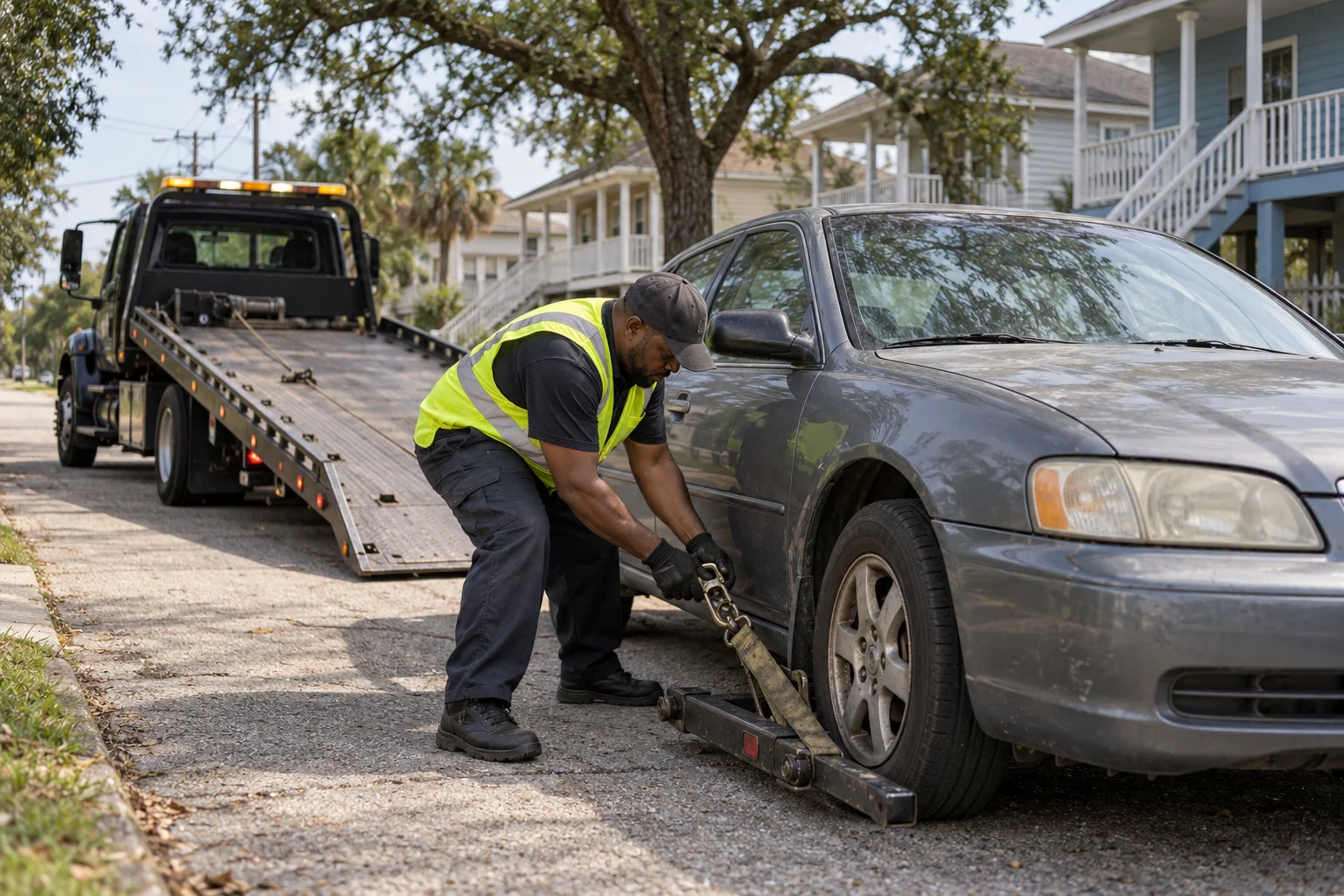
A stalled car in the Lower Ninth Ward needs a precise location report. Tell the operator where the car sits, what failed, and where it should go. Those details matter near the Industrial Canal and the St. Bernard Parish line.
Start with the exact block and vehicle condition
Begin with the street name, nearest cross street, and exact block. A dropped map pin helps, but don’t rely on it alone. Read the location aloud and check that the pin matches the car.
Say whether you’re on St. Claude Avenue, North Claiborne Avenue, or a neighborhood street. Include your side of the street and the direction the car faces. Mention a nearby building, business, or intersection only when you can identify it clearly.
Next, describe the vehicle. Give its year, make, model, color, and body style. Tell the operator whether it’s a sedan, pickup, van, motorcycle, or larger vehicle. Mention any trailer attached to it.
Report the car’s actual condition, not just that it won’t move. Useful details include:
- The engine starts but the car won’t move.
- The engine cranks but doesn’t start.
- A tire is flat, missing, or damaged.
- The steering or suspension looks damaged.
- The car won’t shift into neutral.
- One or more wheels appear locked.
- The vehicle left the pavement.
- Fluids are leaking beneath it.
- The keys are unavailable or locked inside.
If the car was hit, say where the damage appears. Airbag deployment, broken glass, bent wheels, and loose body panels can change how an operator approaches the vehicle. For collision damage, request emergency towing help instead of trying to move the car yourself.
Don’t guess at the mechanical failure. Describe what you saw, heard, or smelled. That gives the matched operator better information without turning a roadside observation into a diagnosis.
St. Claude Avenue and neighborhood streets need different details
“Near St. Claude” doesn’t narrow the location enough. St. Claude Avenue continues toward Arabi, while the Industrial Canal separates the Lower Ninth Ward from neighborhoods farther west. Tell the operator whether you’re in the Lower Ninth Ward, near the canal, or closer to the St. Bernard Parish line.
North Claiborne Avenue also needs a cross street or block. The route name alone can leave too much room for error. If you turned from a larger road before stopping, explain that approach in one short sentence.
A neighborhood street requires different information. Report whether the car is along the curb, in a driveway, or blocking access. Mention nearby parked vehicles, a narrow entrance, a low branch, or another visible obstacle. Don’t promise that there’s enough room for towing equipment. Let the operator assess that from your description and photos.
Send clear photos when requested. Start with one wide image showing the car and street. Then photograph the damaged wheel, leaking area, or blocked side. Avoid close-ups that hide the vehicle’s surroundings.
If you’re beside moving traffic, focus on personal safety first. Don’t stand between vehicles or step into a travel lane for a better photo. Share only what you can gather safely.
Before choosing a route away from the neighborhood, check Louisiana’s official traffic map for reported incidents and closures. Current conditions may affect which destination makes sense, but the matched operator decides how the vehicle can be moved safely.
Decide whether roadside help may fit
Not every disabled car needs towing. The symptoms help determine whether roadside assistance may fit or whether the vehicle needs transport.
A usable spare tire, an accessible battery, or an empty fuel tank may point toward roadside service. Tell the operator what supplies are already with the car. For a flat tire, report whether you have a spare and whether the wheel appears damaged. For a battery problem, say whether the lights work and whether the engine clicks or cranks.
Report collision damage, steering trouble, a broken axle, locked wheels, or a serious fluid leak to the operator. The operator can assess whether the vehicle needs towing. It may also be needed when a roadside attempt doesn’t restore normal operation. Don’t continue driving a car that you believe is unsafe.
Standing water changes the decision. Don’t enter moving floodwater or drive around a barricade. If water reached the car, report where it reached and whether the engine was running. Our guide to what to do when your car floods in New Orleans covers the next decisions.
Tell the operator if the vehicle sits on soft ground, against a curb, or partly off the pavement. That may be a recovery situation rather than a standard roadside stop.
Quick Tow New Orleans matches callers with independent, licensed local operators. The line takes calls 24/7. The matched operator determines whether roadside service or towing fits the vehicle’s condition.
Choose an Orleans or St. Bernard destination
Choose the destination before the operator moves the car. From the Lower Ninth Ward, that may mean a repair shop elsewhere in Orleans Parish or a destination toward nearby Arabi in St. Bernard Parish.
Call the shop before naming it as the destination. Confirm that it accepts the vehicle, handles the suspected problem, and has a place for an after-hours drop. Don’t assume an open parking lot means the business allows unattended vehicles.
Give the full business name and street address. A shop name without an address can cause confusion when businesses have similar names. If someone will meet the operator, share that person’s name with the operator directly.
The closest shop isn’t always the right shop. A damaged tire may need a tire store. Collision damage may require a body shop or secure storage arranged by the owner or insurer. A drivetrain problem may need a repair facility familiar with that vehicle.
If the breakdown follows a collision near the parish boundary, our guide to accident towing in Arabi explains what to gather before choosing a destination. Don’t let the nearby parish line replace the actual location. State which side of the line the vehicle occupies and where it needs to go.
If you haven’t selected a shop, say so during the call. The operator may explain available destination options, but you should confirm acceptance with the receiving property. Quick Tow doesn’t own a yard, select a repair shop, or collect the operator’s payment.
What to confirm with the matched operator
Repeat the pickup location and destination before ending the call. Confirm the street, cross street, vehicle description, and a reliable way to identify the car. Correct a misplaced map pin before the operator starts the trip.
Tell the operator about anything that affects access or loading. That includes locked wheels, missing keys, low clearance, collision damage, a trailer, or a car that won’t shift into neutral. Mention modifications such as lowered suspension when they’re relevant.
Confirm these points directly with the independent operator:
- Whether the reported vehicle condition matches the requested service.
- Whether the operator needs additional photos.
- Whether the owner must remain with the vehicle.
- What identification or ownership documents may be requested.
- Where the keys will be handed over.
- How the receiving shop will accept the vehicle.
- What charges and payment methods the operator applies.
- Who to contact if the pickup or destination changes.
Any price, payment term, or service condition comes from the operator. Quick Tow doesn’t set operator prices or warrant an operator’s work. The caller contracts with and pays the operator directly.
Keep your phone available after the match. If you move to a safer nearby place, tell the operator where you are. Don’t relocate the vehicle or change the destination without sharing the update.
A clear report prevents the Lower Ninth Ward location from becoming a vague “near St. Claude” request. The exact block, vehicle condition, access details, and chosen destination give the licensed operator the information needed to assess the job.
When to call us
Call when the car can’t move safely, has collision damage, or needs transport from the Lower Ninth Ward. Call us at (504) 474-5530 and we’ll connect you with a licensed local operator.