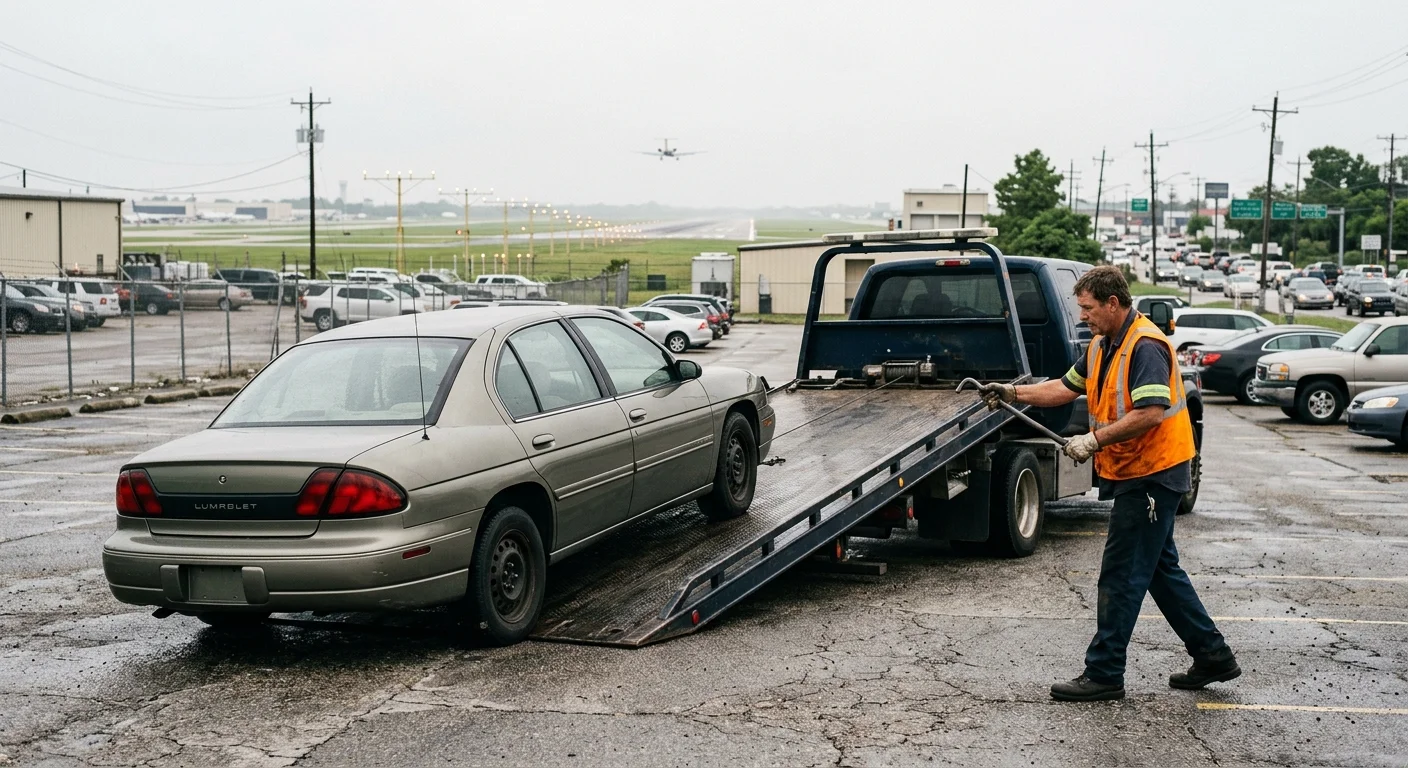
A dead car at Louis Armstrong New Orleans International Airport is a Kenner problem, not a generic airport one. The garage, the economy lot, Loyola Drive, and the I-10 ramps all need different facts before anyone can match you with a licensed operator. Report the place, the posted signs, and how the vehicle sits, then pick a real destination in Kenner or the rest of the metro.
Start with your exact airport-area location
MSY sits in Kenner, in Jefferson Parish, west of Metairie. “I’m at the airport” is not a location. A licensed operator covering Airline Highway is not automatically the one who can work a stall on an upper garage deck. Say Kenner first. Then say whether you are on airport property, on a city street, or on the interstate.
Name the surface you are on. A parking garage, a surface lot, a terminal-side curb, an access road, Veterans Boulevard, Airline Highway, Loyola Drive, and I-10 are different jobs. If you can see a named ramp or a lot letter on a sign, read it out. If you cannot, describe what you can see: a garage entrance, a fence line, a shuttle stop, an overpass, the direction of traffic.
Inside a garage or lot, add the level, the row, and the space number. Photograph the nearest painted column and the overhead clearance sign. Those two shots tell an operator more than a dropped pin, which often lands on the terminal roof. If a passenger can walk to the garage entrance and read the posted name of the facility, have them do that while you stay with the car.
On a public road, add direction of travel and the nearest exit or cross street. I-10 through Kenner is not the same call as a stall on a quiet Kenner side street. If you are in a travel lane, say so. If you made it to a shoulder, a gore, or a parking stall, say that too.
If you are on I-10 itself, Louisiana’s Motorist Assistance Patrol may already be working that stretch. MAP is a fixed-schedule patrol, not a call-out service. It can move a disabled vehicle out of a travel lane and offer minor help such as a jump, a gallon of fuel, or a tire change. It does not tow the car to a Kenner shop. For live closures and incidents, check 511la.org or dial 511. If you are in danger, call 911.
Quick Tow New Orleans takes the call and matches you with an independent licensed operator. We do not run the airport, and we do not own the trucks. The more precise the Kenner pin, the cleaner the match.
A garage and an access road need different details
A garage stall and a breakdown on an airport access road are not the same report. Mix them up and the matched operator shows up with the wrong picture of the job.
In a garage, start with access, not the mechanical problem. Read the posted clearance at the entrance and on your level, and say that number out loud. Say whether the car is in a marked stall, in the aisle, or on a ramp. Say whether it rolls, whether it will go into neutral, and whether a low spoiler, air dam, or AWD system is in play. Tight decks, steep ramps, and concrete columns change how a truck has to set up. That is why flatbed versus wheel-lift is a real choice here, not a catalog line.
We cannot confirm MSY garage rules, escort rules, height limits, or which decks a wrecker may enter. Those are the facility’s rules, and they change. Ask the garage attendant, the parking office, or airport operations on the posted number in the lot. If no one is at a booth, look for a posted after-hours contact on the entrance sign. Do not guess. A wrong guess wastes the operator’s setup and can leave your car sitting.
On an access road, the report is about traffic and room to work. Say which way you were heading, whether you are fully out of the lane, and what is behind you: a curve, a merge, a fence, a ditch, standing water. Kenner summer storms load these low approaches fast. If water is already at the rocker panels, say that before anyone talks about a simple hookup.
A surface lot sits between those two. You still need the lot name if a sign shows one, the row, and whether a gate arm, ticket spit, or booth sits between the street and the car. Gated lots are a property-access problem first. The operator cannot invent a way through a closed arm.
If a lot already tagged the car or had it hauled without you asking, stop and treat that as an impound question. That is not the same as you calling for a tow truck near New Orleans airport. For a City of New Orleans pound, start with nola.gov’s Find My Towed Vehicle page and (504) 658-8100. MSY is in Kenner, so do not assume an Orleans Parish lot holds the car. Ask the facility that ordered the tow where it went, and confirm the yard before you drive.
Report the vehicle’s condition before choosing a service
Location gets the truck to Kenner. Condition decides whether you need a jump, a tire change, a short hook, or a full recovery. Say what failed, what still works, and what you already tried.
A click-no-start with lights that still come on is a different call from a car that will not roll. A flat you can see, an overheat with steam, a CV axle on the ground, and a car that died after a curb strike are not interchangeable. If airbags deployed, or the car will not sit on all four wheels, say that up front. If it is a low sports car, an EV, or it will not shift to neutral, say that too. Those details decide equipment. They are not extra color.
Do not stand in a live lane to inspect the underside. From a safe spot, report: engine running or not, gears you can select, whether the wheels turn, fluid on the ground, and whether the steering lock is on. If you have a spare and a working jack but no room to use them in a packed garage, say the space is too tight. That is useful. Trying to wrench in a stall with shuttle buses behind you is not.
From there, the match is usually roadside assistance or emergency towing. Roadside is the right first ask when the car might leave under its own power after a jump, fuel, lockout, or spare tire. Towing is the right ask when it will not roll safely, the repair is not happening in that stall, or you need it moved off airport property. The operator who takes the job makes the final equipment call after hearing the condition. You are not expected to spec the truck.
If you already know it has to ride, say the reason in one line: “dead automatic, will not go to neutral, level three of the garage, posted clearance on the sign is X.” That sentence does more than a five-minute story. Keep kids and luggage with you, not in the aisle. If you must catch a flight, say your remaining time as a scheduling fact for you, not as a demand the operator can promise to meet. No one here can publish an arrival window.
The same report helps if you later move the conversation to a Metairie shop or a Kenner driveway. Condition travels with the car. Location is only the start.
Choose a Kenner or metro destination
A breakdown at MSY does not decide where the car spends the night. You do. Tell the matched operator the drop point before the truck is loaded, and keep it specific.
Common Kenner and metro drops are a home driveway in Kenner, a repair shop on Veterans Boulevard in Metairie, a body shop farther east, a rental return, or a hotel lot. “Anywhere close” is not a destination. Name the street and the kind of place. If the shop has a night drop and a key slot, say you have that arranged. If you need the car at a house with a tight driveway or a low oak, say that, because the unload is part of the job.
Kenner and Metairie sit next to each other, but they are not the same corridor. A car leaving the airport for a Veterans Boulevard shop is a short Jefferson Parish run. A car headed to the East Bank of Orleans Parish, the Westbank, or the North Shore is a different distance and a different operator coverage question. If you live in Metairie and you are only at MSY because of a flight, read what to report for a Metairie breakdown as well. The destination side of the call is often that Metairie address, not the garage.
Do not send the car to a City of New Orleans pound unless that is actually where it was taken. The Claiborne Avenue release lot is an Orleans Parish city facility. A breakdown you called in from Kenner is a consented job with the operator you were matched to, and the car should go where you said.
If insurance or a motor club is involved, call them first if that is how your policy works. Louisiana does not require towing coverage. Only liability is compulsory. Whether a tow bill is covered is your policy’s optional roadside or towing endorsement, not a state rule. We do not bill your carrier for you, and we do not set the operator’s price.
Have a second drop in mind if the first gate is closed. A Kenner house with a locked HOA arm at midnight is a real stop. A 24-hour shop lot, if the shop has told you it will take the car, is a cleaner unload than guessing at a dark lot.
Confirm property access with the matched operator
Matching you with a licensed local operator does not open an airport gate. Someone still has to confirm the truck can reach the car.
Stay on the line with the facts you already gathered: facility name, level, space, posted clearance, gate or booth, and whether you can meet the truck at the entrance. Then ask the facility the question we cannot answer for you. May a wrecker enter this garage or lot, on this level, at this hour, and is an escort required. If the answer is no, ask where the car may be moved to so a truck can hook it on a public or approved pad. If the answer is yes, ask which entrance to use and whether a ticket or code is needed to exit with the car on the truck.
We have not confirmed MSY’s current access rules, after-hours contacts, or which lots allow wreckers. Treat any number you hear on a blog as stale. The posted sign in front of you, or a person at the facility, is the authority. If you cannot reach anyone, say that in the call so the operator knows the job may stall at a gate.
Airport property, hotel lots along Veterans, and rental-car return yards are all private or controlled parking. A tow you request for your own car is a consented tow. That is different from a lot having the car hauled under Louisiana’s private-property towing rules in R.S. 32:1736. Those rules govern non-consensual removals, signage, and tagging. They do not replace the need for permission when you asked for the truck.
If the operator looks at the deck, the clearance, or the stall and says the car has to be winched to a wider aisle first, that is a setup decision on scene. You can ask what they need from you: keys, steering unlocked, passenger loading, luggage out of the way. You should not try to drag or roll the car into a better spot yourself in a live aisle.
Once access is clear, keep the destination you already chose. Kenner, Metairie, or farther, the hook is only half the job. The line takes calls 24/7, including holidays, and your call routes to the operator covering that zone. Calls to this line are recorded, and you will hear a notice before recording starts.
When to call us
Call when the car will not leave MSY or a Kenner access road under its own power, or when roadside help is not enough and you need it moved to a shop, a driveway, or another metro address. Call us at (504) 474-5530 and we’ll connect you with a licensed local operator.