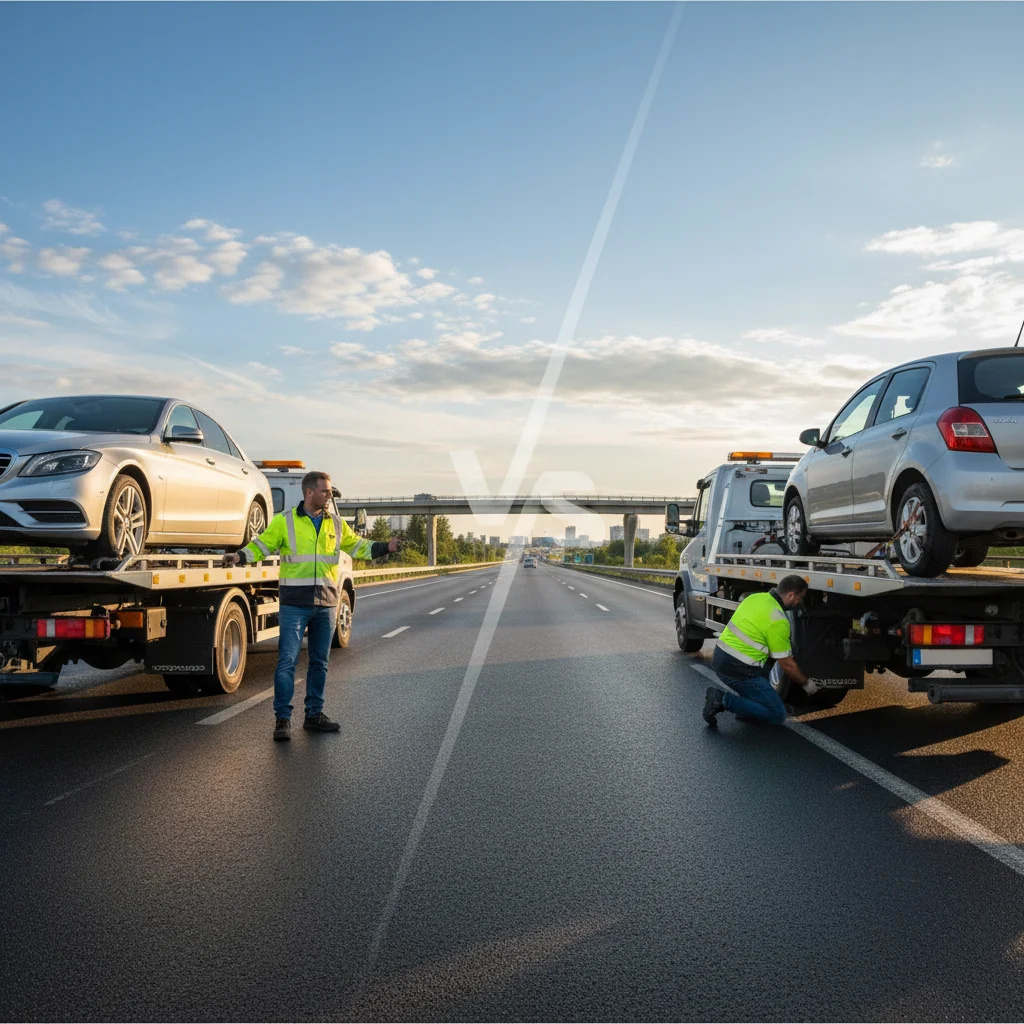
| Situation | Usual method | | AWD, EV, low clearance, or damaged wheels | Flatbed | | Accessible 2WD that rolls | Wheel-lift may be possible |
For a car tight against a curb, see wheel-lift on a parallel-parked car. Follow the owner manual for EVs. Tesla Model 3 is not a rule for every EV.
The right choice depends on the car, its condition, and the pickup location. Check the owner’s manual before approving a towing method.
How each towing method carries the car
A flatbed has a long deck behind the truck cab. The deck tilts or slides toward the pavement. The operator then loads the vehicle onto it and secures the wheels for transport.
Once loaded, the car’s tires don’t roll on the road. This makes flatbed towing a common choice when a vehicle shouldn’t travel on its own wheels. It also gives the operator one platform for moving cars with special towing instructions.
A wheel-lift truck uses a metal assembly near its rear bumper. Adjustable cradles support the tires on one axle. That end rises off the pavement while the opposite wheels remain down.
Some operators can add towing dollies beneath the second axle. Dollies keep those wheels off the road, but they aren’t available on every truck. They also add setup requirements that depend on the vehicle and location.
The basic difference looks like this:
| Towing method | Wheels carried off the road | Main consideration |
|---|---|---|
| Flatbed | All four | The truck needs room to position and load |
| Wheel lift | Two without dollies | The rolling axle must be suitable for road contact |
| Wheel lift with dollies | All four | Equipment and working space must be confirmed |
Neither method is automatically right for every disabled car. A wheel lift may suit a straightforward move when the manufacturer allows it. A flatbed may fit a vehicle whose wheels or drivetrain can’t roll safely during transport.
The matched operator should confirm the setup before loading begins. That decision needs the vehicle details, visible damage, and manufacturer instructions.
Drivetrain and wheel condition change the choice
Start with the drivetrain listed in the owner’s manual. Front-wheel drive, rear-wheel drive, all-wheel drive, and four-wheel drive systems don’t all have the same towing instructions. The transmission design and model year can matter too.
Some front-wheel-drive vehicles may allow the front axle to be lifted. The rear wheels then roll, if the manual permits that method. A rear-wheel-drive model may need a different orientation or another setup.
Some all-wheel-drive and four-wheel-drive manuals require every wheel to remain off the pavement. Other models have specific procedures for short movements or emergency loading. Don’t treat an AWD badge as the complete answer.
Electric vehicles and hybrids also need model-specific handling. Their parking systems, drive units, and low-voltage power can affect loading. Our guide to towing a Tesla explains that narrower situation, but those instructions shouldn’t be applied to every electric car.
Wheel condition matters just as much as drivetrain. Tell the operator if a tire is flat, a wheel is bent, or a suspension corner looks displaced. Also report whether the steering moves and whether the car can shift into neutral.
A basic wheel lift depends on the two road-facing wheels turning normally. A flatbed keeps them off the road during transport, but the car may still need to move during loading. Operators may use skates or other loading equipment when a wheel won’t roll.
Collision damage can change the job again. A wheel tucked under the body isn’t the same as a routine breakdown. The operator may need recovery equipment before either towing method can carry the vehicle.
Use the owner’s manual as the model-specific authority. If you can’t find the printed copy, look for the manufacturer’s official digital manual.
Ground clearance can rule out one setup
Flatbeds solve many wheel and drivetrain concerns, but loading creates an angle. The car must move from the pavement onto the tilted deck. A low bumper, front splitter, side skirt, or modified suspension may reduce the available clearance.
That doesn’t mean every low car needs a wheel lift. It means the operator needs accurate details before choosing equipment. Ramp extensions, blocks, or another loading arrangement may help, depending on the truck and site.
A wheel lift avoids driving the whole car up a deck. Its lifting hardware still needs suitable access to the tires. A low nose, damaged body panel, or tight wheel opening can complicate that setup.
The ground beneath the car matters too. A vehicle sitting against a tall curb creates a different approach than one centered in a flat lot. A soft shoulder, steep driveway, parking stop, or raised median can limit where the truck sits.
New Orleans adds familiar clearance problems. Uneven pavement and steep garage transitions can leave little room beneath a low vehicle. Standing water may also hide pavement edges or damage around the tires. Report those conditions instead of assuming they won’t affect loading.
Photos help the operator assess the visible space. Take wide views from the front, rear, and both sides. Include the curb, ramp, columns, or nearby parked cars. Don’t crawl beneath a disabled vehicle for a better angle.
Mention aftermarket changes when you call. Lowered suspension, oversized wheels, a body kit, or an extended hitch can alter the setup. The year, make, and model alone won’t reveal those changes.
Tight streets and garages add another constraint
The right towing method must fit the pickup site. A truck that can carry the car correctly still needs room to reach it, align, and leave.
Downtown New Orleans garages can have low ceilings, narrow ramps, sharp turns, and closely spaced columns. A flatbed also needs space behind it to position its deck. Those constraints may prevent loading where the car stopped.
A wheel-lift truck may fit some confined spaces more easily. An operator might use it to move a car from a garage to a suitable loading point. Whether that works depends on the vehicle’s manual, wheel condition, and available equipment.
Give the garage name and exact level when possible. Report the posted height clearance without guessing. Tell the operator whether the car is nose-in, backed into a space, or trapped beside a wall. Mention access gates, hanging pipes, steep ramps, and tight exit turns.
Narrow Uptown streets create different problems. Parked cars, live oaks, curb cuts, and limited turning space can restrict the truck’s approach. A breakdown near the St. Charles Avenue streetcar corridor isn’t the same as one in an open Metairie parking lot.
The same principle applies near busy approaches to I-10 and US-90 Business. Tell the matcher whether the car is inside a garage, beside a curb, or near moving traffic. 511 Louisiana publishes current incident and closure information when highway conditions affect access.
Our wheel-lift towing service page explains where that equipment may fit. Still, the vehicle’s towing instructions come first. A smaller access footprint doesn’t override a manufacturer’s requirement to carry all four wheels.
What to report before an operator is matched
Good details prevent the wrong truck from being sent for the job. Start with the vehicle’s year, make, model, and trim. State whether it’s front-wheel drive, rear-wheel drive, all-wheel drive, or four-wheel drive if you know.
Then describe why it can’t move. A dead battery differs from collision damage. A flat tire differs from a wheel that has separated from the suspension. Don’t diagnose the mechanical failure. Describe what you can see and what happened immediately before the car stopped.
Report the following details:
- Whether the engine or electrical system turns on
- Whether the transmission shifts into neutral
- Whether the steering wheel turns
- Whether the parking brake releases
- Which tires are flat, damaged, or blocked
- Any visible suspension, bumper, or underbody damage
- Whether keys or a working key fob are available
- The pickup location and intended destination
- Any posted garage height or vehicle-size restriction
Location details matter across the New Orleans metro. Include the parish, street, nearest cross street, and garage level. A pickup in an Uptown curb lane needs different access planning than a surface lot in Kenner. A West Bank parking structure may add another set of height and ramp constraints.
Say whether the vehicle faces a wall, sits between columns, or is blocked by other cars. Tell us about locked gates or access rules. If flooding, mud, or collision debris surrounds the car, report that before the match is made.
Photos of the vehicle and its surroundings can clarify the request. Include all four corners, the damaged wheels, and the truck’s likely approach. Keep the images focused on visible conditions.
You don’t need to choose the equipment alone. Quick Tow New Orleans matches drivers with independent, licensed local operators. The operator can review the vehicle details and confirm the towing method against the owner’s manual.
When to call us
A licensed towing pro should handle the job when wheels won’t roll, the manual requires a specific method, or access is tight. The line takes calls 24/7. Call (504) 474-5530. We match you with a licensed local operator who quotes before the truck rolls.