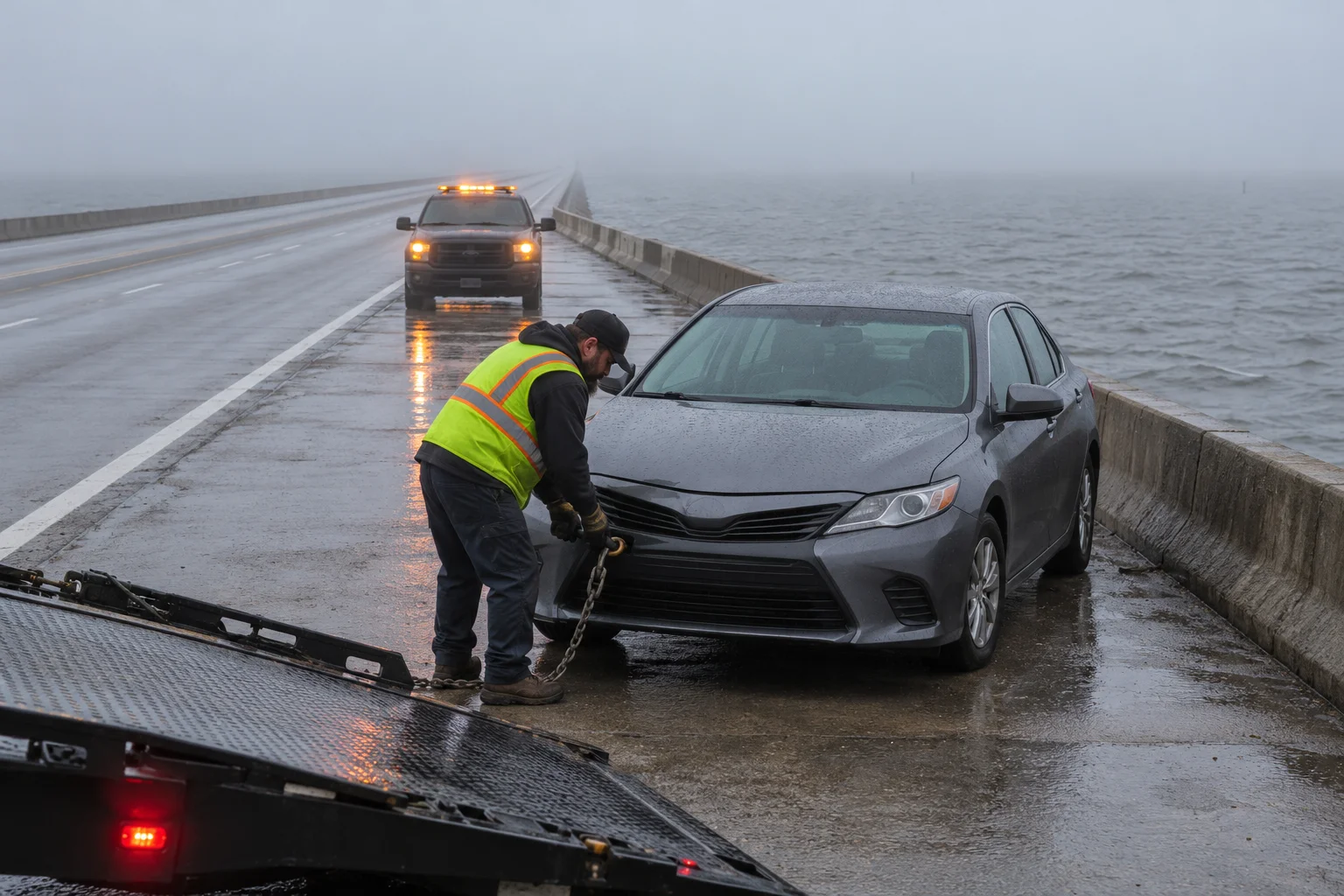
A breakdown in Causeway fog starts with Causeway Police, not a towing company. Call *27 or (504) 835-3116, report where you are, and follow the officer’s directions before arranging roadside help or a tow.
That order matters when low visibility changes traffic flow. Causeway Police control bridge restrictions and can coordinate the safest next step.
Fog on the Causeway is a different problem than a normal breakdown
The Greater New Orleans Expressway Commission identifies roughly October through March as Causeway fog season. During that period, visibility can lead Causeway Police to restrict lanes or place traffic behind a rolling convoy.
A ranking police officer remains on duty and checks visibility before restrictions are authorized. Under single-lane restrictions, the left lane closes to ordinary traffic. It remains available for vehicles that break down and can’t reach a Crossover or Safety Bay.
Rolling-convoy restrictions work differently. An emergency vehicle leads traffic at a controlled pace. Drivers can’t pass or change lanes within that controlled movement. A disabled car can therefore affect more than its driver.
The Causeway’s published fog procedure says not to stop in the open right lane during single-lane restrictions. If the car can still move safely, try to reach a Crossover or Safety Bay. Crossovers are spaced roughly every 3.5 miles, with a Safety Bay halfway between each pair.
If the car can’t reach either refuge, the published procedure directs drivers into the closed lane against the railing. Move safely behind the vehicle, flag approaching traffic, and call Causeway Police. Follow any instructions officers give once contact is made.
Don’t assume these restrictions are active merely because fog is present. Police determine the current operating procedure from observed visibility. The Greater New Orleans Expressway Commission publishes Causeway information, but conditions can change while you’re already crossing.
For ordinary breakdown guidance outside this fog-specific situation, read our I-10 and Causeway breakdown walkthrough.
Who patrols the bridge, and why that call comes first
The Causeway Police Department patrols the Lake Pontchartrain Causeway around the clock. It operates under the Greater New Orleans Expressway Commission and handles stranded motorists on the bridge.
That makes Causeway Police the first call after a breakdown. Dial *27 or (504) 835-3116. If you can’t confirm a current fog rule or traffic restriction, ask the officer directly. Don’t rely on an old screenshot, social post, or memory from another crossing.
A towing referral line can help locate a licensed operator. It doesn’t control Causeway traffic, open a closed lane, or replace police direction. Quick Tow New Orleans owns no patrol vehicles or tow trucks. We match drivers with independent, licensed local operators.
The police call should establish what’s happening around your vehicle. Tell the officer whether you’re still moving, stopped in a refuge area, or unable to leave a travel lane. Mention smoke, leaking fluid, collision damage, or anyone who may be hurt.
Causeway Police may give instructions based on restrictions in effect at that moment. Follow those directions before calling for ordinary roadside service. A service choice that makes sense in clear weather may interfere with controlled bridge traffic during fog.
Drivers can also check Louisiana 511 for official traffic, incident, weather, camera, and closure information. It’s useful context, but it doesn’t replace reporting your disabled vehicle to Causeway Police.
Report direction, location and vehicle condition
A clear location report helps distinguish your car from other lights in the fog. Start with your direction of travel, northbound toward Mandeville or southbound toward Metairie.
Next, describe the safest confirmed location you can see. Say whether you reached a Crossover, entered a Safety Bay, or stopped in the closed lane under the published fog procedure. Give any visible marker exactly as shown. Don’t guess a marker number.
Tell police whether the vehicle can roll, steer, and brake. Those details affect whether it can move under its own power or needs professional towing equipment. Report whether the engine runs and whether the transmission can shift into neutral.
Vehicle condition also matters. Mention a flat tire, dead battery, overheating, empty fuel tank, steering problem, damaged wheel, or fluid beneath the car. If there was a collision, say so immediately. Report injuries or a fire risk before discussing towing.
Then describe the vehicle itself. Give its color, body type, make, and model. Say whether it’s pulling a trailer or carrying an unusual load. Those details help identify the stopped vehicle and later help a matched operator assess equipment needs.
Keep the report short and factual. A useful sequence is:
- Direction of travel.
- Crossover, Safety Bay, closed lane, or another confirmed marker.
- Vehicle color, type, and condition.
- Whether the car can move, steer, brake, and shift.
- Any injury, smoke, leaking fluid, or collision damage.
Our guide to what to report when requesting roadside assistance covers the service details worth gathering. On the Causeway, police location and safety instructions still come first.
Roadside help and a tow are different requests
Not every disabled car needs to leave on a tow truck. Some problems may fit roadside assistance, while others require transportation by a licensed towing operator.
A roadside request may involve a flat tire, dead battery, or an empty fuel tank. Whether that work can happen at your location depends on the vehicle’s condition and Causeway Police instructions.
A tow is the clearer request when the car can’t roll safely, has steering damage, won’t hold a tire, or has collision damage. Overheating and mechanical failure can also require a tow when restarting would risk more damage. The operator should hear the symptoms before accepting the job.
DOTD’s Motorist Assistance Patrol is a separate public program. It provides minor free help and can move disabled vehicles from travel lanes along its covered routes. However, MAP is a fixed-schedule patrol, not a call-out service. Its published New Orleans coverage concerns named interstate and US highway segments, not a general promise of Causeway service.
That distinction prevents a common delay. Calling a public patrol program doesn’t automatically arrange transportation to a repair shop. Calling a towing referral service doesn’t replace the bridge authority’s control over a fog incident.
If the vehicle must leave the bridge, our emergency towing service can connect you with an independent, licensed local operator. The Quick Tow line takes calls 24/7. It doesn’t promise an arrival window, and the matched operator performs the physical work.
Use the right request from the start. Say “roadside help” only when you know the likely problem. Say “tow” when the vehicle can’t be made safely roadworthy where it sits.
What to confirm before a matched operator is sent
Police coordination comes first. Tell the referral line that you’ve contacted Causeway Police and repeat any instructions you received. If the officer specified a meeting point or movement plan, relay it without changing the wording.
Confirm the vehicle’s exact type. A compact sedan, pickup, motorcycle, SUV, and vehicle with a trailer can require different equipment. Report lowered suspension, locked wheels, collision damage, missing tires, or an inability to shift into neutral.
Next, confirm where the vehicle should go. You may choose a repair shop, dealership, home, or another lawful destination. Check whether that destination is open and prepared to receive the vehicle. Don’t assume a closed business has an accessible drop area.
Discuss payment and charges directly with the independent operator before service begins. Quick Tow doesn’t set operator prices or collect payment for the physical tow. Ask what service is being authorized, what equipment is expected, and which conditions could change the charge.
Don’t describe a fog breakdown as a routine parking-lot pickup. The operator needs to know that the vehicle is on the Lake Pontchartrain Causeway and that police are involved. Share your direction of travel and confirmed refuge location.
Keep your phone available after making the request. Conditions may change, and Causeway Police directions remain controlling while your vehicle is on the bridge.
Notify the referral line or matched operator if the vehicle’s condition or location changes. Clear updates help everyone work from the same information.
When to call us
Call after you’ve reported the Causeway fog breakdown to Causeway Police and confirmed that roadside help or towing is appropriate. The line takes calls 24/7, and Quick Tow will match you with an independent, licensed local operator.
Call us at (504) 474-5530 and we’ll connect you with a licensed local operator.