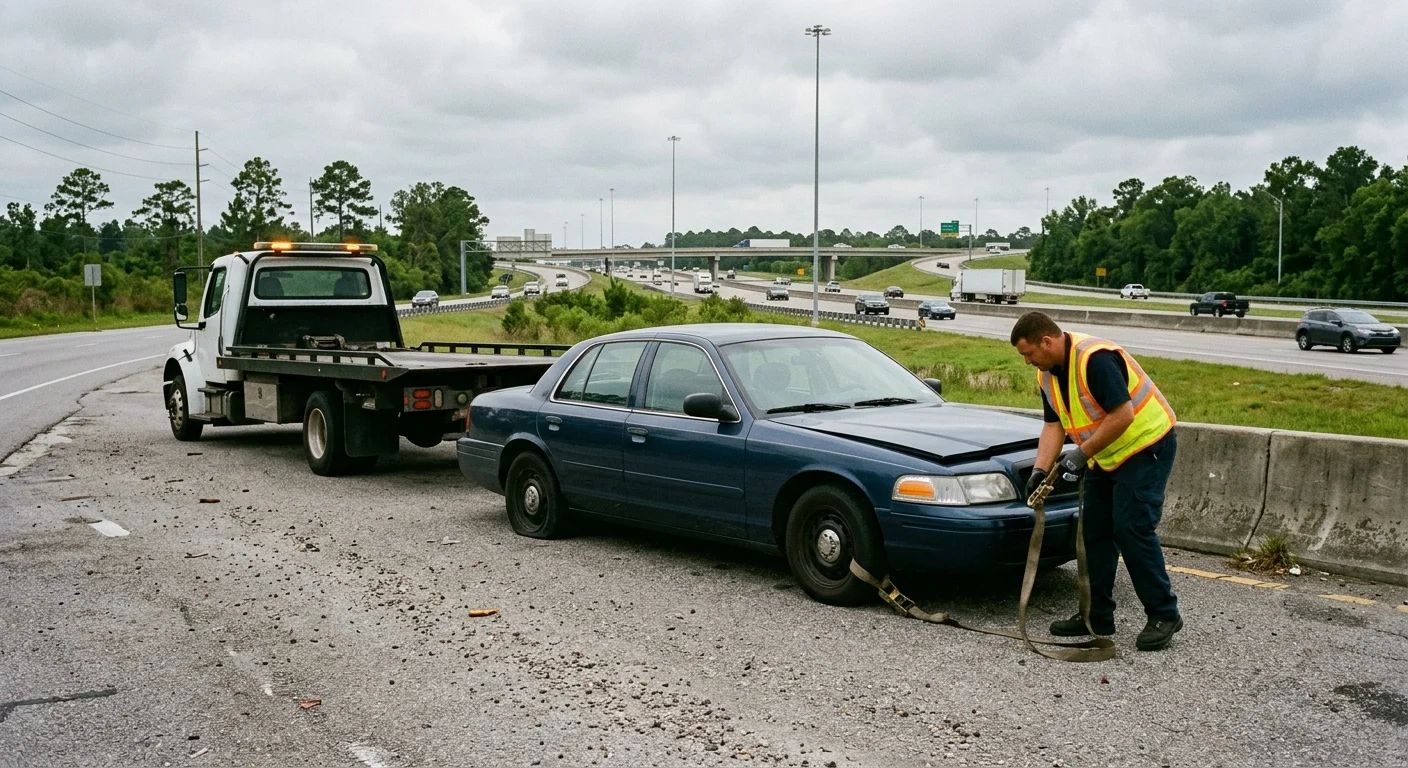
Slidell is in St. Tammany Parish, on I-10 and I-12. Use the Slidell city hub. Ask the same LPSC invoice questions we list in how to choose a licensed operator instead of repeating that checklist here.
Start with your exact Slidell location
Start by sharing more than “Slidell” with the operator. Send the road name, travel direction, and nearest visible exit or landmark. If your phone shows a map pin, share that too.
Direction matters on divided highways. “I’m on I-10” still leaves several possibilities. The operator needs to know whether you’re eastbound or westbound. Also explain whether you’re before an exit, beyond it, or near an interchange.
Describe where the vehicle has stopped. It could be on a shoulder, in a parking lot, beside a business, or blocking a travel lane. These details help the operator understand access and choose suitable equipment.
If the car is near the I-10 and I-12 connection, name both roads. Don’t rely on the word “interchange” alone. State which highway you were driving and which direction you intended to continue.
A street address helps, but it may not tell the whole story. Large parking areas can have several entrances. Tell the operator which side of the property you’re on. Mention any gate, low clearance, tight turn, or blocked entrance you can see.
Check 511 Louisiana for current incidents, closures, and traffic conditions. That official information can help explain why a normal access route isn’t available. It also gives you clearer details to share during the call.
Good location information prevents confusion before the towing request reaches an operator. It’s the first step in arranging a tow after a breakdown in Slidell.
I-10 and I-12 need different location details
I-10 and I-12 create different pickup situations around Slidell. I-10 may mean the westbound Twin Span approach or the eastbound side through Slidell. I-12 traffic meets I-10 near the city, so a vague location can point toward the wrong corridor.
On I-12, give the operator your direction and nearest exit. Say whether you’re still on I-12 or already entering the interchange. If you left the highway, provide the road or business where you stopped.
On I-10, mention the Twin Span immediately when it applies. There’s a major difference between being near the bridge approach and already being on the bridge. Don’t describe either location as simply “outside Slidell.”
If the vehicle is in a travel lane or another immediate danger exists, call 911. A towing referral line doesn’t replace emergency services or traffic control.
Your vehicle’s orientation also matters. Tell the operator whether it faces with traffic, sits at an angle, or can’t roll. Report visible crash damage, a flat tire, a locked wheel, or anything hanging beneath the vehicle. Don’t attempt to diagnose hidden damage from the shoulder.
Our guide for a breakdown on I-10 or the Causeway covers the information highway drivers should collect. The Causeway and Twin Span aren’t the same bridge, so always name the one you’re actually using.
Clear corridor details let the matched operator evaluate the job accurately. They also help separate an ordinary roadside stop from a recovery requiring different equipment.
Decide whether roadside help may solve the problem
Not every disabled car needs to be transported. Start with what happened just before the vehicle stopped. Then describe what the car can and can’t do now.
A flat tire, weak battery, locked keys, or lack of fuel may point toward roadside assistance. That depends on the vehicle’s condition and the operator’s capabilities. Share whether you have an intact spare tire, whether the engine turns over, and whether the keys are visible inside.
A tow is usually the clearer request when the vehicle can’t roll or steer normally. The same applies after visible crash damage or repeated stalling. Overheating, fluid beneath the car, or damaged wheels should also be reported before the operator selects equipment.
Don’t ask for a jump-start if the car has collision damage. Don’t request a tire change without mentioning a damaged wheel or suspension. The symptom you noticed first may not be the whole problem.
Louisiana DOTD’s Motorist Assistance Patrol provides limited free help along its published patrol routes. Services include flat-tire changes, jump-starts, radiator water, and about a gallon of emergency fuel. MAP is a fixed-schedule patrol, not a call-out towing service.
If MAP isn’t already present, stranded motorists should contact local law enforcement, or 911 during an emergency. Don’t assume a MAP vehicle can be requested for a specific Slidell pickup.
When roadside work can’t make the vehicle usable, request emergency towing. Give the operator the same symptoms you shared during the first call. That information helps them assess the vehicle without an unsupported promise about timing.
Choose a Northshore or cross-lake destination
Choose the destination before confirming the tow. A Slidell pickup doesn’t automatically mean a Slidell drop-off. Your repair shop, dealership, home, or approved storage location may be elsewhere.
A Northshore destination can keep the vehicle near Slidell. A cross-lake destination may make sense when your regular mechanic, dealership, or home is in New Orleans or Jefferson Parish. These are different towing requests, even when the pickup point stays the same.
Give the operator the complete destination address. A business name alone may match several locations. Confirm that the receiving shop accepts the vehicle and can handle its problem.
If the business is closed, ask that business about its drop-off procedure. Don’t assume it has an open gate, key box, or space for an unattended vehicle. Those details come from the receiving location, not the referral service.
Tell the operator when an insurer or motor club is involved. Ask that third party whether it limits the destination or requires prior approval. Quick Tow doesn’t claim a relationship with any insurer or membership program.
The destination also affects what you should ask about cost. A customer-requested tow has different pricing considerations from a police-arranged or City impound tow. Our guide to tow costs in the New Orleans area explains those distinctions and the questions to ask.
Don’t let parish names blur the request. Slidell is on the Northshore, while New Orleans and Jefferson Parish are across the lake. Tell the operator which side holds the destination and whether the requested trip involves the Twin Span.
A specific destination gives the matched operator a defined job. It also reduces the chance of changing the drop-off point after the vehicle is loaded.
Confirm the request with the matched operator
Quick Tow New Orleans is a referral service, not the towing operator. We take the request and match the caller with a licensed, independent local operator. The driver contracts with and pays that operator directly.
Before agreeing, repeat the pickup location and travel direction. Confirm the vehicle’s year, make, model, and condition. Mention drivetrain details if you know them, but don’t guess.
Ask which equipment the operator plans to use. Report damaged wheels, low clearance, steering problems, or a vehicle stuck away from pavement. The operator should decide what the job requires from those facts.
Repeat the full destination address. Confirm that the operator has accepted that destination. If plans change, discuss the new location before loading begins.
Ask the operator how charges will be calculated. Confirm accepted payment methods and request an itemized explanation of possible charges. Quick Tow doesn’t set operator prices, collect tow payments, or promise a total.
Pricing rules depend on how the tow was arranged. The Louisiana Public Service Commission schedule sets maximum rates for non-consensual towing. It doesn’t establish Quick Tow’s price or a universal price for customer-requested towing.
Even a tow that a vehicle owner asks a police officer to arrange counts as non-consensual under that schedule. A tow requested directly from an operator is a different category. Ask who authorized the tow whenever that distinction isn’t clear.
Finally, remove anything you’ll need immediately, when access is safe and permitted. Keep your identification, keys, medication, and destination information available. Tell the operator if another person will meet the vehicle at the drop-off point.
When to call us
Call when basic roadside help won’t make the car usable, there’s crash damage, or the vehicle needs transport from I-10, I-12, or the Twin Span approach. The line takes calls 24/7, and your request routes to the operator covering your zone. Call (504) 474-5530. We match you with a licensed local operator who quotes before the truck rolls.