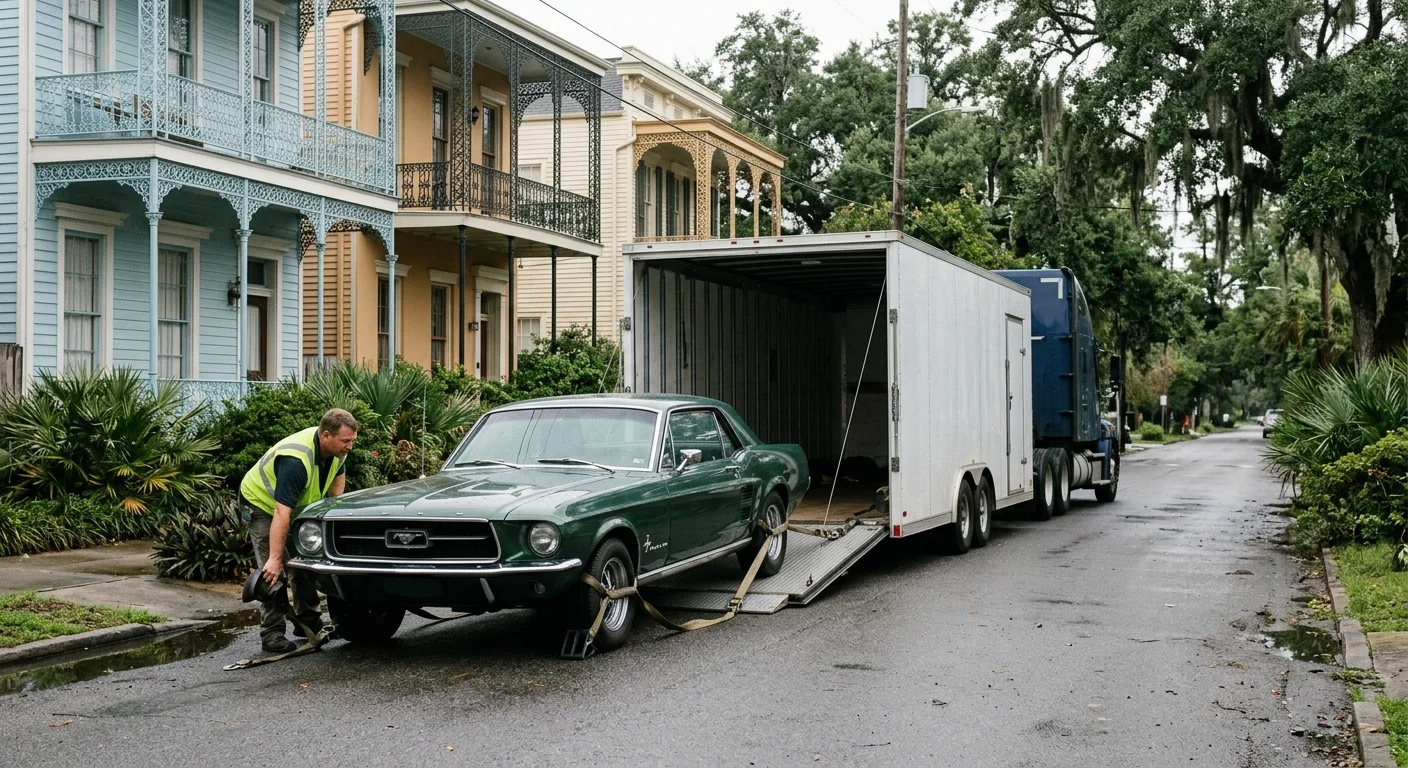
Use a flatbed and soft straps. Do not put a wheel-lift on a low-clearance classic. For French Quarter access, see exotic car towing in the French Quarter. We do not invent OEM ride-height specs or publish testimonials.
Why classic car towing in New Orleans needs a deck, not a wheel-lift
A wheel-lift supports one end of a vehicle while the other end rolls. That method has a place, but it usually isn’t the first choice for a preservation-focused classic move.
Older cars may have long overhangs, low exhaust systems, unusual wheel sizes, or modified suspension. Some also have drivetrains that shouldn’t be treated like those in modern cars. A previous restoration can change the safe lifting and securement points. Those details may not be visible from the curb.
A flatbed carries all four wheels away from the pavement. That avoids making the unloaded axle roll through potholes, standing water, and street debris. It also gives the operator more control over how the vehicle sits during transport. Our exotic and classic vehicle towing service matches owners with licensed operators equipped for these details.
A flatbed alone doesn’t make a move careful. The loading angle still matters. So do the winch connection and strap locations. The operator should know the car’s ground clearance, steering condition, transmission, and drivetrain before loading begins.
Share the year, make, model, and known modifications when you call. Mention whether the car runs, rolls, steers, and brakes. Tell the operator about loose trim, side pipes, lowered suspension, or bodywork near the wheels.
An owner’s manual or restoration record is better than a guess. If the correct towing points aren’t documented, say that plainly. The matched operator can review the car and choose suitable equipment instead of relying on assumptions.
Open deck or enclosed, and what actually decides it here
An open flatbed works well for many local classic-car moves. It carries the whole vehicle and can fit situations where a larger enclosed trailer can’t turn or stage. The car remains exposed to weather and road spray during transport.
Enclosed transport adds a barrier between the car and those conditions. That can matter for delicate paint, an open cabin, incomplete weather seals, or freshly restored trim. It may also make sense when the vehicle will travel beyond the New Orleans metro.
Local conditions sharpen that choice. A clear morning can give way to a heavy downpour. Humidity and salt air moving inland from Lake Pontchartrain also deserve consideration when the car has exposed metal or sensitive finishes.
Distance isn’t the only deciding factor. Consider the car’s condition, weather sealing, ground clearance, and destination. Then consider the pickup block. Enclosed trailers need room to approach, turn, and load. A narrow Marigny street may favor an open deck even when enclosed transport sounds better on paper.
Ask the operator to explain the tradeoff for that exact address. For a local move, our flatbed towing service may be the practical starting point. A planned evacuation, auction delivery, or distant restoration shop may call for long-distance towing with an open or enclosed carrier.
Get the carrier type in writing before the move. Confirm whether the vehicle will remain on that carrier through delivery. If another truck or storage location could become involved, ask the operator to explain that part too. Quick Tow New Orleans doesn’t set the operator’s prices or transport terms.
Loading in the Quarter, the Marigny and Uptown
The street address isn’t enough in older New Orleans neighborhoods. A carrier also needs the car’s exact position, its direction, and the space around it.
The French Quarter and Marigny have narrow streets and tight turns. Parked vehicles, deliveries, festivals, and curb activity can reduce usable space. An enclosed trailer that works on a broad Jefferson Parish road may not fit the same way on a compact Orleans Parish block.
Send clear photos of the street from both directions. Include the nearest corner, driveway slope, curb, gates, and overhead clearance. Show how close the car sits to walls, balconies, posts, and neighboring vehicles. If the car is inside a courtyard, describe every turn between it and the street.
Uptown brings a different concern. Streetcar tracks run along St. Charles Avenue, and a loading plan shouldn’t depend on placing a deck or ramps across the rails. The operator may need a lawful loading point away from the tracks. That decision belongs to the operator after reviewing access.
Downtown garages also need special attention. A standard carrier may not clear a low entrance or tight internal ramp. Give the operator the posted garage height and photos before equipment is selected. Don’t assume a truck can enter because the car did.
Tell the operator if the steering is locked, the brakes don’t hold, or a tire won’t roll. Those details change the loading setup. They matter even when the engine runs.
Complete a photo walkaround before the car moves. Capture every side, the wheels, glass, trim, interior, and existing marks. Keep copies of the images and the operator’s paperwork. This creates a shared condition record without relying on anyone’s memory later.
Storm season changes the timeline, not the technique
Storm season can change roads, destinations, and transport demand. It shouldn’t lower the standard used to load and secure a classic car.
Choose the destination before requesting a hurricane-season move. A trip from Uptown to Metairie is different from a move across Lake Pontchartrain or out of Louisiana. Share the complete destination, access instructions, and delivery contact with the operator.
Check 511 Louisiana for current incidents, closures, construction, and weather-related road information. Conditions along I-10, US-90 Business, and routes toward the North Shore can change. If water is reported near an underpass or another low point, the operator must choose a lawful route that avoids the closure.
A storm move may also require deciding between open and enclosed transport. Enclosed hauling reduces direct exposure during the trip, but it doesn’t override a closed road or unsafe operating conditions. An open carrier may offer easier access on a constrained block. The operator should explain which concern controls the decision.
Prepare the car before weather deteriorates. Remove loose items, secure removable trim, and gather keys and transport instructions. Photograph the vehicle while it’s clean enough for its existing condition to be visible. Tell the operator if rain has entered the cabin or trunk.
Humidity doesn’t change the correct tie-down points. Neither does evacuation traffic. Wheel straps, ramp clearance, and documented loading steps still deserve the same attention. Avoid a rushed plan that starts with the wrong carrier and depends on solving access problems after the truck reaches the block.
What to confirm with the hauler before the car goes on the deck
The matched operator should answer specific questions before loading begins. Keep the conversation focused on the car, carrier, route, and paperwork.
Confirm these details:
-
Give the full year, make, model, and drivetrain information. Describe modifications, lowered suspension, side pipes, long overhangs, or nonstandard wheels.
-
State whether the car starts, rolls, steers, and brakes. Mention locked steering, flat tires, missing keys, or mechanical parts that aren’t secured.
-
Confirm whether transport will use an open flatbed or enclosed trailer. Ask whether all four wheels will remain off the road.
-
Ask how the car will be loaded. Confirm the proposed winch connection, wheel straps, ramp setup, and clearance checks.
-
Share the pickup location’s access limits. Include garage height, gate width, driveway slope, tight corners, streetcar tracks, and the car’s direction.
-
Confirm the delivery address and receiving contact. Tell the operator about destination gates, garages, restricted access, or storage instructions.
-
Request the operator’s legal business name and licensing details. Ask for any insurance information and service terms you need before approving the job.
-
Ask what storage would cost if the car has to sit. When a vehicle is stored after a non-consensual tow, the LPSC schedule caps the charge at $34.00 per calendar day outside, $40.50 covered and $61.50 oversize. That’s the state maximum in that situation, not a Quick Tow New Orleans price.
-
Get the operator’s charges in writing. Ask what the stated amount includes and whether mileage, specialized equipment, waiting, storage, or a carrier change could create another charge.
-
Complete a condition report. Photograph the body, wheels, trim, glass, interior, and odometer before handing over the keys.
Quick Tow New Orleans is the matching service, not the towing company. The independent operator performs the move, sets the price, receives payment, and provides its own service terms. Confirm those terms directly with that operator.
Don’t let rarity replace preparation. A familiar model can still have restoration changes that alter the loading plan. Clear photos, accurate mechanical details, and written transport instructions give the operator useful information before the car reaches the deck.
When to call us
Low clearance, a non-running car, tight garage access, or enclosed transport calls for a licensed towing pro. Our line takes calls 24/7, and we match you with an independent local operator. Call (504) 474-5530. We match you with a licensed local operator who quotes before the truck rolls.