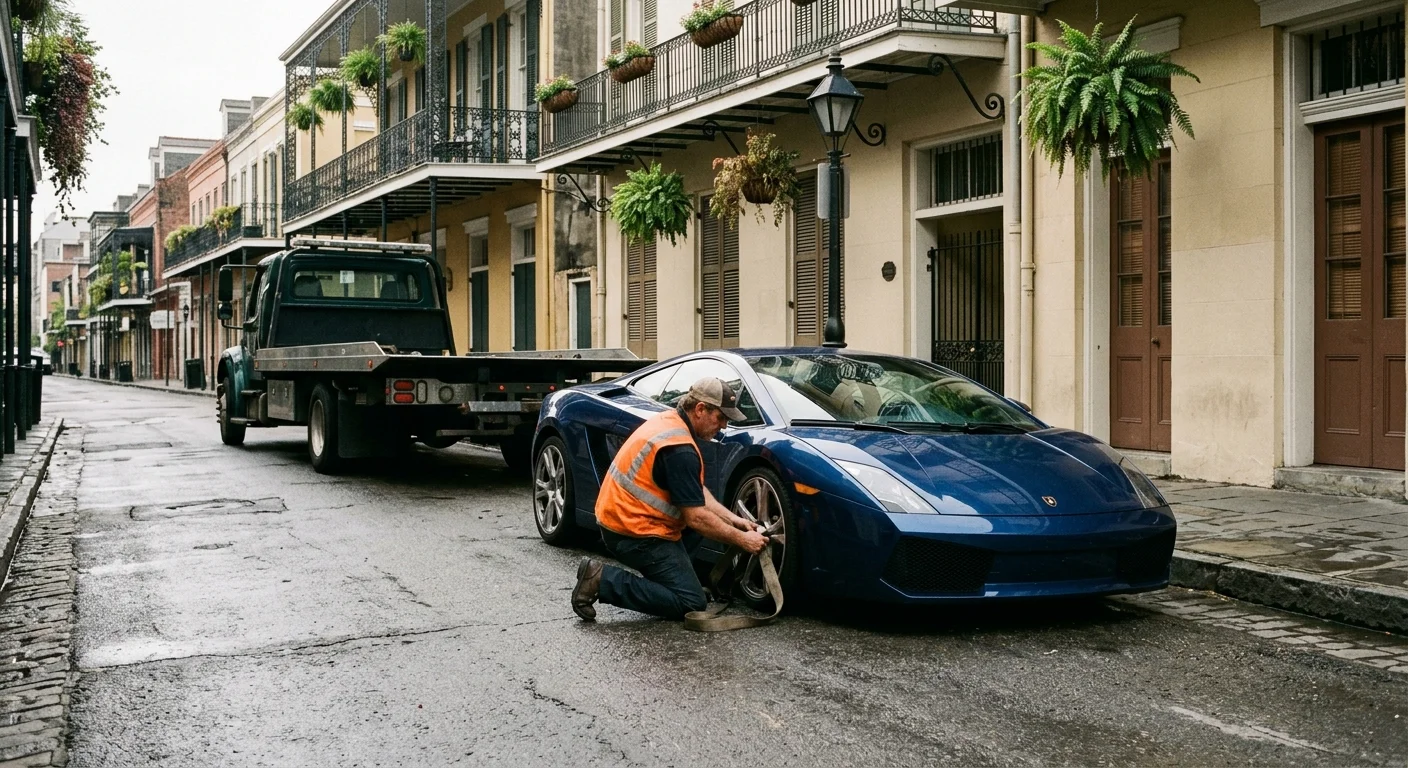
French Quarter streets are tight, garage height is low, and a flatbed is the usual request. Report the block, garage height if you are inside a structure, and whether the car rolls. We do not invent OEM ride-height numbers.
Start with the exact block and vehicle condition
“French Quarter” isn’t a precise pickup location. A car on Royal Street near St. Louis presents a different setup than one near Rampart Street or Esplanade Avenue. The operator needs the nearest intersection, curb side, and direction the car faces.
Say whether the vehicle is curbside, inside a garage, or in a hotel drive. Mention nearby parked cars, delivery vehicles, barriers, and heavy foot traffic. If a temporary closure affects the block, share that too. Don’t assume the operator already knows the current street access.
Next, describe the car itself. Provide the year, make, model, and trim. Tell the operator whether the engine starts and whether the steering unlocks. Confirm whether each wheel rolls, the parking brake releases, and the transmission can enter neutral.
Report visible leaks, collision damage, loose bodywork, or a failed suspension. A car sitting unusually low needs a different evaluation than a healthy car with a dead battery. Photos of the front, rear, wheels, and curbside space can help the operator review the situation before choosing equipment.
Check the owner’s manual for model-specific towing instructions. Some manufacturers give exact directions for transport mode, tow points, wheel movement, and key position. Those instructions should guide the loading plan.
Our exotic and classic vehicle towing service connects drivers with licensed local operators. Quick Tow doesn’t own towing equipment or perform the physical tow.
Street space can limit equipment positioning
Street width is only part of the problem. The operator also needs working room behind or ahead of the car. Parked vehicles, intersections, loading activity, and temporary access controls can change that space.
Picture a disabled coupe parked close to the curb on Bourbon Street. Another vehicle behind it may prevent straight loading. A crowded corner may leave no safe working area. The operator might need a different approach, different equipment, or a nearby loading position.
Don’t push the car into traffic to create room. Don’t attach straps or hooks based on guesswork. Low bodywork can hide vulnerable panels, cooling lines, or manufacturer-approved attachment points.
A flatbed may be suitable for many exotic vehicles, but it isn’t automatically right for every block. The bed still needs enough space for positioning and loading. The vehicle’s condition may also call for extra planning. Our guide to flatbed towing explains the service without assuming it fits every situation.
Give the operator current street details before the truck is selected. If access changes while you wait, share the new conditions. A delivery truck, event barrier, or newly occupied curb space can alter the plan.
For route conditions approaching the French Quarter, Louisiana 511 provides official traffic and incident information. It isn’t the authority for curb access, parking permission, or local event restrictions. Confirm those conditions at the pickup location.
Clearance and drivetrain still shape the loading plan
Exotic cars often combine low bodywork with model-specific drivetrain rules. Neither issue should be handled from appearance alone. Two similar-looking coupes may have very different towing instructions.
Start with the lowest visible areas. These may include the front splitter, side skirts, rear diffuser, exhaust components, or underbody panels. Tell the operator about aftermarket bodywork, lowered suspension, or a suspension system that won’t rise.
Photos taken near wheel height can show the gap beneath the car. Include the approach area around the tires and curb. Don’t crawl beneath an unstable or damaged vehicle to get those images.
The drivetrain matters too. Tell the operator whether the car is rear-wheel drive, front-wheel drive, or all-wheel drive if you know. Don’t guess. The owner’s manual or manufacturer guidance should confirm how the vehicle may be moved.
Also report whether the transmission is locked, the battery is dead, or the electronic parking brake won’t release. A vehicle that can’t roll freely may require a different loading method. The operator should know that before attempting movement.
Our low-clearance towing guide covers the information worth gathering before loading begins. It also explains why ground clearance alone doesn’t determine the equipment choice.
Ask the matched operator to explain the planned contact points and wheel handling. Factory-approved tow points should be identified before tension is applied. Removable trim, loose aerodynamic parts, and visible damage should be documented before the car moves.
The operator makes the final equipment decision after reviewing the vehicle and location. Quick Tow matches the call with an independent, licensed local operator. It doesn’t direct the operator’s loading procedure or warrant the completed work.
Choose the destination before the car moves
Know where the car is going before loading starts. “A shop in New Orleans” leaves too many details unresolved. Provide the business name, street address, contact instructions, and entrance information.
Call the destination first when possible. Confirm that it accepts the vehicle and can receive it under its current condition. A dealership may direct deliveries to a service entrance rather than its public driveway. A specialist may use a locked gate or a separate unloading area.
Destination access matters as much as pickup access. A shop near the Central Business District presents a different route than one in Metairie or Gretna. The operator needs the complete destination to evaluate both ends of the tow.
Tell the receiving shop about collision damage, locked wheels, leaking fluids, or missing keys. Those details may affect where staff want the vehicle placed. If the car can’t be left unattended, arrange a person who can accept it.
Remove loose valuables before loading when it’s safe. Keep the key, owner’s manual, wheel-lock key, and any transport instructions together. Decide who will hand them to the operator and who will receive them at the destination.
If the car needs specialty repair, don’t choose the nearest business without confirming capability. The destination should be ready for that model and problem. Changing destinations after loading can complicate the route and handoff.
What to confirm with the matched operator
Give the operator a complete picture before agreeing to the tow. Start with the vehicle’s year, make, model, drivetrain, condition, and exact location. Then confirm that the operator has reviewed the owner’s manual instructions you provide.
Ask what equipment the operator plans to use. A request for flatbed towing for an exotic car in New Orleans doesn’t guarantee that one setup fits the car and block. The operator should account for clearance, locked wheels, steering position, and available loading space.
Confirm these details directly:
- The pickup intersection, curb side, and vehicle orientation
- Whether the car starts, steers, rolls, and enters neutral
- Any suspension failure, collision damage, or visible leak
- Manufacturer instructions for towing or transport mode
- Planned attachment points and wheel handling
- The complete destination and receiving contact
- How keys and written instructions will be transferred
- The operator’s charges and payment terms
Quick Tow doesn’t set the independent operator’s price. Ask the operator for the charge structure before work begins. Clarify what could change the total, including additional labor or a destination change.
Photograph the vehicle before loading. Capture each side, the wheels, existing body damage, and the surrounding curb space. Repeat the photos after unloading. Keep any paperwork provided by the operator.
Owners of collectible vehicles may also find our guide to classic car towing in New Orleans useful. The same preparation habits apply, but manufacturer instructions still control each car’s handling needs.
If anything about the plan is unclear, pause before movement begins. Ask the operator to explain the loading method in plain language. Don’t approve a method that conflicts with the vehicle manufacturer’s written instructions.
When to call us
Call when an exotic or performance car needs a licensed towing pro and the French Quarter pickup requires careful planning. The line takes calls 24/7. Call (504) 474-5530. We match you with a licensed local operator who quotes before the truck rolls.