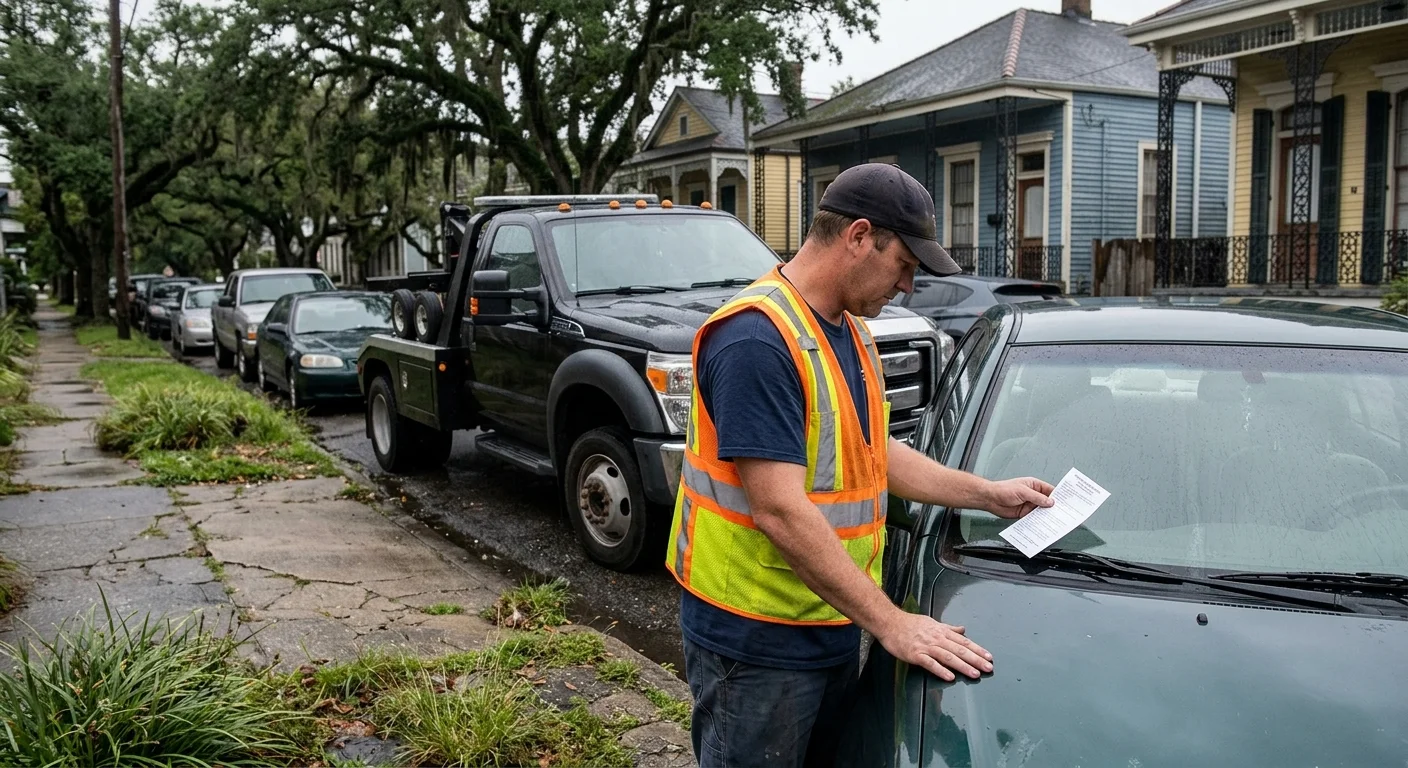
Three buckets: a consensual tow you requested, a nonconsensual private-lot or police-arranged tow, and a City impound. See private-property law, city yard, belongings, and impound receipt. We do not state City storage or boot. LPSC complaints and the R.S. 32:1727 hearing path stay. Call (504) 474-5530 only for a private consensual tow.
Keep every notice, invoice, photograph, and mailing envelope. The dates and details can determine which rights apply.
The notice a New Orleans towing yard owes you
Louisiana’s notice rules sit within the Louisiana Towing and Storage Act. Under R.S. 32:1720, a storage facility must notify the vehicle owner and any recorded lienholder after receiving ownership information from the department.
The usual deadline is ten business days after the department sends that information. It becomes five business days when the information arrives electronically. The facility sends the notice by mail with a certificate of mailing to the last known address.
That notice must identify the storage facility and describe the vehicle. It must include the plate, towing authority, storage date, vehicle condition, and charges. It must also explain the R.S. 32:1727 hearing right, when that right applies. The notice must state the deadline and explain that the hearing request goes by certified mail with return receipt requested.
Read every line before contacting the yard. Compare the plate, vehicle description, tow date, and named authority with your records. Preserve the envelope because its postmark can help establish the mailing date. Take clear photos or scans of every page.
A mistake or missing detail doesn’t tell you the outcome by itself. It does give you something specific to raise with the ordering agency, the Louisiana Public Service Commission, or an attorney. Don’t replace the written record with a phone conversation.
This notice process isn’t the same as locating a recently impounded car. If the City of New Orleans may have ordered the tow, follow the separate guide to finding your towed car in New Orleans. That page covers the City’s lot process without mixing it into these statewide notice rights.
The hearing right, and which tow it attaches to
Louisiana doesn’t give every towed vehicle owner the same hearing. R.S. 32:1727 applies when a vehicle is stored by a public agency. That distinction matters across Orleans Parish and neighboring Jefferson Parish, where different agencies may order or handle a tow.
The owner must request the hearing within ten days of the date the R.S. 32:1720 notice was mailed. The request goes to the agency that ordered the tow. It must be sent by certified mail with return receipt requested.
Once the agency receives the request, the hearing must be held within three business days. Its purpose is narrow. The hearing determines whether the towing and storage were proper. The statute doesn’t name damages, automatic release, or another specific remedy. Don’t assume a successful challenge produces an outcome the law doesn’t state.
This public-agency hearing shouldn’t be confused with a private-property dispute. A vehicle removed from an apartment lot or commercial parking area doesn’t receive an R.S. 32:1727 hearing merely because a towing company stored it. Other rules may govern the authorization, signage, invoice, and rates.
Booting also has a different hearing right. Under R.S. 32:1741, an owner may request an administrative hearing within ten days to contest a boot or its fee. That ten-day window belongs to the booting rules. It isn’t the same right as the hearing for a public-agency tow.
First identify who ordered the tow. Then identify whether the vehicle was stored by a public agency, removed from private property, or booted. Those facts tell you which process fits. There’s no accurate shortcut that says every New Orleans tow automatically comes with a hearing.
What an operator may not do at the scene
R.S. 32:1736 limits non-consensual towing from parking areas. An operator may not perform that tow unless law enforcement authorized it or the vehicle was properly tagged for removal. The property owner’s authorized representative also may not be the tow truck’s owner or operator.
Private-property signage matters too. Property owners must post signs at entrances and exits. Those signs must name the towing company and display its address and phone number. The required lettering must be at least two inches high.
If your vehicle is still at the scene, don’t step between vehicles or interfere with the operator. From a safe position, photograph where the car was parked. Capture each entrance, exit, posted sign, curb marking, and removal tag. Wide photographs show context that a close-up can miss.
Write down the location and time. Note the property name and any person who identified themselves as its representative. Keep any receipt, card, or paperwork you receive. These records can help show whether law enforcement authorized the removal or whether the vehicle was tagged.
Operators must provide itemized invoices. The invoice includes the date and time of service, operator name, the law enforcement agency when applicable, and each fee. Billing invoices, service contracts, and the property owner’s contact information must also be available to law enforcement or an LPSC officer on request.
For more detail about parking-lot removals, read the local guide to private-property towing. It explains the service without treating a customer-requested tow like an impound.
Overcharging has a price attached to it
Louisiana sets maximum statewide rates for non-consensual towing and recovery. The current figures appear in the LPSC non-consensual towing schedule. The schedule adjusts each April, so the effective date matters when checking a bill.
“Non-consensual” is broader than many drivers expect. A tow can remain regulated even when the vehicle’s owner asks a police officer to arrange it. The operator can’t move that police-arranged tow outside the prescribed rate system merely because the driver requested help.
Start with the full itemized invoice. Compare the vehicle’s weight class, towing service, recovery work, transit time, storage dates, gate fee, and any surcharge against the applicable schedule. The separate guide to New Orleans towing costs explains the current rate categories without repeating a long fee table here.
Every invoice must state the LPSC complaint address: P.O. Box 91154, Baton Rouge, LA 70821, and lpsc.louisiana.gov. You’re entitled to an invoice copy without paying first. Tow companies must also accept credit cards, with any passed-through processing fee listed separately.
A written LPSC complaint has a specific protection. If the Commission later finds the charges excessive, storage fees stop accruing as of the complaint date. That protection depends on the later finding. Keep proof of the written complaint and the date it was sent.
The Commission may order a refund of up to 200 percent of an overcharge. You don’t need to pay the invoice first to have standing before the Commission. Separately, R.S. 32:1736 allows recovery of the excess charge, storage costs, attorney’s fees, and court costs for charging above the LPSC rate. The available result depends on the facts and process used.
If there’s a lien on the car
The required R.S. 32:1720 notice goes to more than the vehicle owner. It must also be mailed to any recorded lienholder. That usually means the lender named on the vehicle’s title receives the facility, vehicle, towing, storage, and charge information.
R.S. 32:1720.1 gives the lienholder of record a defined route to the vehicle. After the required notice has been mailed, the storage facility must surrender the vehicle when the lienholder pays all towing and storage charges in full and signs a hold-harmless agreement.
That right belongs to the lienholder of record. It doesn’t promise that the lender will exercise the option, pay the charges for the borrower, or return the vehicle to the borrower. Those decisions depend on the lender and the finance agreement.
Contact the lienholder quickly if the car remains financed. Provide the vehicle identification number, storage location, towing date, and copies of the notice and invoice. Ask whether it received the statutory notice and whether it plans to act under R.S. 32:1720.1.
Keep communication in writing when possible. If the notice lists the wrong lienholder, vehicle, plate, or storage date, document the difference. A public-agency hearing deadline continues to run from the notice mailing date, so contacting the lender shouldn’t replace a timely hearing request.
New Orleans drivers often cross parish lines during normal travel. A breakdown might occur near Metairie, while a later storage dispute involves an Orleans Parish address. Focus on who ordered the tow, where the vehicle is stored, and who holds the recorded lien. Those details matter more than the driver’s home address.
When to call us
If your car is disabled and needs a customer-requested move, emergency towing requires a licensed operator, not an impound dispute. The line takes calls 24/7. Call (504) 474-5530. We match you with a licensed local operator who quotes before the truck rolls.