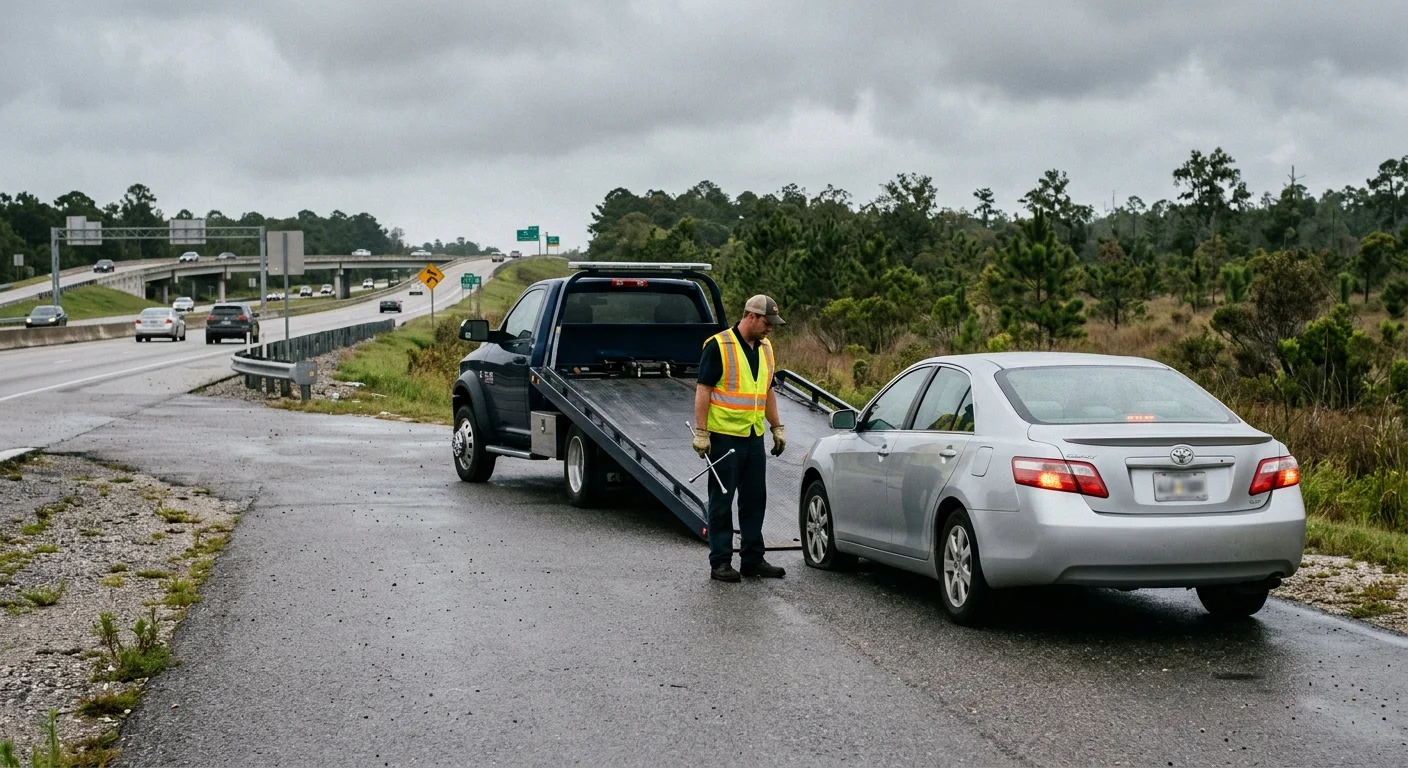
A stalled car on I-12 near Covington is a location problem first. Tell the line whether you are eastbound or westbound, name the nearest exit, and say whether the vehicle is in a travel lane, on the shoulder, or already in a pullout. Quick Tow New Orleans matches that report with a licensed independent operator on the Northshore. The line takes calls 24/7. We do not run the truck.
Start with your exact I-12 location
I-12 is the east-west spine of St. Tammany Parish. Covington sits on it where US-190 meets the interstate. That interchange is the landmark most local drivers already know. If you can see US-190, say so. If you just passed a Covington or Mandeville sign, say that too.
Mile markers help when you can read one from the seat. An exit name helps when you cannot. “West of US-190, still on I-12” is usable. “Somewhere near Covington” is not. The operator covering this stretch cannot guess which side of town you are on.
Stay on I-12 in the report. Do not mix this scene with the Lake Pontchartrain Causeway. The lake crossing is a different road, with Causeway Police, not a DOTD interstate shoulder. If you actually broke down on I-10 or on the bridge, that is a different call. We published a separate walkthrough for drivers broke down on I-10 or the Causeway.
If the car still rolls, ease it onto the shoulder or a paved pullout and out of the travel lane. Hazard lights on. If you cannot move it, stay in the vehicle with seat belts on unless you are in immediate danger. Other drivers have a duty under Louisiana’s Move Over law, R.S. 32:125, when a parked vehicle is using authorized visual signals, including flashing amber or yellow warning lights. On a multi-lane highway they change lanes away from that vehicle when it is safe, or they slow to a reasonably safe speed when a lane change is not possible. The statute names the lights. It does not name tow trucks.
While you wait, check 511la.org for incidents, lane closures, and construction on this stretch. 511 is Louisiana’s official traveler feed. It will not dispatch a truck, but it will tell you if the lane next to you is already a mess.
Report the direction, nearest exit and vehicle condition
Direction first. Eastbound I-12 from Covington runs toward Slidell. Westbound runs toward Hammond. A Northshore operator needs that before anything else. The wrong direction sends the truck to the other side of the median.
Nearest exit second. Name it the way the sign reads. US-190 is the Covington and Mandeville interchange most locals use. LA-21 is the other Covington access off I-12. If you only remember “the Covington exit,” add which town you were heading toward. That single extra word cuts the search in half.
Vehicle condition third. Running or dead. Neutral or stuck in park. Flat tire, overheat, or impact damage. Keys in hand or locked in the car. How many people are with you, and whether anyone is hurt. Injury, fire, or a car sitting in a live lane is 911. That is not a matching-line job.
Also say the surface under the tires. Firm pavement on the shoulder is one job. Soft grass, a ditch, or standing water after a Gulf storm is another. Ground off the paved shoulder on the Northshore can be wet even when the travel lanes look dry. Do not try to drive out of a ditch. That is recovery work for the operator who arrives, not a DIY yank with a strap from a passerby.
A photo of the wheel, the dash lights, and the nearest sign helps the match. Take it from the shoulder, not from a live lane. Keep the plate unreadable if you are sending the picture to anyone other than the operator. Color, make, and model matter more on I-12 than a plate number the truck cannot see from the next exit.
If a St. Tammany deputy or state trooper is already on the shoulder with you, say that in the first minute. The officer may have already decided which side of the car the operator should work from. Follow that. Do not walk up the interstate to “flag the truck.” Stay with the vehicle unless you are told to move.
Decide whether roadside help may fit
Some I-12 stops are roadside assistance if the car can be made safe to drive on the spot. A flat on a sound rim, on firm pavement, with a usable spare, is the usual example. A dead battery in a pullout can be a jump. An empty tank is fuel, if the operator can reach you without standing in a travel lane.
Roadside help is the wrong call when the car cannot roll, cannot shift, or sits where a tire change would put someone in traffic. Overheat that already dumped coolant, a CV axle, a locked transmission, or a wheel that will not turn needs a tow. If you are unsure, describe the symptom. The matched operator decides whether a jack and a spare are enough, or whether the car has to leave the interstate on a truck.
DOTD’s Motorist Assistance Patrol is a scheduled patrol, not a call-out. You do not phone MAP and order a truck. The New Orleans-area MAP routes DOTD publishes cover stretches of I-10, all of I-610, I-55 from I-10 to Manchac, and US-90B. I-12 through Covington is not on that list. Do not sit on this shoulder waiting for a MAP truck assigned to a different interstate. If a MAP unit is already on scene, it can move a disabled vehicle out of a travel lane and offer minor help: a spare, a jump, a little fuel, a local call. It does not tow the car to a Covington shop. Coverage and hours are on DOTD’s MAP page. If you need scene protection and no patrol is present, contact local law enforcement, or 911 in an emergency.
A tow you request yourself is a consented tow. That is a different product from a police-ordered or private-property tow. The Louisiana Public Service Commission sets maximum rates for non-consensual towing and storage. Those ceilings are not a quote for a driver-called hookup on I-12, and they are not Quick Tow’s price. Ask the matched operator what this job will cost before the car is hooked.
Choose a Northshore destination before the tow
Name the drop-off before the truck is rolling. Covington, Mandeville, Abita Springs, and the rest of the Northshore each have shops and driveways. “Take it to Covington” is not an address. Give a street, a shop you have already called, or a driveway the operator can find without circling US-190.
If the car has to go south of the lake, say so up front. That is a different run from a local Northshore drop. Metairie and Orleans Parish sit across the water. A car breakdown in Metairie is a Jefferson Parish scene, not an I-12 Covington scene. Do not assume the same operator covers both until you say where the car has to end up.
You choose the destination on a driver-requested tow. Confirm the shop will take a disabled car after hours. Many Northshore bays close in the evening. If the bay is closed, you need a storage plan the operator actually has. Quick Tow New Orleans does not run a yard and does not hold cars. The matched operator does.
Do not send this car to a City of New Orleans impound lot from I-12. Those lots, including the release window at 400 N. Claiborne Ave, are for City tows in Orleans Parish. A breakdown in St. Tammany is not that process. If a local agency on the Northshore ordered the tow, ask that agency where the car was taken. Do not guess a New Orleans address.
If home is in Covington and the shop is in Mandeville, pick one. Changing the destination after the truck is loaded can add time and a second handling step. Settle it while you are still on the phone.
What the matched operator needs from you
The matching line needs a clean report. Use this order, then stop.
Eastbound or westbound I-12. Nearest exit or the US-190 or LA-21 landmark. Shoulder, pullout, or travel lane. Make, model, color, and plate if you have it. What failed. Whether the car rolls and shifts to neutral. Destination address. A callback number that will actually ring on the shoulder.
Keys, wheel locks, and a charging port or tow-mode setting on an EV all matter. Say if the car is AWD. Say if a wheel is locked. The operator brings the truck that fits. Wheel-lift versus flatbed is their call once they hear the condition. You do not need to spec the truck.
If you have cargo, a trailer, or a motorcycle in the bed, say that before the match. A sedan on I-12 and a truck-plus-trailer are different jobs. Occupants ride in the operator’s cab only if that operator allows it. Do not assume a ride into Covington is part of the tow.
Quick Tow New Orleans is the matching service. Licensed local operators perform the emergency towing. We hold no Louisiana towing license, we own no fleet, and we do not store the car. Your contract is with the operator who hooks the vehicle. Calls to our line are recorded. You will hear that notice on the call.
Stay reachable. Cell coverage on I-12 near Covington is usually fine, but a dying phone is a common failure on a long wait. If your battery is low, say so and keep the line free. When the operator calls back, answer with the same location string you gave the first time: direction, exit, color, and where you are standing.
When to call us
If the car cannot sit safely on I-12, or roadside help will not get it driving, you need a licensed towing pro for this Covington stretch. Call us at (504) 474-5530 and we’ll connect you with a licensed local operator. The line takes calls around the clock.