Do not jump flooded or wet cables. Do not jump an EV or hybrid unless the owner manual says that 12-volt procedure is allowed. Otherwise ask for a tow. See jump-start and weekend jump-start. No unsourced dollar figure.
Start with what happened before the car stopped
The useful clues often appear before the driver turns the key. Tell us what the car was doing, where it stopped, and what changed.
Maybe the car sat overnight in a Metairie driveway. Perhaps its lights or accessories stayed on. It may have started normally earlier, then failed in a Kenner parking lot. Those details help distinguish a basic jump-start request from a problem that may require towing.
Report what you can observe without taking anything apart. Helpful details include dim interior lights, clicking, silence, or normal dashboard lights with no start. Mention whether another jump was already attempted. If the engine started and then stopped again, say that too.
The history matters more than a guess about the battery. A driver may call it a dead battery when the cause hasn’t been confirmed. The matched operator can assess what service makes sense at the vehicle.
Visible damage also changes the request. Tell us if the car stopped after a collision, entered floodwater, or has damaged cables or body panels near the hood. Don’t leave those facts for the operator to discover after the match.
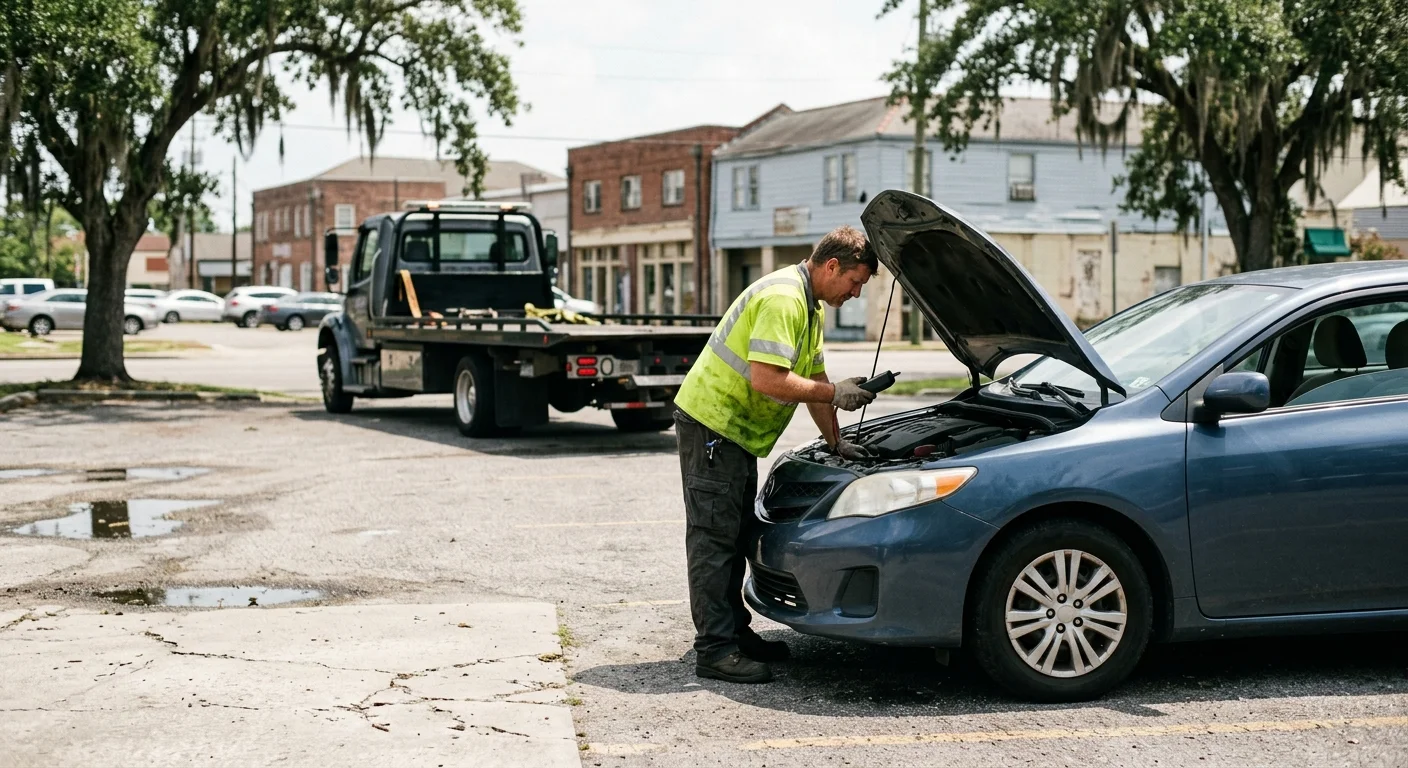
Our roadside assistance service is the right starting point when the vehicle is parked and a jump may solve the immediate no-start. Quick Tow New Orleans takes the call and matches you with an independent, licensed local operator. The operator decides what work can be performed at the scene.
When a jump-start request may fit
A battery jump-start service may fit when the car is stationary, accessible, and otherwise appears intact. This often applies after a vehicle sits with an electrical accessory left on. It can also fit when the driver already knows the battery has lost its charge.
Location still matters. A car facing outward in a Gretna parking lot presents different access than one boxed into a narrow Uptown space. Tell us which side of the vehicle is reachable. Mention a locked gate, parking garage, low ceiling, tight aisle, or another car blocking access.
A jump request isn’t a promise that the car will start. It tells the matched operator what happened and what help you expect. The operator may bring a portable jump pack, assess access, and decide whether a jump attempt fits the situation.
Don’t choose the service based only on price. The final charge comes from the independent operator and depends on the actual job. Our guide to jump-start service costs explains which questions to ask before authorizing work.
Timing also affects access, especially at gated apartments, garages, and commercial lots. Our guide to weekend jump-start service in New Orleans covers what information to gather when offices or property contacts may be unavailable.
The cleanest jump-start request is specific: the car is parked, the battery problem is suspected, and the operator can reach it. If any part of that description is uncertain, say so during the call.
When the problem may need a tow
A tow becomes more likely when a jump attempt doesn’t restore an operable vehicle. It may also be the better request when the vehicle starts but stops again. Tell us exactly what happened instead of requesting repeated jump attempts.
Other conditions can shift the match toward towing. The car may have visible collision damage. Its hood may not open. The vehicle could be stuck in gear, blocked inside a garage, or positioned where roadside battery service isn’t practical. Each detail affects which operator and equipment may fit.
A jump start addresses the immediate no-start. It doesn’t confirm the battery’s condition or identify every possible electrical or mechanical problem. If the car can’t be driven after the operator’s assessment, removal to a repair facility may be the next step.
Have a possible destination ready, but treat it as a preference. Share the repair shop’s name, exact address, and any access details. The matched operator can confirm whether the destination and vehicle position work for that tow.
Our emergency towing service connects drivers with licensed local operators when the vehicle needs removal rather than roadside battery help. Quick Tow doesn’t perform the tow, select repair work, or warrant an operator’s service. You contract with and pay the independent operator directly.
Don’t guess about tow equipment. Report the vehicle’s year, make, model, drivetrain if known, and current condition. The operator can determine what equipment the job calls for.
Location changes what details matter
A dead battery in a parking lot isn’t the same request as one on an interstate shoulder. Metro New Orleans crosses several parishes, road systems, and constrained locations. Exact location details help match the right kind of assistance.
In an Orleans Parish neighborhood, provide the street and nearest cross street. Mention whether the car is curbside, inside a courtyard, or behind a gate. In Metairie or Kenner, include the business, apartment complex, or parking section. On the West Bank, specify whether you’re in Gretna, Terrytown, Marrero, or another community.
Interstate locations need route and direction. State whether you’re on I-10, I-610, or US-90B. Include the direction of travel and the nearest exit or visible marker. A vague report such as “near downtown” can describe several very different access points.
The Louisiana DOTD Motorist Assistance Patrol provides free jump starts and other minor help on covered routes during its patrol schedule. MAP is a fixed-schedule patrol, not a call-out service. It also doesn’t tow a vehicle away for repair.
Drivers can check Louisiana traveler information for current incidents, closures, and traffic conditions. That context may clarify the vehicle’s location before a service request.
A breakdown on the Lake Pontchartrain Causeway follows a different process. The bridge is patrolled around the clock by Causeway Police, and stranded motorists should contact that agency. The Causeway’s official site carries its police and roadway information.
What to report before an operator is matched
A clear call helps us match the request without pretending the cause is already known. Start with the vehicle and location. Then describe the no-start in the order it happened.
Provide the year, make, and model. Say whether it’s gasoline, diesel, hybrid, or electric if you know. Mention modifications, unusual height, or low ground clearance that could affect access or towing.
Give the exact location next. Include the address, cross street, parking level, gate instructions, or interstate direction. Tell us whether the car is in a marked space, travel lane, shoulder, driveway, or garage.
Then describe the symptoms in plain words. Useful reports include:
- The car sat before it stopped starting.
- The lights were left on.
- The dashboard lights appear dim or normal.
- The car clicks, stays silent, or tries to start.
- A jump was already attempted.
- The engine started, then stopped again.
- There is visible damage around the vehicle.
- The hood, doors, steering, or gear selector won’t operate normally.
You don’t need to diagnose the car. Avoid removing parts or presenting a suspected battery failure as confirmed. The operator needs the observed facts, not a technical label.
Also say whether you have the keys and can access the vehicle. If towing may be needed, provide your preferred destination. Mention any garage clearance, gate, loading area, or property restriction.
Quick Tow New Orleans uses those details to connect you with an independent, licensed local operator. The operator confirms the service, price, payment terms, and job details directly with you.
When to call us
If a jump hasn’t worked, the car won’t remain operable, or its position calls for removal, ask for a licensed towing operator. The line takes calls around the clock. Call (504) 474-5530. We match you with a licensed local operator who quotes before the truck rolls.