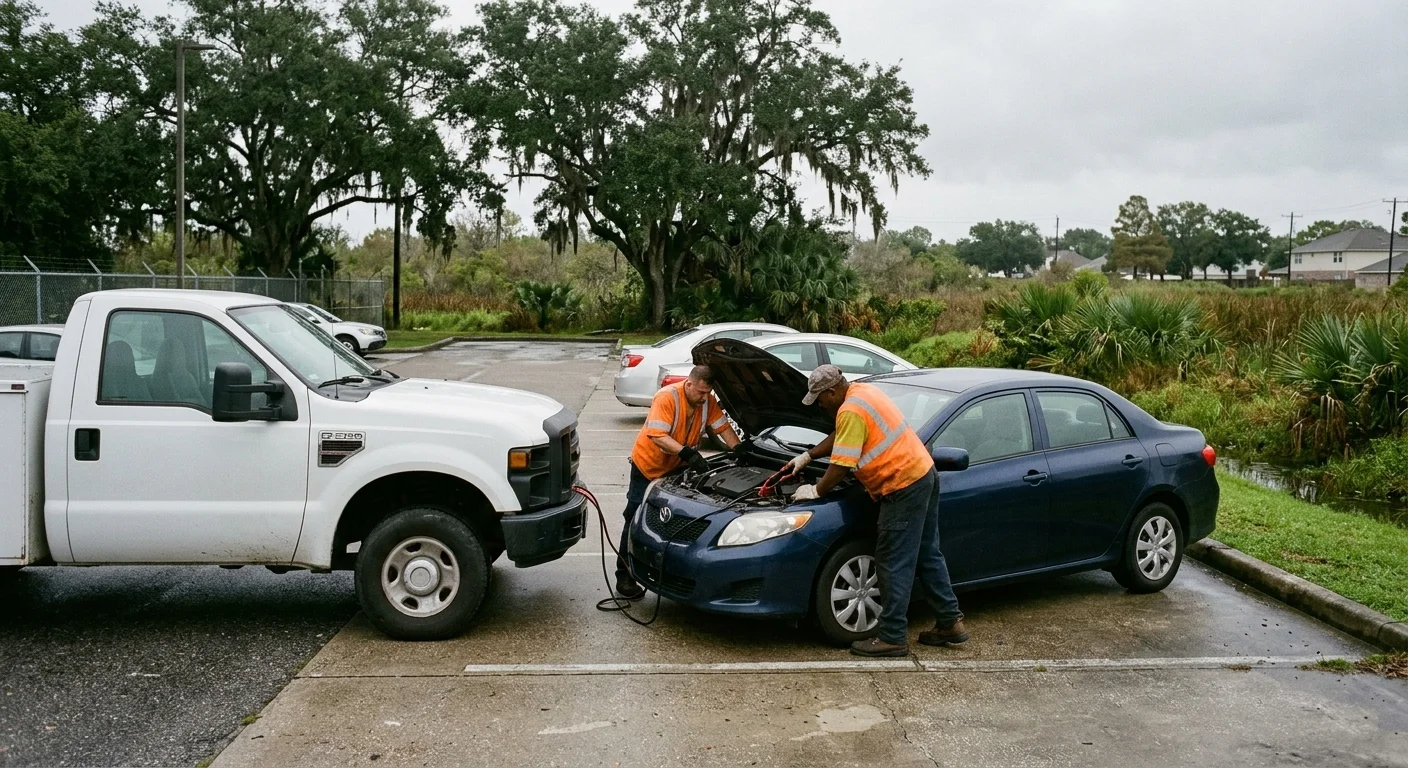
Yes, weekends. The line takes calls Saturday and Sunday. The matched operator quotes before the truck rolls. Check flood and heat first. See jump-start or tow. No unsourced jump price.
What a jump fixes, and what it only postpones
A jump supplies outside power to help start a vehicle with a discharged battery. It may help after lights or accessories were left running. It can also get a car moving when the battery no longer holds enough charge to start the engine.
A clean jump gets you driving again in 5 to 10 minutes. That describes the work itself, not how long an operator takes to reach you. The starting process may be short, but it doesn’t explain why the battery lost power.
Pay attention to what happens after the engine starts. A warning light, rough electrical behavior, or another no-start condition can point beyond a one-time drain. The operator may recommend moving the vehicle to a repair shop instead of repeating the jump.
Tell the operator what happened before the battery went quiet. Mention clicking sounds, dim lights, an engine that turns slowly, or complete silence. Also say whether the car recently needed another jump. Those details help the operator understand the request before connecting equipment.
Our jump-start service is a matching service. Quick Tow doesn’t own the service vehicle or perform battery work. We connect you with a licensed local operator, and you contract with that operator directly.
Treat a jump as a restart, not a battery diagnosis. If the car runs normally afterward, follow the guidance in its owner’s manual. If it shuts down again, continued attempts may only postpone the tow or repair it needs.
The free weekend jump start service in New Orleans most drivers miss
Louisiana DOTD’s Motorist Assistance Patrol can jump-start a battery at no charge. It can also move a disabled vehicle from a travel lane. However, MAP is a fixed-schedule patrol, not a service motorists can call out to any address.
New Orleans daytime coverage runs from 5:30 a.m. to 7:30 p.m., seven days a week. Covered roads include I-10 from US-61 in Ascension Parish to Michoud Boulevard, all of I-610, I-55 from I-10 to Manchac, and US-90B from the I-10 split to Westwood.
Night coverage runs from 7:30 p.m. to 5:30 a.m., seven days a week. It covers I-10 from US-51 at LaPlace to Morrison Road, all of I-610, and US-90B from Exit 234A to Barataria Boulevard at Exit 4A.
Those limits matter on weekends. A dead battery in a Mid-City parking lot isn’t covered just because MAP is patrolling I-10. The same applies to curbside spots in Lakeview, Uptown, or the Marigny. MAP must already encounter you on one of its covered corridors.
If MAP isn’t already on scene, DOTD tells stranded motorists to contact local law enforcement. Call 911 when there’s an emergency. You can also check 511 Louisiana for current incidents, closures, construction, cameras, and traffic conditions before choosing a route.
MAP handles minor roadside help. It doesn’t tow a vehicle away for repair. A car that won’t stay running may still need an independent operator through a roadside assistance referral.
Weekend and parade parking is its own problem
A weekend battery problem often begins in a crowded lot, garage, or curbside space. Access can matter as much as the battery. A second vehicle may not have room to pull close, and garage height can limit which service vehicle can enter.
New Orleans event weekends add another layer. Streets around St. Charles Avenue, Canal Street, the Central Business District, and Mid-City may have barricades or changed traffic patterns. Festival activity can also alter the practical entrance to a lot. Share the entrance that’s actually open, not only the street address.
Send a location pin and describe where the car sits. Include the garage level, lot name, nearby cross street, and vehicle color. If the car is behind a gate, confirm how the operator can enter. Don’t assume the entrance you used earlier remains available after an event ends.
Also check the actual problem before requesting battery service. Locked keys can look like a dead-car problem when you can’t reach the ignition. That situation calls for car lockout service, not jumper cables.
A vehicle parked near City Park presents a different access problem than one beside US-90B on the West Bank. Metairie shopping lots, French Quarter streets, and Uptown curb spaces also have different approaches. Specific location details help the operator decide whether a jump-start visit is workable.
If the car disappeared from a legal parking space, don’t order a jump. First confirm whether it was relocated or towed during the event. Battery service can’t help until you know where the vehicle is.
What to ask before anyone clips a cable to your battery
Start with the vehicle’s year, make, model, and powertrain. Tell the operator whether it uses gasoline, diesel, hybrid power, or full electric power. Don’t assume every vehicle uses the same connection points or starting procedure.
Ask whether the operator will check the vehicle’s specified jump points before connecting equipment. Some batteries are easy to see under the hood. Others use remote terminals or sit behind panels. The owner’s manual is the authority for your exact vehicle.
Describe any recent work or modifications. Aftermarket alarms, audio systems, battery switches, and other electrical additions may change what the operator encounters. Mention them before the hood opens, even if they don’t seem related.
You should also describe the current symptoms precisely:
- Do the interior and dashboard lights turn on?
- Does the engine click, turn slowly, or remain silent?
- Does the engine turn normally without starting?
- Did the car start and then stop after an earlier jump?
- Is the battery or its surrounding area visibly damaged?
These observations don’t replace a diagnosis. They help the operator decide whether a jump is the right first step. If the request doesn’t match a discharged battery, the operator may recommend towing the car to a repair facility.
Ask what equipment the operator plans to use and what happens if the car doesn’t start. Confirm the operator’s charge and accepted payment method before work begins. Quick Tow doesn’t set or collect operator prices. The independent operator sets the terms and receives payment directly.
Keep the keys available and remove items blocking access to the hood. If the car is in a garage, provide the posted clearance. Follow the operator’s directions while equipment is connected.
When a jump is the wrong call
A jump won’t solve every no-start condition. If the engine turns normally but doesn’t fire, the battery may not be the issue. Give the operator that detail before requesting cables.
Repeated failure also changes the decision. A car that starts, shuts down, and immediately needs another jump may require repair. Moving it to a shop can make more sense than repeating the same temporary restart.
Visible battery damage, unusual heat, smoke, strong odors, or liquid around the battery shouldn’t be presented as a routine jump request. Describe those conditions before anyone handles the vehicle. Let the operator determine whether the car should be moved instead.
Floodwater creates another clear boundary in New Orleans. A car sitting in water near an underpass or low street isn’t an ordinary battery call. Don’t ask an operator to attach equipment until the vehicle’s condition and location have been assessed.
Collision damage can also block a simple jump. A damaged wheel, leaking vehicle, crushed front end, or deployed airbag may mean the vehicle needs recovery or towing. Report what you can see without guessing about the mechanical condition.
The same principle applies on I-10, I-610, and US-90B. A disabled car in a travel lane needs traffic protection and law-enforcement attention, not just battery cables. MAP may help when its patrol encounters the vehicle on a covered route.
Finally, check whether battery access is actually the obstacle. A locked car needs lockout help. A vehicle with damaged steering, suspension, or tires may need towing. Clear symptoms help the matched operator bring the right equipment for the job.
When to call us
Call when a weekend jump doesn’t hold, the car can’t start, or the operator determines it needs towing. Our line takes calls 24/7, and Quick Tow matches drivers with independent local operators. Call (504) 474-5530. We match you with a licensed local operator who quotes before the truck rolls.