Lead with origin, destination, running-or-not, and loaded miles. The $95 figure is a local light-duty hookup only, not a long-haul total. See long-distance towing and tow or hire vehicle transport.
What sets long distance towing prices in New Orleans
Distance matters, but the address pair tells only part of the story. A run from Mid-City to Baton Rouge follows a different route from one headed across Lake Pontchartrain. Houma and the Mississippi coast create other route choices.
Start with the exact pickup and drop-off points. “New Orleans to the North Shore” isn’t precise enough. A vehicle near Gentilly has a different starting point than one in Algiers or New Orleans East. The destination could also be a repair shop, home, storage lot, or another operator’s facility.
The operator also needs accurate vehicle details. Share the year, make, model, and current condition. Say whether the vehicle rolls, steers, and has accessible keys. Don’t describe an SUV as a standard car just to get a lower initial number. The operator needs the right information before accepting the job.
Ask which towing method the operator plans to use. A long-distance towing service may involve a flatbed, wheel-lift equipment, or another setup selected for the vehicle. If you want all four wheels off the road, discuss flatbed towing before the truck rolls.
For a customer-arranged tow, ask the matched operator to state its pricing method. Confirm what the stated amount covers and what could change it. Quick Tow New Orleans doesn’t set operator prices. You contract with and pay the independent operator directly.
The one case where the state caps the price
Louisiana sets maximum statewide rates for non-consensual towing and recovery. Those maximums come from the Louisiana Public Service Commission rate schedule. They aren’t a price list for every voluntary long-distance tow.
“Non-consensual” reaches further than many drivers expect. A tow still falls within that category when the vehicle’s owner asks a police officer to arrange it. The prescribed rates continue to apply even though the driver requested help. An operator can’t charge above the regulated maximum simply because the driver flagged down the tow through an officer.
For tows on or after April 1, 2026, light-duty transit time is capped at $152.50 per hour. Medium-duty transit time is capped at $355.00 per hour. Heavy-duty transit time is capped at $430.50 per hour.
The same schedule lists light-duty towing at $152.50 per hour, with a 1.5-hour minimum. Medium-duty towing is $335.00 per hour with a one-hour minimum. Heavy-duty towing is $430.50 per hour with a one-hour minimum. Charges are computed in half-hour increments after the applicable minimum.
Light duty covers vehicles weighing 10,000 pounds or less. Medium duty covers 10,001 through 26,000 pounds. Heavy duty begins at 26,001 pounds.
These are regulated maximums, not Quick Tow New Orleans prices. They also aren’t flat-rate promises from an operator. The LPSC adjusts its schedule every April 1 using the Producer Price Index. The adjustment takes effect when posted, so published figures become stale on a fixed annual date. Check the current LPSC attachment before relying on an older article or invoice comparison.
The fuel surcharge, and what it does not touch
The LPSC schedule includes exact fuel-surcharge bands for non-consensual towing. The applicable band follows the U.S. Energy Information Administration’s Gulf Coast PADD3 on-highway diesel average.
The current bands are:
-
$0.00 to $1.24 per gallon: no surcharge
-
$1.25 to $1.99 per gallon: 3 percent
-
$2.00 to $2.99 per gallon: 9 percent
-
$3.00 to $3.99 per gallon: 12 percent
-
$4.00 to $4.99 per gallon: 14 percent
-
$5.00 per gallon and above: 16 percent
The surcharge applies only to towing, recovery, transit time, and extra truck or trailer charges. It can’t be added to storage or other fees. That distinction matters on an itemized bill. A percentage attached to the entire balance may capture charges the fuel adjustment doesn’t cover.
Don’t rely on the diesel price displayed at the nearest gas station. The regulated calculation uses the regional PADD3 average. Ask which published band the operator applied and where it appears on the invoice.
Complicated recoveries can involve separate equipment or labor. Under the LPSC schedule, rented or subcontracted specialized labor or equipment bills at the actual invoice plus 10 percent. The supporting invoice must be attached. That rule doesn’t turn every piece of equipment into an extra charge. For non-consensual work, operators may not charge separately for ordinary equipment that Louisiana requires on the truck.
A voluntary long-distance tow may follow the independent operator’s own pricing terms. Ask about fuel before agreeing to that tow. Don’t assume the regulated surcharge bands control a customer-arranged job unless it qualifies as non-consensual.
Runs that leave the metro
A long-distance run can cross several distinct parts of the New Orleans region. The North Shore sits across Lake Pontchartrain. Baton Rouge lies west along I-10. Routes toward Houma may use US 90 and LA 24. Mississippi coast destinations generally send the trip east along I-10.
Those place names aren’t substitutes for addresses. “North Shore” could mean a destination near the Causeway or farther into St. Tammany Parish. “Mississippi coast” covers more than one city. Give the operator a complete destination before discussing the charge.
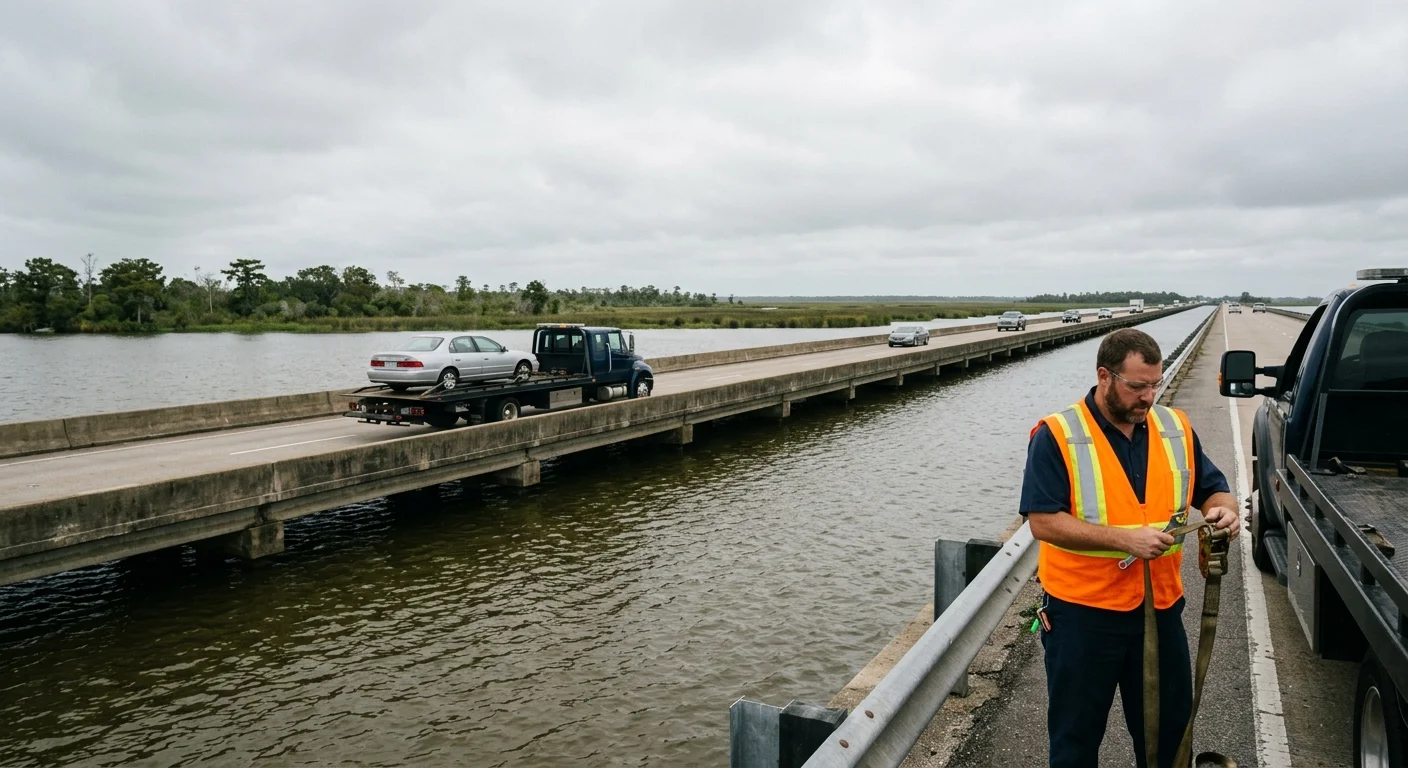
For a Causeway crossing, road restrictions can affect the trip itself. The Greater New Orleans Expressway Commission publishes bridge and fog information. Causeway fog procedures can include single-lane restrictions or controlled rolling convoys. Check current conditions instead of assuming the normal route is open.
For Baton Rouge, Houma, or Mississippi, confirm where the vehicle will be left. A repair shop may have its own receiving instructions. A closed destination can create a problem if nobody has agreed to accept the vehicle. Get the destination’s approval and access details before the tow begins.
Also confirm whether the same operator will complete the entire run. If another company or specialized provider will participate, ask who bills you and what documentation you’ll receive. Under the regulated non-consensual schedule, subcontracted specialized equipment or labor requires its actual invoice when billed with the allowed 10 percent addition.
Check Louisiana 511 for current incidents, construction, and closures. Route information won’t set the operator’s price, but it helps everyone discuss the same planned trip.
Questions worth asking before the truck rolls
A clear conversation can prevent disagreements at the destination. Keep the pickup address, drop-off address, vehicle details, and payment method ready.
Ask the matched operator these questions:
-
Is this a customer-arranged tow or a regulated non-consensual tow?
-
What vehicle weight class applies?
-
Is the pricing hourly, mileage-based, or stated another way?
-
What work and distance does the stated amount include?
-
Does a fuel adjustment apply, and how is it calculated?
-
Will another operator or specialized provider participate?
-
What documentation supports any specialized equipment charge?
-
Will the final invoice separate towing, transit, recovery, storage, and fees?
For non-consensual towing, the invoice must be itemized. It must also state the LPSC complaint address. The operator must provide a copy without requiring payment first. Tow companies must accept credit cards, and any passed-through processing charge must appear separately.
Compare the paperwork with the current LPSC schedule when its maximum rates apply. If the tow was arranged directly with an operator, read that operator’s terms instead of treating the state caps as a voluntary-tow quote.
Local hookup charges and city impound fees are different topics. Our guide to what a tow costs in New Orleans explains those local categories. Don’t combine a City of New Orleans impound charge, an LPSC maximum, and a customer-arranged long-distance price. They cover different situations and may be set by different parties.
Quick Tow New Orleans is a referral service. We match callers with independent, licensed local towing operators. The operator chooses whether to accept the route, states its terms, performs the work, and collects payment.
When to call us
A disabled vehicle headed across the Causeway or beyond the metro needs a licensed towing operator with the right equipment. The line takes calls 24/7. Call (504) 474-5530. We match you with a licensed local operator who quotes before the truck rolls.