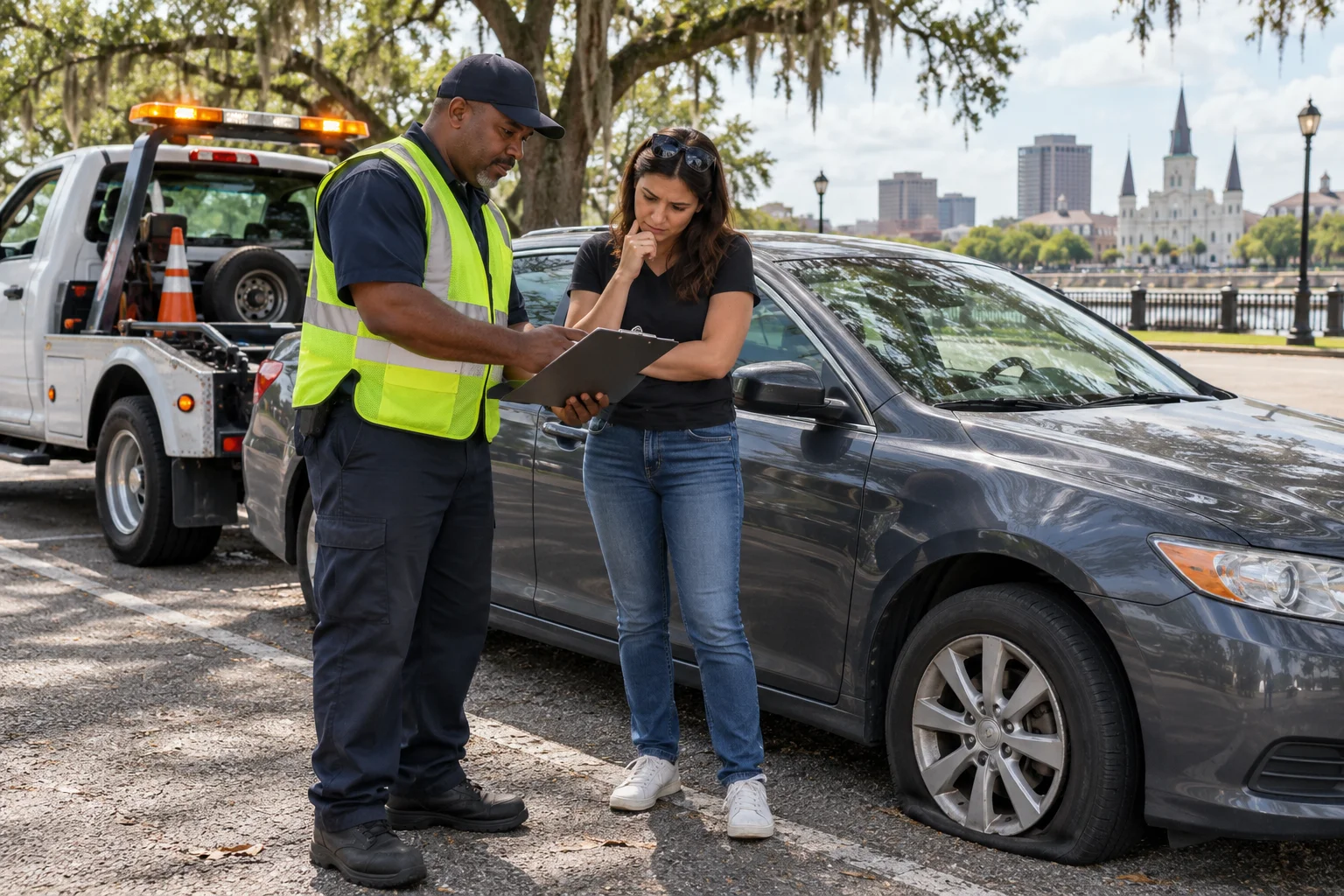
There isn’t one verified flat rate for roadside tire changes across New Orleans. The independent operator sets the charge after learning where you are, what you drive, and whether your spare can be installed. Ask for the full expected charge before work begins.
The independent operator sets the roadside charge
Quick Tow New Orleans is a referral service. We take your call and match you with an independent, licensed local operator. That operator performs the roadside work, sets the price, and collects payment directly.
Our approved local sources don’t confirm a standard roadside tire change price. That means an honest search for “tire change cost near me” can’t produce one reliable amount for every driver. A sedan parked in Metairie and a loaded pickup beside I-10 aren’t the same request.
Louisiana publishes maximum rates for non-consensual towing. Those rules cover situations such as certain police-arranged or private-property tows. They don’t establish the price for a roadside tire change you request and approve. The distinction matters because the LPSC rate schedule shouldn’t be presented as a roadside service menu.
Describe the problem clearly when you call. Say that you have a flat, whether you have a spare, and where the vehicle is stopped. Share the vehicle’s year, make, model, and approximate size. Also mention any wheel lock or visible wheel damage.
Those details help the matched operator understand the request. They also reduce the chance that a simple tire-change request becomes a different roadside or towing job after arrival. Our roadside assistance service explains the types of minor breakdown help an operator may provide.
The tire and wheel condition change the request
A roadside tire change normally means removing the flat and installing your usable spare. It doesn’t automatically include repairing the damaged tire, selling a replacement tire, balancing a wheel, or performing an alignment. Those are separate services, often completed at a tire shop.
Start by confirming that a spare is present. Tell the operator whether it’s a compact spare or a full-size wheel, if you know. If the spare looks damaged or won’t hold air, say that before work starts. A missing or unusable spare can turn the request into a tow.
The wheel itself also matters. Report missing lug nuts, a damaged rim, or a wheel that looks out of position. Mention a wheel lock and whether its matching key is available. Don’t describe the job as a basic change if the tire failed after a collision or hard curb strike.
Some vehicles store the spare beneath the body. Others have it inside the cargo area. If luggage, tools, or other belongings cover the access point, tell the operator. Clear information helps them identify what the job involves without assuming every vehicle is arranged the same way.
A puncture also doesn’t tell you whether the tire can be repaired. That decision belongs to the shop or operator inspecting it. If you’re unsure whether roadside help is enough, read our guide to choosing flat-tire help or a tow.
Location and vehicle access may affect the job
“Near me” can mean very different places across metro New Orleans. A parking lot in Kenner offers different access than a narrow curb in the French Quarter. A vehicle on the Westbank Expressway also presents a different setting than one in a Metairie driveway.
Give the precise location, not only the neighborhood. Include the street, nearby cross street, business name, garage level, or highway direction. If you’re on I-10, I-610, US-90B, or another divided route, say which direction you’re traveling. A dropped map pin can help distinguish one side of a roadway from the other.
Also describe the ground and surrounding space. Mention a parking garage, low ceiling, soft shoulder, steep slope, standing water, or traffic close to the vehicle. Don’t move into floodwater to improve access. If the location feels immediately dangerous, contact emergency services.
Louisiana DOTD’s Motorist Assistance Patrol can change a flat tire at no charge when a patrol encounters a stranded driver on a covered route. MAP is a fixed-schedule patrol, not a service you can call out directly. Its New Orleans coverage includes portions of I-10 and US-90B, plus all of I-610, but the covered segments differ between daytime and nighttime schedules.
Drivers outside those routes, or not encountered by MAP, still need another plan. The North Shore also sits across Lake Pontchartrain, so a Mandeville or Slidell request isn’t equivalent to one in Orleans Parish.
Your coverage may pay part of the charge
Your auto policy, motor club, vehicle warranty, or credit card benefits may include roadside assistance. Coverage isn’t automatic, and Louisiana law doesn’t require towing or roadside coverage. Your own contract decides whether a roadside tire change qualifies.
Check the benefit before authorizing work when circumstances allow. Look for a roadside-assistance or towing-and-labor endorsement. Confirm whether the provider sends its own contractor, reimburses you after payment, or requires prior approval. Also ask whether it covers only labor or other related costs.
Don’t assume liability insurance pays for the service. Louisiana requires liability coverage, but it doesn’t require towing, collision, comprehensive, or roadside assistance. Our guide to insurance and towing coverage in Louisiana explains why the policy language controls.
A membership isn’t always required to request help. You can contact a roadside provider directly and pay the independent operator under the terms you accept. Read more about requesting roadside assistance without a membership.
Keep any itemized invoice the operator provides. If you plan to seek reimbursement, ask your insurer or benefit administrator what documents it needs. Quick Tow doesn’t decide coverage, submit claims, or promise reimbursement. Those decisions belong to the company that issued your policy or benefit.
What to confirm before work begins
A short, specific conversation can prevent confusion. First, confirm that the request is for installing your spare. If you don’t have a usable spare, say so. The operator may need to discuss towing instead of treating the call as a standard tire change.
Ask the matched operator to explain the expected charge before work begins. No current, verified local figure supports a universal roadside tire change price. The operator should identify what the stated charge covers and whether another service would be separate.
Confirm these details:
- The vehicle’s year, make, model, and approximate size
- The exact location and travel direction
- Whether the vehicle is in a garage or restricted area
- Whether a usable spare is present
- Whether the wheel requires a locking-lug key
- Whether the rim or suspension appears damaged
- Which payment methods the operator accepts
- Whether you’ll receive an itemized invoice
If the situation changes after inspection, pause before approving additional work. Ask what changed and what service is now being proposed. A tire replacement, wheel repair, recovery, or tow isn’t the same purchase as installing a spare.
Quick Tow doesn’t set operator prices or warrant an operator’s work. The line takes calls 24/7, including holidays, and routes your call to the operator covering your area. Calls are recorded after the caller hears the recording notice.
When to call us
Call when a flat can’t be handled safely where the vehicle sits, the spare needs professional installation, or the vehicle may require towing. Call us at (504) 474-5530 and we’ll connect you with a licensed local operator.