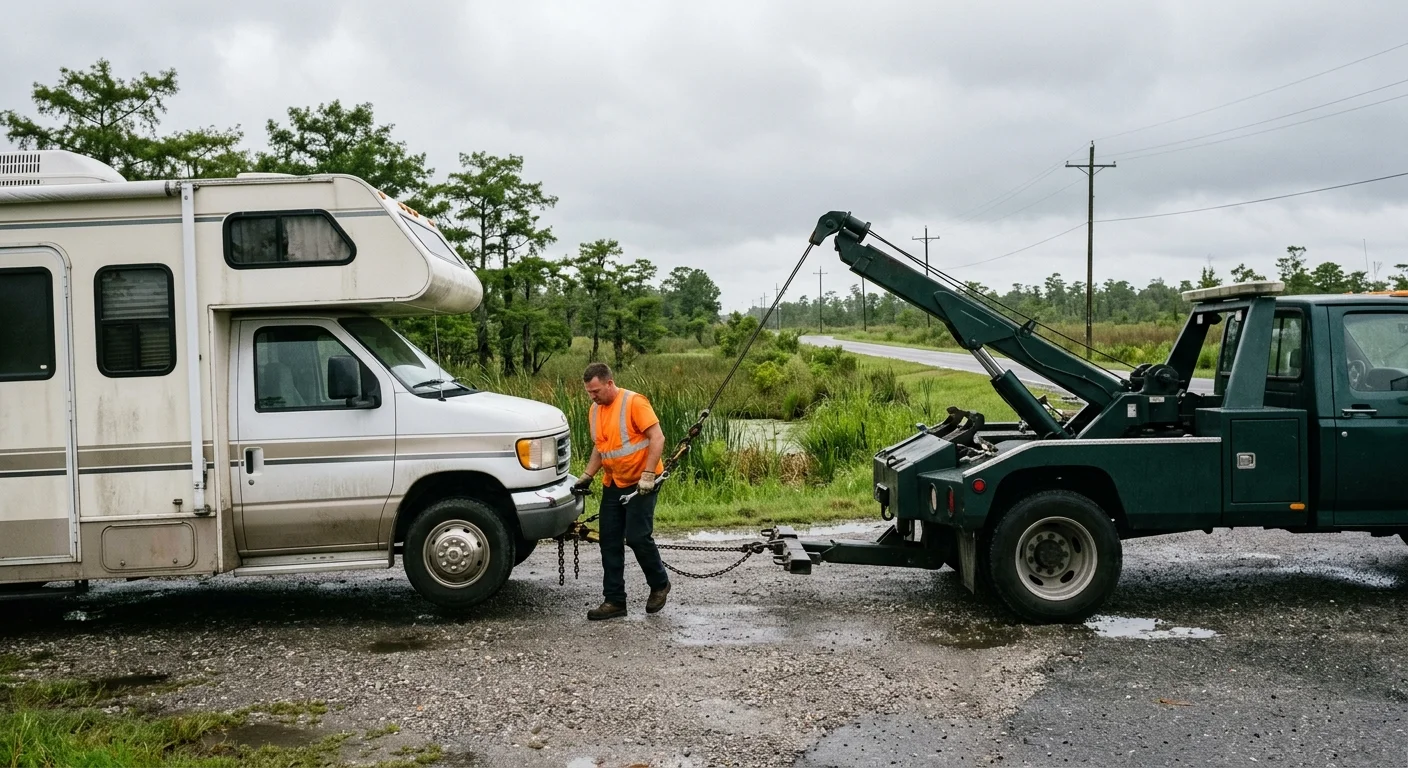
LaPlace sits on I-10 in St. John the Baptist Parish. Report height and GVWR, not just ‘RV.’ See what changes RV towing cost and travel trailer breakdown. No unsourced RV prices.
Start with the RV and tow vehicle
When an RV dies near LaPlace, start with what is actually disabled. The dead unit might be the motorhome. It might be the truck that was pulling a trailer. It might be the trailer itself.
Those are three different recoveries. A match for RV and trailer towing depends on that split, not on the word “RV” alone.
Then read the data plate and the owner’s materials. Don’t guess length or weight from memory. If you can reach the label without stepping into a lane, photograph the GVWR, VIN, and any printed length. On a motorhome it’s often in a door jamb or near the driver’s seat. On a trailer it’s usually on the tongue or a forward sidewall.
Louisiana sorts non-consensual wrecker work by GVWR. Light duty is 10,000 lbs or less. Medium duty is 10,001 to 26,000 lbs. Heavy duty is 26,001 lbs and up. Many motorhomes sit in medium or heavy.
Those classes matter when an officer arranges the tow. Under Louisiana Public Service Commission rules, even a tow you ask an officer to set up counts as non-consensual. It stays bound by the prescribed maximums for that duty class for tows on or after April 1, 2026. A tow you book yourself is a private contract. Don’t treat a statewide cap as a quote or as our price. We don’t set operator prices.
If a dinghy or trailer is still coupled, say so. An operator can’t plan a two-unit hook as one.
Keep people away from traffic. Use flashers. R.S. 32:125 requires a lane change away from authorized flashing amber, yellow, or green lights on a multi-lane highway, when that’s safe. If a lane change isn’t possible, drivers must slow to a reasonably safe speed. A violation can bring a fine not to exceed $200.
Separate a motorhome problem from a trailer problem
A motorhome is one vehicle. Engine, transmission, and chassis share a frame. A no-start or a transmission that won’t go into neutral is still one unit to move.
A travel trailer isn’t. You have a tow vehicle and a separate house on wheels. The failure might be the truck, an axle, the hitch, or the wiring. That’s why a travel trailer breakdown needs a cleaner report than “the RV died.”
Say which unit failed. If the truck is dead and the trailer is still hitched, tell the operator both are connected. If you already unhitched in a lot, say where each unit sits. Don’t unhitch in a live interstate lane.
Name the hitch. A bumper-pull and a fifth-wheel are different hooks. Photograph the coupler if you’re unsure.
Some failures are roadside assistance jobs, like a jump or a matching spare. DOTD’s Motorist Assistance Patrol can change a flat and provide about a gallon of emergency fuel. It can jump-start a battery, add radiator water, and let you make a local call. It also protects the scene and can move a disabled vehicle out of a travel lane. It doesn’t tow a vehicle away for repair.
MAP is a fixed-schedule patrol, not a call-out. If a truck isn’t already on scene, contact local law enforcement, or 911 in an emergency. An RV that still needs a shop still needs a licensed tow operator.
House-side problems like a stuck slide don’t need a wrecker. Chassis, brakes, axles, and a vehicle that won’t roll do.
I-10, I-55 and US-51 need precise location details
LaPlace sits in St. John the Baptist Parish, on I-10 between Baton Rouge and New Orleans, with I-55 heading north. That junction is why “I’m near LaPlace” isn’t a location.
Name the road first. I-10, I-55, and US-51 aren’t interchangeable. I-10 runs east toward the Bonnet Carré Spillway, Kenner, and Jefferson Parish, and west toward Reserve and Ascension Parish. I-55 begins at I-10 in LaPlace and runs north over the Manchac wetlands toward Hammond. US-51 is the surface route that meets I-10 in town and then tracks that northbound run.
Name direction of travel. Eastbound I-10 toward New Orleans is not westbound toward Baton Rouge. Northbound I-55 toward Manchac is not a U-turn into the interchange.
Add a mile marker, exit name, or the I-10/I-55 interchange. If you’re on the flyover, say you’re on the interchange, not just in LaPlace. Check 511la.org or dial 511 for incidents and cameras, from a safe position.
MAP coverage isn’t the same on all three roads, and it changes after dark.
Daytime MAP runs 5:30 a.m. to 7:30 p.m., seven days. It includes I-10 from US-61 in Ascension Parish to Michoud Blvd, and I-55 from I-10 to Manchac (Exit 15). Nighttime MAP runs 7:30 p.m. to 5:30 a.m., seven days. It covers I-10 from US-51 at LaPlace east to Morrison Road. It doesn’t list I-55, and it doesn’t list US-51 as a patrol route.
A nighttime breakdown on I-55 toward Manchac sits outside that published night box. A nighttime I-10 problem west of US-51 may sit outside it too. A US-51 shoulder in town is a parish-road problem, not an interstate patrol problem.
Say whether you’re in a travel lane, on a shoulder, on a ramp, or already in a lot. MAP can clear a travel lane on the routes it actually patrols. It still won’t haul the RV to a shop.
You’re in St. John Parish, not Metairie.
Choose a River Parishes destination before transport
Don’t let the truck start rolling on “just take it somewhere.” Name the drop first.
A licensed operator needs a street address: a shop you’ve confirmed will take the rig, a campground, or home. Confirm it can accept the length and height. Call that shop if you can. This page can’t verify which River Parishes bays will take your motorhome.
Think about the haul, not just the town name. A drop in Reserve or LaPlace stays in St. John Parish. A Kenner or Metairie shop means crossing the Bonnet Carré Spillway on I-10. A North Shore shop means I-55 over Manchac. What changes the cost of towing an RV is often that distance plus duty class, not a single flat number.
If the RV is where you sleep, say so. Storage and after-hours gate rules belong to the destination. For a non-consensual tow, LPSC storage maximums apply statewide for tows on or after April 1, 2026, and a power unit and trailer count as two vehicles. For a job you book yourself, ask where the unit will sit and what that yard charges. We don’t set that price.
Don’t aim at a City of New Orleans impound lot. Those lots are for City tows in Orleans Parish. LaPlace isn’t Orleans Parish. If an officer orders the tow, ask which yard and write the name down.
Louisiana doesn’t require towing coverage on an auto policy. Only liability is compulsory. Ask your own insurer or motor club what they pay.
What to confirm with the matched operator
Quick Tow New Orleans matches you with an independent, licensed local operator. We don’t own the wrecker. We don’t run a yard. The person on the truck works for the company that takes the job. The pros we connect you with are licensed and insured.
Have this ready:
- Motorhome, travel trailer, fifth-wheel, or tow vehicle, and whether anything is still hitched.
- GVWR from the data plate, plus length and height from the label or owner’s materials.
- Exact road: I-10, I-55, or US-51, direction, and the best marker you have.
- Destination address, and confirmation the place will accept the rig.
- Whether the unit rolls, shifts to neutral, or has a brake or axle issue.
- Pets and passengers. Ask if anyone needs a ride. Don’t assume the cab has room.
Ask what they will send once they have the weight. Don’t prescribe a truck type. This page won’t invent equipment limits.
Ask for an itemized invoice. On a non-consensual job, it must break out towing, recovery, and storage, and carry the LPSC complaint address at P.O. Box 91154, Baton Rouge, LA 70821 / lpsc.louisiana.gov. You can get a copy without paying first. On a consented job, still ask for labor and mileage on separate lines.
If you already called a motor club, say so. Two trucks rolling on one RV helps no one.
When to call us
Call when the motorhome, trailer, or tow vehicle can’t move to a safe River Parishes address on its own, or when MAP-style help can’t finish the job. The line takes calls around the clock. Call (504) 474-5530. We match you with a licensed local operator who quotes before the truck rolls.