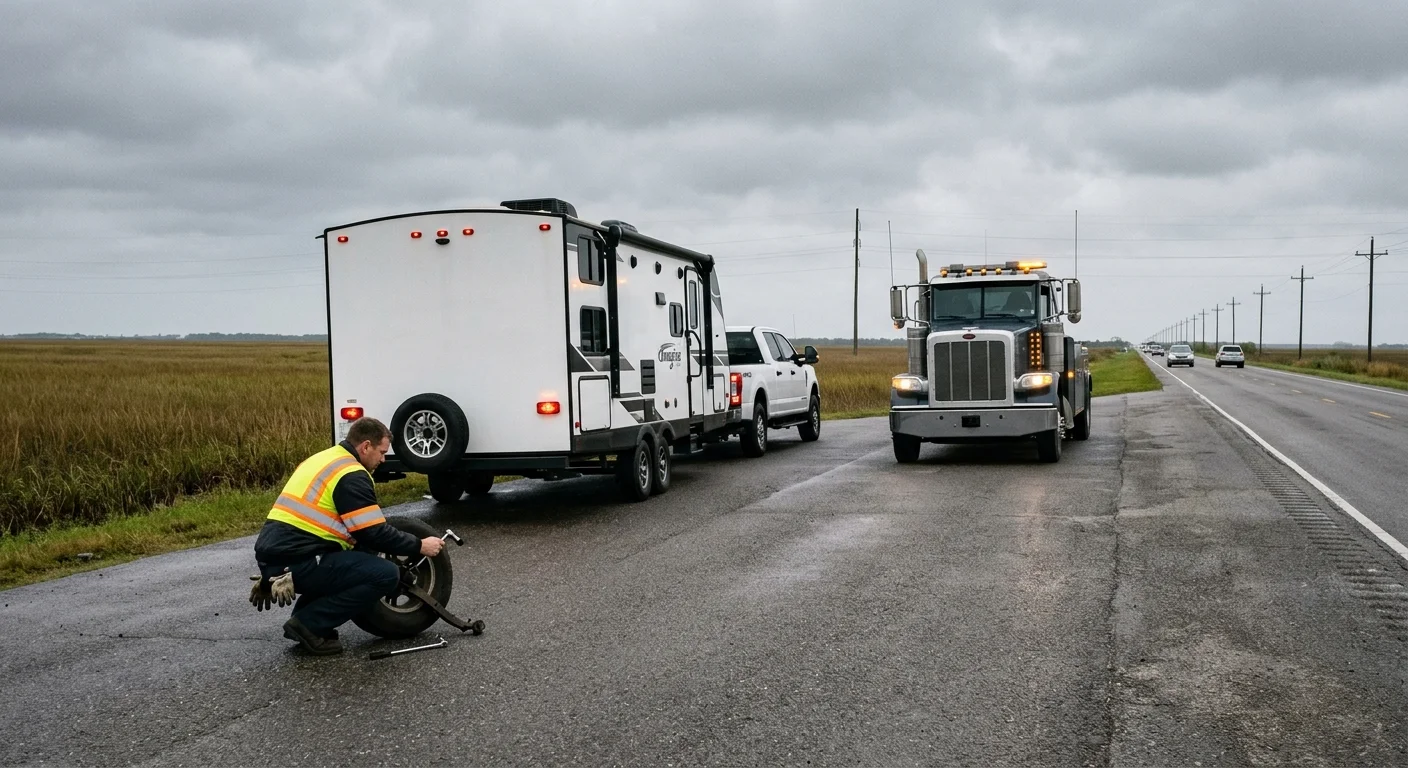
Lead with tongue weight, brakes, and whether you can disconnect. See RV towing. No unsourced trailer rates.
Separate the tow vehicle problem from the trailer problem
Start by treating the tow vehicle and trailer as separate machines. The truck or SUV may have the problem while the trailer remains sound. The trailer may also have a failed wheel, axle, hitch, brake, or electrical component while the tow vehicle still runs.
Note what happened before you stopped. Record warning lights, unusual sounds, smoke, vibration, or a sudden change in handling. Don’t keep testing the combination on a highway shoulder. Moving it again could require an operator’s judgment and equipment.
Look at both units from a safe position. Don’t crawl underneath them beside moving traffic. Check whether either unit is leaning, touching the pavement, or showing visible damage. Photograph anything unusual without stepping into a travel lane.
A battery, ordinary tire, or similar tow vehicle problem may be suitable for travel trailer roadside assistance. That doesn’t mean the trailer should be disconnected on the shoulder. Tell the roadside provider that a trailer is attached before anyone is sent.
Trailer trouble usually requires a different conversation. A provider needs to know whether the trailer can roll and steer safely behind another vehicle. A damaged hitch or wheel assembly may rule that out. The operator must assess the condition before deciding how it can be moved.
If both units are disabled, say that immediately. The tow vehicle and trailer may need separate handling. Don’t describe the call as a standard car breakdown and mention the trailer later.
Record the trailer size, weight and hitch condition
Travel trailers vary widely, even when two models look similar. Don’t estimate the specifications from appearance. Find the trailer data plate and the owner’s materials, then report the values exactly as printed.
Start with the year, make, model, and vehicle identification number. Record the listed weight information and the trailer’s stated dimensions. If you can’t confirm a value, say it’s unconfirmed. Send a clear photograph of the data plate instead of guessing.
Tell the matching service about anything that changes the trailer’s current profile. That includes extended slide-outs, a loose awning, roof damage, or cargo that shifted. Mention whether fresh, waste, or fuel tanks may contain material. The operator can decide what details affect the move.
Photograph the hitch from several angles. Include the coupler, ball mount, safety chains, breakaway cable, tongue jack, and nearby frame. Don’t adjust damaged parts unless a qualified operator instructs you. A connection that looks intact from one side may still need inspection.
Record the number of axles and the condition of every wheel. Note any missing tire, damaged rim, displaced axle, or wheel sitting at an angle. Photograph both sides of the trailer. Include the space beneath it when that can be done without entering traffic or crawling underneath.
This information helps an independent operator evaluate the job before accepting it. Our RV and trailer towing service connects callers with licensed local operators. The operator, not Quick Tow, determines suitable equipment and whether the trailer can be moved safely.
When roadside work may not solve the breakdown
Roadside work makes sense when the problem can be reached safely and repaired without moving damaged structure. The actual decision depends on the trailer, its position, and the failed component. A roadside provider must inspect those conditions.
A visibly damaged axle, hub, frame, coupler, or suspension can change the job from roadside help to recovery and transport. The same applies when a wheel has separated, the trailer has entered a ditch, or its underside rests on the road. Don’t pull it with another vehicle just to clear the area.
A tire problem also isn’t automatically a simple tire change. The wheel, hub, brake assembly, or surrounding bodywork may have damage. Tell the operator what you see and let that operator decide whether roadside work is appropriate.
The tow vehicle creates another complication. Repairing its immediate problem doesn’t establish that it can safely continue pulling the trailer. Don’t reconnect or resume the trip until the relevant vehicle and trailer conditions have been checked.
On covered New Orleans routes, the DOTD Motorist Assistance Patrol may provide minor free help or clear a disabled vehicle from a travel lane. MAP is a fixed-schedule patrol, not a call-out towing service. It doesn’t transport a trailer to a repair facility.
If MAP, law enforcement, or bridge personnel take control of the scene, follow their directions. Their immediate concern may be clearing an active lane. Your preferred repair destination can be discussed after the combination reaches a safer position.
Why bridges and parish lines affect the destination
A travel trailer breakdown near New Orleans can involve more than mileage. The route, bridge, parish, and repair destination all shape the move. A shop that accepts the tow vehicle may not handle the trailer’s damaged component.
On the Lake Pontchartrain Causeway, contact Causeway Police and follow the published Causeway safety guidance. Don’t attempt to disconnect, inspect, or repair the trailer in an exposed lane. Bridge personnel control the scene and can direct the safest next step.
A breakdown on the I-10 Twin Span toward Slidell creates different access than one near Metairie. The Causeway leads toward Mandeville, while the Twin Span reaches the Northshore near Slidell. Confirm which crossing you’re on before requesting help.
River Parish routes also need precise location details. I-10 near LaPlace, I-310 through St. Charles Parish, and U.S. 61 near Destrehan don’t lead to the same service options. State the direction of travel, nearest exit, and last confirmed landmark.
West Bank travel brings another destination decision. A trailer near Gretna, Marrero, or Terrytown may need to cross the Mississippi River for a suitable facility. That crossing shouldn’t be assumed. Confirm that the chosen shop accepts the trailer’s size and reported problem before the move begins.
Check Louisiana 511 for current closures, incidents, and construction. Conditions can change which route remains available. Our guide to breaking down on I-10 or the Causeway covers the first safety steps for those corridors.
What to confirm before an operator is matched
Give a precise location first. Name the roadway, direction of travel, nearest exit, parish, and visible landmark. Say whether the combination is in a lane, on a shoulder, inside a parking lot, or beyond the pavement.
Then provide separate details for both units:
- Tow vehicle year, make, model, and current condition
- Trailer year, make, model, and type
- Specifications copied from the trailer data plate
- Hitch type and visible hitch damage
- Number of axles and condition of each wheel
- Whether the trailer appears upright and supported
- Visible frame, body, roof, or undercarriage damage
- Extended slide-outs, awnings, jacks, or stabilizers
- Known cargo shifts or tank contents
- Passengers, pets, and accessibility needs
Don’t say the trailer “should be light enough” or “looks towable.” Send the label photograph and full exterior photos. If a specification can’t be confirmed, label it unknown. The operator can ask for additional information.
Explain your preferred destination and why you chose it. Call that facility first when possible. Confirm that it accepts travel trailers and can address the reported problem. Also ask where the trailer can be placed if its repair department is closed or unable to receive it.
Tell the operator about access limits at both ends. Narrow gates, low branches, soft ground, steep driveways, and crowded storage areas can affect placement. Report them without deciding what equipment will solve them.
Quick Tow New Orleans is a referral service. We take the calls and match drivers with independent, licensed local operators. The customer contracts with and pays the operator directly. Equipment decisions, charges, and any warranty belong to that operator, so confirm those terms before service begins.
When to call us
Call when the trailer can’t roll safely, has hitch or structural damage, or needs transport to a suitable facility. The line takes calls 24/7. Call (504) 474-5530. We match you with a licensed local operator who quotes before the truck rolls.