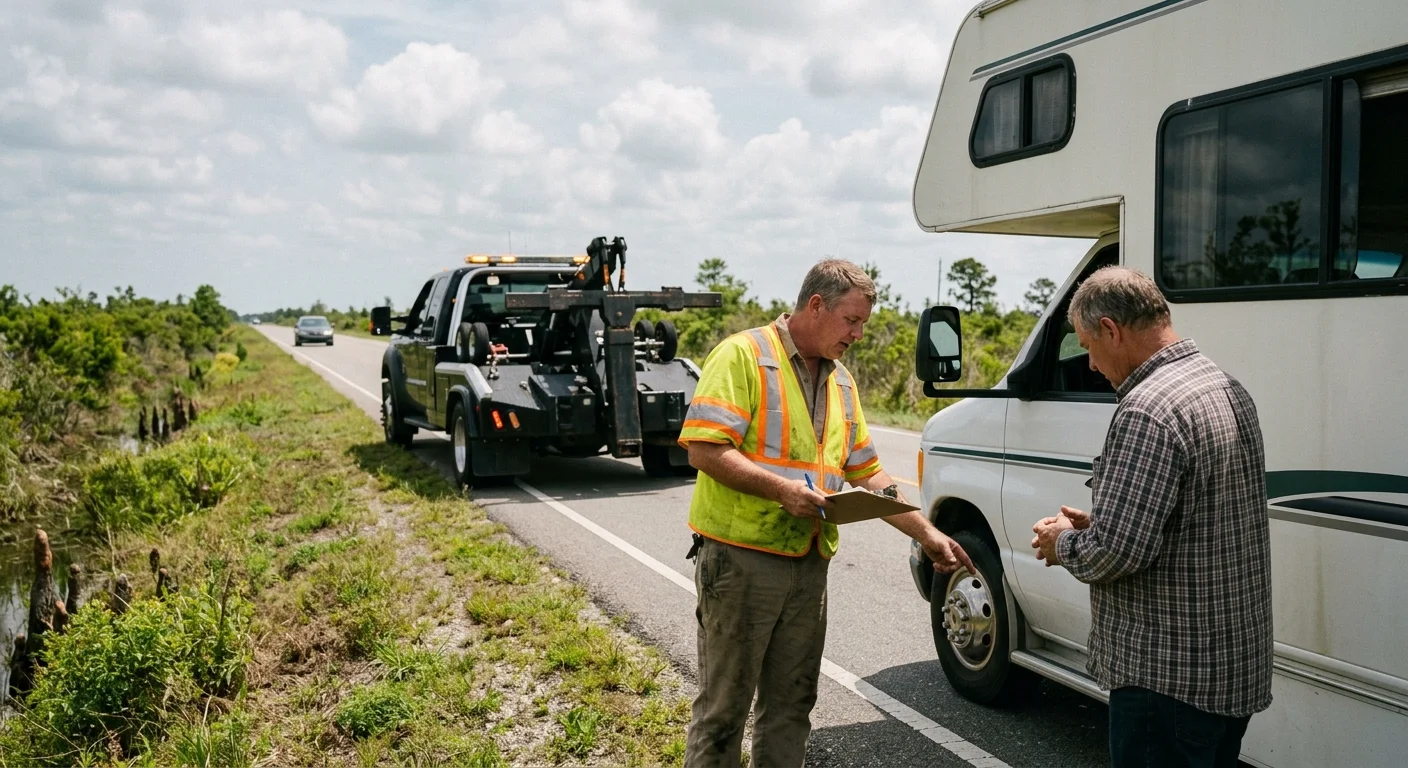
Lead with GVWR, height, toad, and loaded miles. The $95 figure is auto light-duty only, not an RV total. See RV towing and RV breakdown near LaPlace. No unsourced RV dollar totals.
The short answer on RV towing cost
An RV isn’t one standard towing job. A camper van, motorhome, fifth-wheel, and travel trailer can require different plans. Weight, length, damage, location, and destination all affect what the operator must arrange.
For a tow you request directly, the independent operator sets the price. Quick Tow New Orleans doesn’t own trucks or set operator rates. Ask for written terms covering the hookup, travel, recovery work, storage, tolls, and other possible charges.
A separate rule applies when the tow is nonconsensual. That category can include a tow arranged by police, even when the vehicle owner asked an officer for help. Louisiana sets maximum rates for those jobs through the LPSC nonconsensual towing schedule.
For tows performed on or after April 1, 2026, the maximum towing rates are:
- Light Duty, 10,000 pounds or less: $152.50 per hour, with a one-and-a-half-hour minimum.
- Medium Duty, 10,001 through 26,000 pounds: $335 per hour, with a one-hour minimum.
- Heavy Duty, 26,001 pounds and above: $430.50 per hour, with a one-hour minimum.
Those figures aren’t Quick Tow prices or owner-requested RV quotes. They apply only to nonconsensual towing. Recovery, transit time, permitted add-ons, and a fuel surcharge may also apply. The schedule changes each April, so confirm the current version before relying on it.
For a normal customer-called tow, there is no verified metro-wide mileage rate or RV total. The operator’s written terms are the source that matters.
Why RV type and condition change the request
Start with the exact kind of RV. A motorhome has its engine and living space in one unit. A travel trailer or fifth-wheel depends on a separate tow vehicle. That distinction changes what is disabled and what needs moving.
Tell the operator whether the request involves:
- A Class A, Class B, or Class C motorhome
- A camper van or converted bus
- A travel trailer or fifth-wheel
- A tow vehicle with a trailer still attached
- An RV carrying another vehicle
Give the year, make, model, and gross vehicle weight rating. The weight label is more useful than a guess based on length. It helps the operator identify the correct duty class and equipment.
Condition matters just as much. Explain whether the RV rolls, steers, and brakes. Report flat or missing tires, damaged wheels, locked steering, suspension damage, leaking fluids, fire damage, or flood exposure. Mention deployed leveling jacks, extended slide-outs, loose awnings, and anything hanging beneath the unit.
Don’t crawl under an RV to inspect it on a shoulder. Photograph visible damage from a safe position. A picture of the vehicle label, wheel area, and surrounding pavement can help the operator review the request.
Our RV and trailer towing service connects drivers with licensed independent operators. The operator still needs accurate details before accepting the work. Describing the unit only as “an RV” leaves out information that can change the towing plan and final charge.
How loading and recovery needs affect the charge
A clean roadside hookup isn’t the same as a recovery. An RV with intact wheels on firm pavement presents a different request from one leaning into mud, resting on a damaged axle, or blocked by a low branch.
Location details help define the work. Say whether the RV is in a campground, parking lot, driveway, travel lane, narrow shoulder, or soft ground. In Metro New Orleans, that could mean a paved lot in Metairie, a shoulder near I-10, or wet ground outside Chalmette. Send photos showing the RV and the available working space.
Also disclose what the RV is carrying. Water, personal belongings, a motorcycle, an attached trailer, or a towed car can change the unit’s weight and configuration. Don’t disconnect, unload, or reposition anything unless the operator says it can be done safely.
For a travel trailer attached to a disabled pickup, the solution may involve moving both units or separating them. That situation is covered more closely in our travel-trailer breakdown guide. This page focuses on how the complete RV towing request gets priced.
Louisiana’s nonconsensual schedule illustrates why recovery details matter. It treats towing, standard recovery, transit time, labor, and some specialized equipment as separate categories. Certain complicated-recovery charges require photographs, invoices, or other documentation. Ordinary equipment required on the truck can’t be billed separately in a nonconsensual tow.
Those rules don’t set a customer-requested RV price. They do show why “hook it up and tow it” may not describe the whole job. Before accepting the operator’s terms, identify which work is towing and which work is recovery.
Why distance and destination matter
Distance begins with two exact locations. Give the RV’s current position and the complete destination address. “Near New Orleans” isn’t enough for a route that could start in Slidell, Kenner, Gretna, or St. Bernard Parish.
Metro geography can make two similar-looking trips very different. Moving an RV within Metairie isn’t the same route as taking it from the North Shore to Jefferson Parish. A trip from Chalmette to an RV shop near I-10 also differs from a move across the Westbank.
Ask the receiving shop whether it accepts the RV before towing begins. Confirm its entrance, gate access, operating hours, and safe unloading area. If the destination refuses the unit, another move or storage decision may follow.
The independent operator should state how distance affects the bill. Ask whether the terms use mileage, time, zones, tolls, or another method. No current metro-wide RV mileage charge could be confirmed from the approved local claims ledger. The operator setting the charge must provide that figure.
For trips beyond the immediate metro, review the differences between a local move and long-distance towing. Our guide to long-distance towing prices in New Orleans explains the questions to ask without treating one operator’s method as a universal rate.
A disabled RV may need towing, while a running unit moved on a planned schedule may fit another transport service. The comparison between a tow and scheduled vehicle transport can help clarify that choice.
Check Louisiana 511 for current incidents, closures, and construction. Traffic conditions don’t create a published universal surcharge, but they can affect the route an operator is willing to accept.
What to confirm before accepting the operator’s terms
Get the important terms in writing. A phone total without clear assumptions can leave both sides describing different jobs.
Confirm these points with the independent operator:
- The exact RV, weight rating, and current condition
- Whether attached trailers or vehicles are included
- The planned towing or loading method
- Which services count as recovery work
- How distance, travel time, or mileage is calculated
- Any tolls, storage, gate, fuel, labor, or equipment charges
- The approved destination and unloading location
- Accepted payment methods
- Cancellation terms if the job changes
- What happens if the reported weight or damage is inaccurate
Ask whether the figure is a fixed total or based on measured time and distance. If it’s conditional, ask which conditions can change it. Don’t assume a verbal starting figure includes recovery, storage, or an attached vehicle.
For a nonconsensual tow, request the itemized invoice. Louisiana requires that invoice to separate towing, recovery, storage, fuel surcharge, and additional charges. You can request a copy without paying first. Tow companies must accept credit cards, although a processing fee may appear as a separate line item.
The invoice must also provide the LPSC complaint information. A written complaint can stop additional storage fees from accruing after the complaint date when the charges are later found excessive. These protections apply to regulated nonconsensual jobs, not every customer-requested RV tow.
Keep photographs, messages, written terms, and receipts together. They create a clear record of the RV’s condition and the terms you accepted.
When to call us
An RV with steering, wheel, axle, or recovery damage needs a licensed towing professional. The line takes calls 24/7 and routes your request to the operator covering your area. Call (504) 474-5530. We match you with a licensed local operator who quotes before the truck rolls.