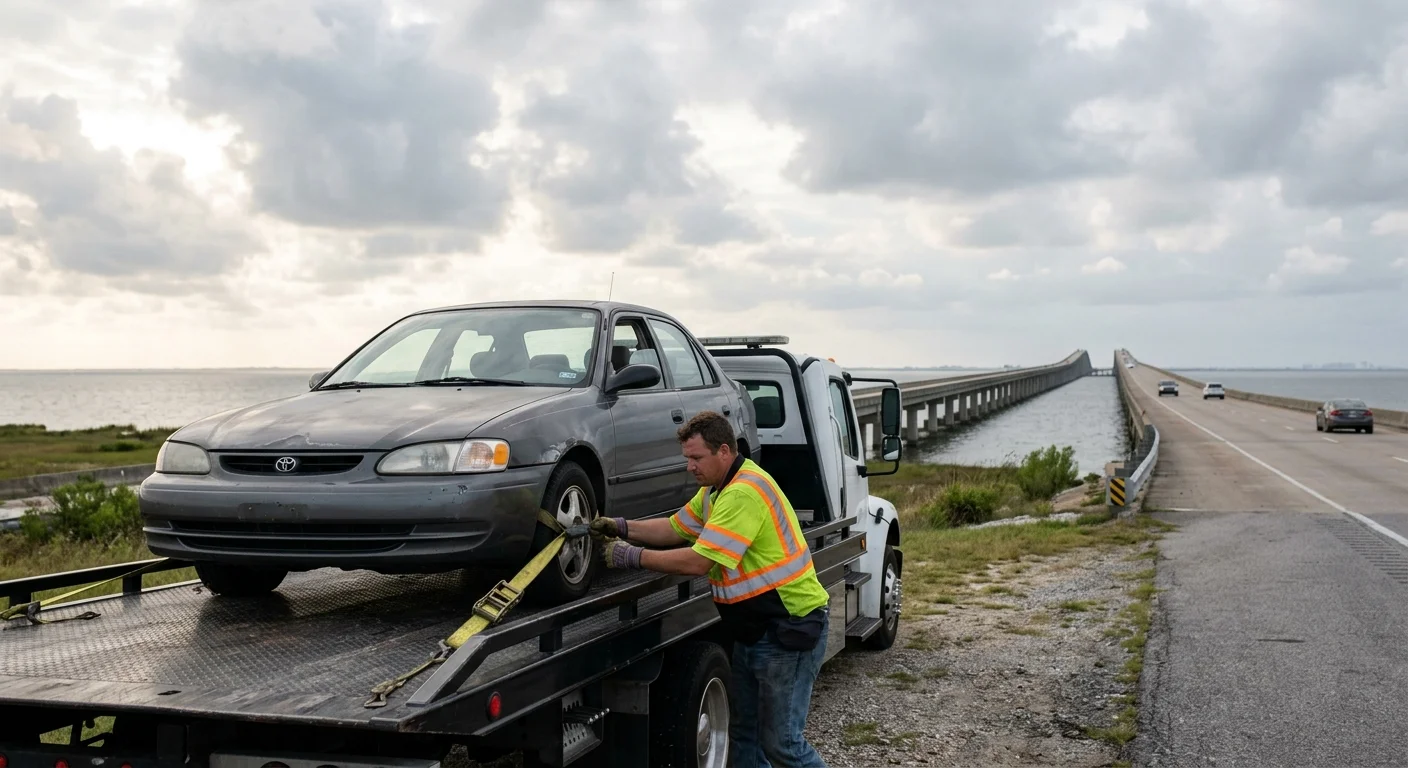
Mandeville is on the Northshore. If you are on the Causeway, call Causeway Police at *27 or (504) 835-3116 first. I-10 around the lake is the other routing. Use the Mandeville city hub. We do not publish arrival times or copy competitor speed claims.
Quick Tow New Orleans connects drivers with independent, licensed local operators. The matched operator decides whether the route, vehicle, and destination fit its equipment.
Start with the car’s exact location and condition
“Mandeville” isn’t a precise pickup location. A car beside a business near US-190 presents a different loading situation than one inside a parking garage, behind an apartment gate, or along a roadway.
Give the operator a street address or recognizable property name. Add the parking level, row, entrance, or nearby landmark when useful. If the car is on a shoulder, describe which direction it was traveling. Don’t cross active traffic to inspect a marker or sign.
The car’s position matters as much as its address. Tell the operator if it’s:
- Fully inside a parking space
- Close to a wall, curb, or another vehicle
- Inside a garage with limited overhead space
- Down a slope or off the paved surface
- Blocking traffic or exposed to moving vehicles
- Behind a locked gate or controlled entrance
Next, describe what failed. The operator needs to know whether the engine starts, the transmission shifts, and the steering turns. Mention a locked wheel, damaged suspension, flat tires, collision damage, loose body panels, or visible leaking fluid. Say whether the parking brake releases and whether you have the keys.
Share the vehicle’s year, make, model, and drivetrain if known. A low-clearance car, electric vehicle, pickup, or loaded SUV can change the equipment decision. If the vehicle can’t roll normally, say that before the operator accepts the trip.
These details help the matched operator evaluate access and loading. They also reduce the chance that the equipment arriving for the job doesn’t suit the car’s condition.
Choose the destination before the job is accepted
A cross-lake tow needs a specific drop-off point. “Somewhere in New Orleans” leaves too many decisions unsettled. Choose the repair shop, dealership, residence, or other approved destination before confirming the job.
The neighborhood also matters. A destination in Metairie creates a different route discussion than one in Mid-City or New Orleans East. The operator needs the complete address, not only the city or ZIP code.
Call the destination before arranging the tow. Confirm that it accepts the vehicle and can receive it under the circumstances. Ask where the car should be left and whether a gate, service entrance, or after-hours procedure applies. Quick Tow can connect you with an operator, but it doesn’t control the receiving property.
If the repair shop hasn’t diagnosed the car, explain that too. Some drivers automatically choose the nearest dealer. Others already have a trusted mechanic in Orleans or Jefferson Parish. The right destination depends on who can accept and work on that specific vehicle.
Avoid changing the destination after loading. A new address can affect the route, job scope, and operator’s price. If you’re comparing options, settle them before you authorize transport.
Our guide to long-distance towing prices in New Orleans explains why distance alone doesn’t determine the bill. Access, vehicle condition, equipment, and final placement can also affect the operator’s quote. Quick Tow doesn’t set operator prices. You contract with and pay the matched operator directly.
The Causeway and Twin Span create different route contexts
Mandeville sits across Lake Pontchartrain from the New Orleans East Bank. Two route discussions commonly arise: the Lake Pontchartrain Causeway or an eastbound path toward Slidell and the I-10 Twin Span.
These aren’t interchangeable names for the same trip. The Causeway leads south from the Northshore toward Jefferson Parish. The Twin Span approach involves traveling east toward Slidell before crossing into New Orleans East. The final destination helps the operator assess which corridor fits the job.
Don’t assume a preferred route before the operator reviews it. Vehicle weight, equipment, pickup access, traffic conditions, weather, and the receiving address can shape that decision. The matched operator decides whether the job and route fit its equipment.
Check 511 Louisiana for current closures, incidents, construction, and traveler information. That check matters because a route discussed when booking may not remain suitable later. It isn’t a promise that either crossing will be available.
The Causeway has its own police department and operating procedures. It’s patrolled around the clock by Causeway Police. Fog procedures can include lane restrictions or controlled convoys. The Greater New Orleans Expressway Commission publishes current Causeway guidance.
A breakdown already on the Causeway is different from a pickup elsewhere in Mandeville. Call Causeway Police at *27 or (504) 835-3116 and follow their instructions. Don’t arrange your own stopping position or walk into an active lane.
Drivers facing an active roadside breakdown can also review what to do after breaking down on I-10 or the Causeway. Safety comes before choosing the New Orleans destination.
A disabled-car tow differs from planned transport
A disabled-car tow begins with a mechanical or physical problem. Planned transport usually starts with an operable vehicle, a scheduled handoff, and controlled access at both ends. Those differences affect what the operator must evaluate.
A disabled car may not steer, roll, brake, or shift into neutral. Its battery may be dead. One tire may be collapsed, or collision damage may prevent normal loading. A planned transport vehicle usually doesn’t present those same recovery questions.
Be precise about the car’s current state. “It won’t start” doesn’t tell the operator whether it rolls freely. “It was running yesterday” doesn’t describe what it can do now. Report what happens when you try the key or start control, without repeatedly forcing the vehicle to move.
Equipment selection belongs to the operator. A flatbed towing option may be considered when the vehicle’s condition or design calls for it. Other cars may suit different equipment. Don’t request a loading method based only on appearance or habit. Share the facts and let the licensed operator assess them.
Access can also turn a simple transport into a recovery problem. A car facing a wall, sitting in a tight garage, or resting off pavement may need more than ordinary loading. Send clear photos if the operator requests them. Include the car’s surroundings, not only the damaged area.
For a planned move between two accessible properties, see our guide to long-distance towing. For a newly disabled car, lead with its location, movement limits, and visible damage.
What to confirm for a cross-parish tow
A Mandeville pickup begins in St. Tammany Parish. A New Orleans destination may be in Orleans Parish, while a Metairie destination is in Jefferson Parish. State the exact destination so everyone agrees on the requested trip.
Before accepting the operator’s terms, confirm:
- The exact pickup and drop-off addresses
- The vehicle’s year, make, model, and condition
- Whether the car rolls, steers, brakes, and shifts
- The equipment the operator plans to use
- The quoted price and what that amount covers
- The accepted payment methods
- Who will give the operator the keys
- Where the vehicle will be placed at delivery
- What happens if the destination won’t accept it
- Whether personal items should be removed first
Ask the operator to explain any charge you don’t understand. This is a customer-requested tow, so don’t treat Louisiana’s maximum schedule for non-consensual towing as the price for your trip. The independent operator sets its own price for the accepted job.
Confirm the drop-off instructions directly with the repair shop or property owner. A locked gate or full lot can leave the operator without an approved place to unload. If nobody will meet the vehicle, arrange the key handoff and placement instructions beforehand.
Keep your phone available, but don’t rely on vague directions given during loading. Put the destination name, address, contact details, and agreed placement in writing when possible. Check that the operator has the same information.
Quick Tow is the matching service, not the carrier. It doesn’t own trucks, select the route, transport the car, or warrant the operator’s work. Your agreement for the towing job is with the independent operator that accepts it.
When to call us
A disabled car needing a cross-lake trip requires a licensed towing pro when it can’t be driven safely to its destination. The line takes calls 24/7. Call (504) 474-5530. We match you with a licensed local operator who quotes before the truck rolls.