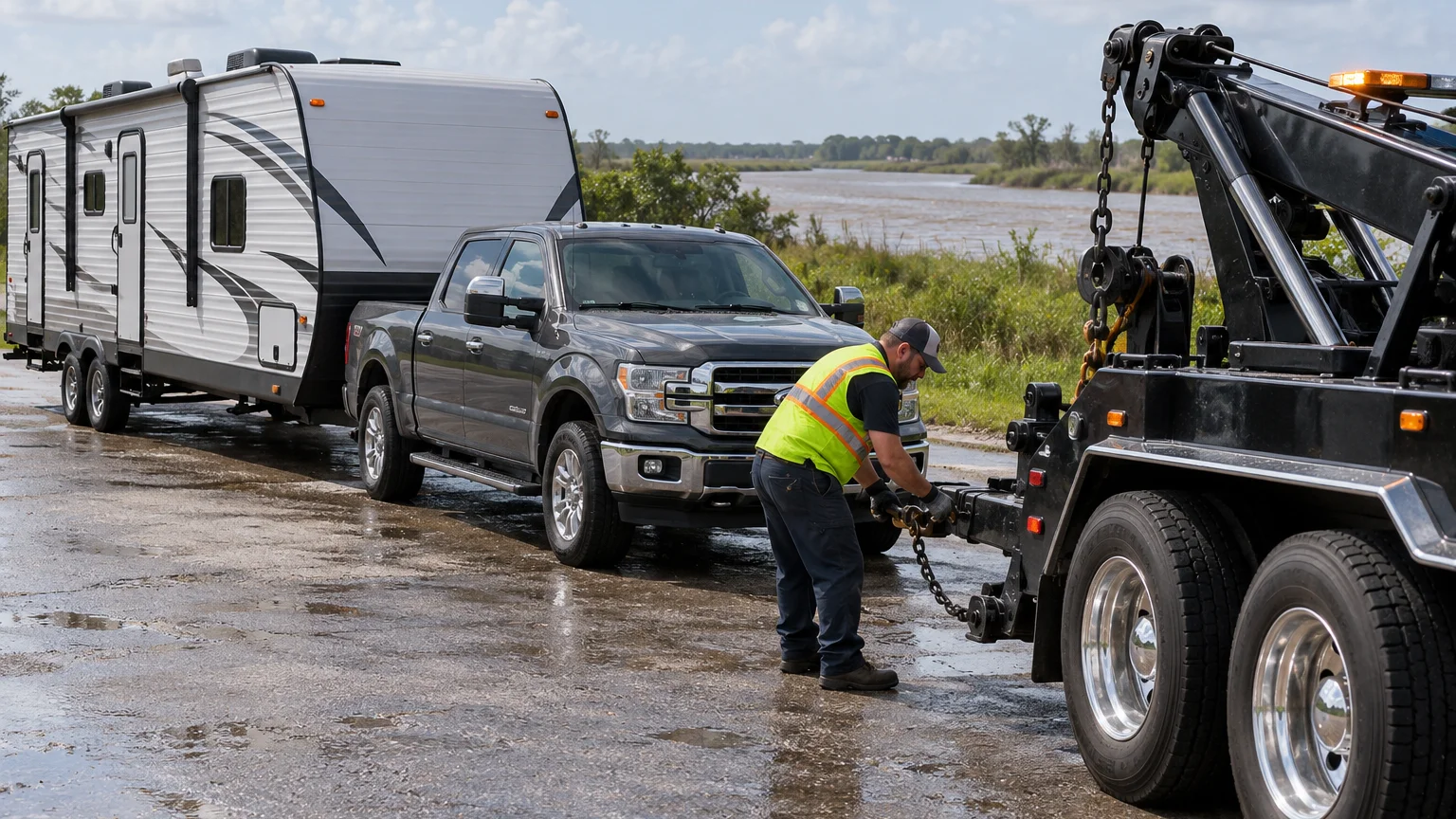
A disabled travel trailer near Belle Chasse needs more planning than a standard car tow. The operator must understand the tow vehicle, trailer, location, and intended destination before choosing an approach.
Quick Tow New Orleans matches callers with independent, licensed local operators. The line takes calls around the clock, including for RV breakdowns in Belle Chasse and Plaquemines Parish.
Separate the tow vehicle from the trailer problem
Start by identifying what actually failed. A travel trailer and its tow vehicle form one combination, but either unit can create the breakdown.
The tow vehicle may have an engine, transmission, battery, cooling, or tire problem. The trailer may have a damaged wheel, axle, suspension part, coupler, jack, or electrical connection. Sometimes the combination still rolls, but it can’t continue safely.
Tell the operator whether the tow vehicle starts, shifts, steers, and rolls. Then describe the trailer separately. Mention visible damage, unusual wheel angles, dragging parts, smoke, fluid, or anything touching the pavement.
Don’t uncouple the trailer beside moving traffic just to simplify the call. A loaded trailer can shift after support or hitch components are moved. Wait for instructions from the matched operator unless remaining connected creates an immediate danger.
A minor tow-vehicle problem may call for roadside assistance instead of trailer transport. A battery issue, flat tire, or empty tank doesn’t automatically mean both units need towing. However, roadside service won’t solve a bent trailer axle or damaged running gear.
If the trailer itself can’t roll, say that clearly. The operator may need a different recovery plan than one used for a working trailer behind a disabled pickup. Our general guide to a travel trailer breakdown explains the first safety checks in more detail.
The most useful opening description is simple: identify the failed unit, describe its condition, and explain whether the combination blocks traffic.
Report your Belle Chasse location clearly
“Belle Chasse” alone doesn’t give an operator enough information. A caller might be along Louisiana Highway 23, inside a business lot, near a residence, or farther down Plaquemines Parish.
Give the direction you were traveling and the nearest visible cross street. Share a business name only if you can read it directly. A map pin can help, but confirm that it marks your stopped vehicle rather than a nearby address.
Tell the operator whether you’re:
- On the travel lane or fully outside it
- On a paved shoulder, gravel edge, grass, or parking lot
- Connected to the trailer or already separated
- Facing north or south on Louisiana Highway 23
- Near a gate, narrow entrance, median, ditch, or low obstruction
- Blocking another vehicle or access point
Don’t guess at a mile marker or street name. Say that you can’t confirm it, then describe what you can see. If your phone shows coordinates, keep them available for the operator.
Belle Chasse sits within the lower-river side of the West Bank travel pattern. A destination in Belle Chasse differs from one in Gretna or elsewhere across the metro. Giving both your pickup point and intended destination prevents confusion about the requested transport.
Check 511 Louisiana for current incidents, closures, and traffic conditions before choosing a route or destination. The site is useful for current road information, but it doesn’t replace direct safety instructions at an active scene.
If you’re exposed to traffic or see a fire, injury, downed line, or fuel leak, call emergency services first. Move people to a safer place when that can be done without crossing traffic.
Use the trailer data plate for specifications
Travel trailers that look similar can have different dimensions, weights, axles, and hitch arrangements. Don’t estimate these details from appearance. Use the trailer’s data plate and owner’s materials when they’re accessible.
Photograph the entire data plate instead of reading from memory. Also photograph the hitch area, both sides of the trailer, each wheel position, and the visible damage. Make sure no one stands in moving traffic to take pictures.
The operator may ask for:
- Trailer manufacturer and model
- Vehicle identification number
- Gross vehicle weight rating
- Trailer length, width, and height
- Number of axles
- Hitch or coupler type
- Current load and any unusual cargo
- Slide-out, awning, or stabilizer position
- Wheel, tire, axle, or suspension damage
Use the plate’s wording exactly. If a figure isn’t readable, say it couldn’t be confirmed. The owner’s manual, registration materials, or manufacturer information may provide another way to check.
Don’t describe a trailer as “light” or “standard” unless you also have its specifications. Those labels aren’t enough for equipment planning. The matched operator decides what equipment is suitable after reviewing the trailer and scene details.
Cargo matters too. Tell the operator about full holding tanks, added equipment, motorcycles, generators, or other substantial loads. Don’t provide an invented loaded weight when it hasn’t been measured. Describe what’s aboard and let the operator determine what further information is needed.
Our RV and trailer towing service page explains how the matching process works. Quick Tow doesn’t own towing equipment or select a recovery method itself. The independent operator evaluates those requirements.
Choose a West Bank destination before transport
Decide where the trailer and tow vehicle should go before transport begins. That destination might be a repair facility, campground, storage property, home, dealership, or another approved location.
Call the destination first when possible. Confirm that it accepts travel trailers and can address the actual failure. A general auto shop may work on the tow vehicle but not the trailer. An RV shop may service the trailer but not a disabled pickup.
Ask the destination about:
- Permission to leave the trailer
- Entrance access for the trailer and towing equipment
- Available space for both units
- Gate procedures and posted receiving hours
- Whether the tow vehicle and trailer should arrive together
- Whether someone must meet the operator
- Any instructions for keys or paperwork
These details matter when comparing a Belle Chasse destination with one in Gretna or another West Bank community. Don’t assume a property can accept the combination because it has a large parking lot. The property manager or repair facility makes that decision.
If you haven’t chosen a facility, explain the type of repair needed. The operator may be able to discuss practical destination options, but you should confirm acceptance directly with the receiving property.
The final destination also affects the job’s scope. Distance, access, trailer condition, recovery work, and required equipment can all influence what an operator charges. Read what changes the cost of towing an RV before approving service. No single online figure can account for every damaged trailer or pickup.
Keep the destination address written down. Verify it with the operator before the combination moves. Similar business names and map listings can otherwise send a trailer to the wrong entrance.
What to confirm with the matched operator
Before authorizing travel trailer towing in Belle Chasse, confirm that the operator understands the whole situation. Repeat the trailer specifications, visible damage, surface conditions, and destination.
Ask whether the operator intends to move the trailer, the tow vehicle, or both. If separate operators or separate movements are proposed, confirm which unit moves first and what happens to the other one.
You should also confirm:
- The operator’s business name
- Which vehicle or trailer is covered by the requested service
- The agreed destination
- How keys will be handled
- Whether you must remain at the scene
- What payment methods the operator accepts
- How charges will be calculated
- Whether extra recovery work requires separate approval
- What paperwork you’ll receive
Quick Tow New Orleans doesn’t set the independent operator’s prices or collect payment for the work. Ask the operator directly about the expected charges before authorizing service. If the scene changes after inspection, ask for an explanation before approving additional work.
Take photographs of the trailer, tow vehicle, hitch, and visible damage. Remove loose valuables when it’s safe and permitted. Secure pets separately, since they shouldn’t remain inside a trailer during towing.
Don’t rely on a verbal description such as “RV tow” when the unit is a travel trailer. A motorhome is one powered vehicle. A travel trailer has a separate tow vehicle and connection system. That distinction changes the information the operator needs.
If police or another public agency arranged the tow, say so. Louisiana treats some agency-arranged towing differently from a customer-selected tow. The Louisiana Public Service Commission schedule covers maximum rates for non-consensual towing, not a normal customer-approved trailer tow. Don’t treat that schedule as a quote for your job.
When to call us
Call when a disabled tow vehicle or damaged travel trailer needs a licensed towing professional in Belle Chasse or elsewhere on the West Bank. Call us at (504) 474-5530 and we’ll connect you with a licensed local operator.