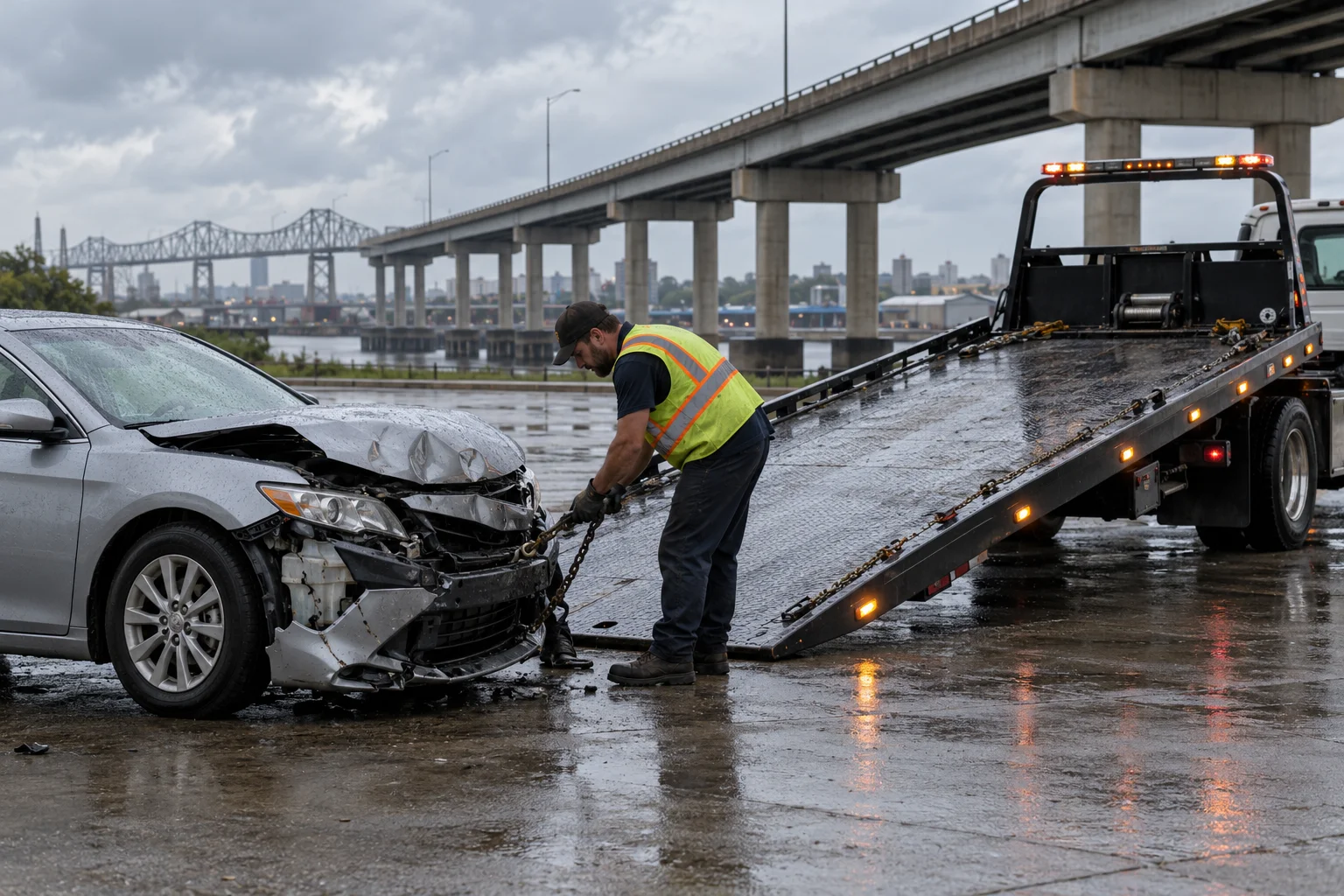
After a Marrero crash, the first towing decision depends on the vehicle’s condition. Its position, damaged wheels, and final destination determine whether the operator faces a standard transport or a recovery job.
For accident towing in Marrero, LA, start with specific details. “Near the Westbank Expressway” isn’t enough when the vehicle could be near Barataria Boulevard, Harvey, or another West Bank connection.
Start with the vehicle’s position and visible damage
Begin with where the vehicle stopped. A sedan sitting normally on firm pavement presents a different job from one resting against a curb, down an embankment, or partly outside the roadway.
Tell the operator whether all four wheels remain on pavement. Mention if the vehicle is sideways, nose-down, leaning, or blocked by another damaged vehicle. Include nearby barriers, curbs, soft ground, and narrow access points. Those details help the operator assess the recovery before accepting the job.
Next, describe what you can see without diagnosing the car. Useful details include:
- A wheel folded inward or pointing away from the others
- A tire separated from its wheel
- Bodywork pressed against a tire
- Broken suspension parts visible near a wheel
- Deployed airbags
- Shattered glass around the vehicle
- Fluid visible beneath the car
- A trunk, hood, or door that won’t close
Don’t label the problem as “just cosmetic” unless a qualified professional has checked it. A car can look upright while a damaged wheel prevents an ordinary loading approach.
Also state the vehicle type. A compact car, pickup, motorcycle, and loaded work van can require different equipment. If you know whether the parking brake is set or the transmission can shift, share that too. Don’t force any damaged control.
Our accident recovery and winch-out service connects drivers with licensed local operators. The operator evaluates the position, equipment needs, and loading method.
The Westbank Expressway needs an exact location
The Westbank Expressway runs through several West Bank communities and junctions. A caller saying only “I’m on the Expressway” leaves out the detail needed to identify the scene.
Give the road name, travel direction, and nearest cross street or exit. Barataria Boulevard is especially useful when the crash is near central Marrero. If you passed a recognizable intersection before stopping, name it and explain whether the vehicle is before or beyond it.
Make clear whether you’re on the elevated expressway, a surface road, a frontage road, or nearby private property. Don’t assume the location shown by a phone pin tells the full story. The operator needs to understand the access point, not just the general area.
Nearby places can also prevent a Marrero and Harvey mix-up. Say whether the scene is closer to Barataria Boulevard, Harvey, Westwego, or the approach toward the Crescent City Connection. Marrero is in Jefferson Parish, while a destination across the river may be in Orleans Parish. That difference changes the route and the practical destination choices.
For current incidents and closures, drivers can check Louisiana’s official 511 service. It provides real-time traffic and incident information, but it doesn’t arrange a tow.
If the crash happened outside regular business hours, our guide to 24-hour towing in Marrero and the West Bank explains what information to gather. The Quick Tow line takes calls around the clock, including holidays, but no arrival window is promised.
Recovery and transport are different requests
Recovery is the work needed to place a vehicle where it can be loaded. Transport is the trip after loading. A crash can require one, both, or neither in the form a caller expects.
A car resting normally with wheels that roll may need transport from the scene. A vehicle below the pavement, trapped against a barrier, or sitting with damaged wheels may first need controlled recovery. The operator makes that assessment from the vehicle’s position and condition.
Describe the scene before requesting a particular truck or loading method. Asking for a flatbed doesn’t explain how a vehicle will reach the bed. Likewise, saying “I only need a tow” can hide a wheel that won’t turn or a car that can’t be approached directly.
Our guide to accident recovery versus a standard tow explains the distinction in more detail. The key difference is what must happen before transport begins.
This distinction also matters on an invoice. Louisiana regulates maximum rates for non-consensual towing and recovery through the Louisiana Public Service Commission. A tow arranged by a police officer can count as non-consensual even when the driver asked the officer to arrange it. The current terms and rate classes appear in the LPSC non-consensual towing schedule.
Those regulated maximums aren’t Quick Tow prices. Quick Tow doesn’t set operator charges or collect payment for the operator. For a driver-requested tow, confirm the operator’s terms directly before the vehicle moves when circumstances allow.
Choose a West Bank or Orleans destination
A tow request isn’t complete until the destination is clear. “Take it somewhere nearby” gives the operator no usable endpoint and can create another towing decision later.
For a Marrero crash, the practical choices often begin on the West Bank. The destination might be a repair facility in Marrero, Harvey, Gretna, or another location selected by the vehicle owner. The right choice depends on who can receive the vehicle and what kind of damage needs evaluation.
Confirm that the destination will accept the vehicle in its present condition. A location that handles routine mechanical work may not accept a heavily damaged car. A closed business may also have specific instructions for leaving a vehicle. Those arrangements come from the destination, not from Quick Tow.
Crossing the Crescent City Connection for an Orleans Parish destination adds a river crossing to the transport. That may make sense when the chosen facility or other approved destination is across the river. It shouldn’t happen simply because the destination was left undecided.
Give the operator the full destination name and street address. Also share any access details provided by that destination. Don’t rely on a business name alone, since similarly named locations may exist on both sides of the river.
If no destination has been selected, say that before the operator accepts the job. Quick Tow can match you with a licensed local operator, but it doesn’t select a repair shop, storage yard, or body shop for you.
What to confirm before the vehicle moves
Before loading begins, make sure the operator has the correct vehicle and destination. Confirm the year, make, model, color, and plate state when available. Mention any keys that are missing and any wheel or steering damage already discussed.
Ask who will receive the vehicle. Write down the destination exactly as provided. If the vehicle must cross from Marrero toward Orleans Parish, confirm that choice rather than assuming the nearest route is the intended one.
You should also know whether the tow is driver-requested or arranged through law enforcement. That distinction can affect which rate rules apply. For a non-consensual tow, the operator must provide an itemized invoice. LPSC rules require the invoice to separate towing, recovery, storage, fuel surcharge, and additional charges.
Quick Tow is a referral service. We take the call and match the driver with an independent, licensed local operator. The vehicle owner contracts with and pays that operator directly. Quick Tow owns no tow trucks, operates no storage yard, and doesn’t warrant the operator’s work.
For urgent situations that aren’t limited to crash recovery, the emergency towing service page explains the matching process. Share the vehicle’s exact position, visible condition, and destination during the first call. Clear information helps the operator decide whether the requested job fits its equipment and service area.
Keep the operator’s name and the destination details together. That gives you a clean record of who accepted the vehicle and where it was taken.
When to call us
Call when a crash-damaged vehicle in Marrero needs a licensed towing professional for recovery or transport. The line takes calls 24/7, and Quick Tow will match you with an independent operator covering the area.
Call us at (504) 474-5530 and we’ll connect you with a licensed local operator.