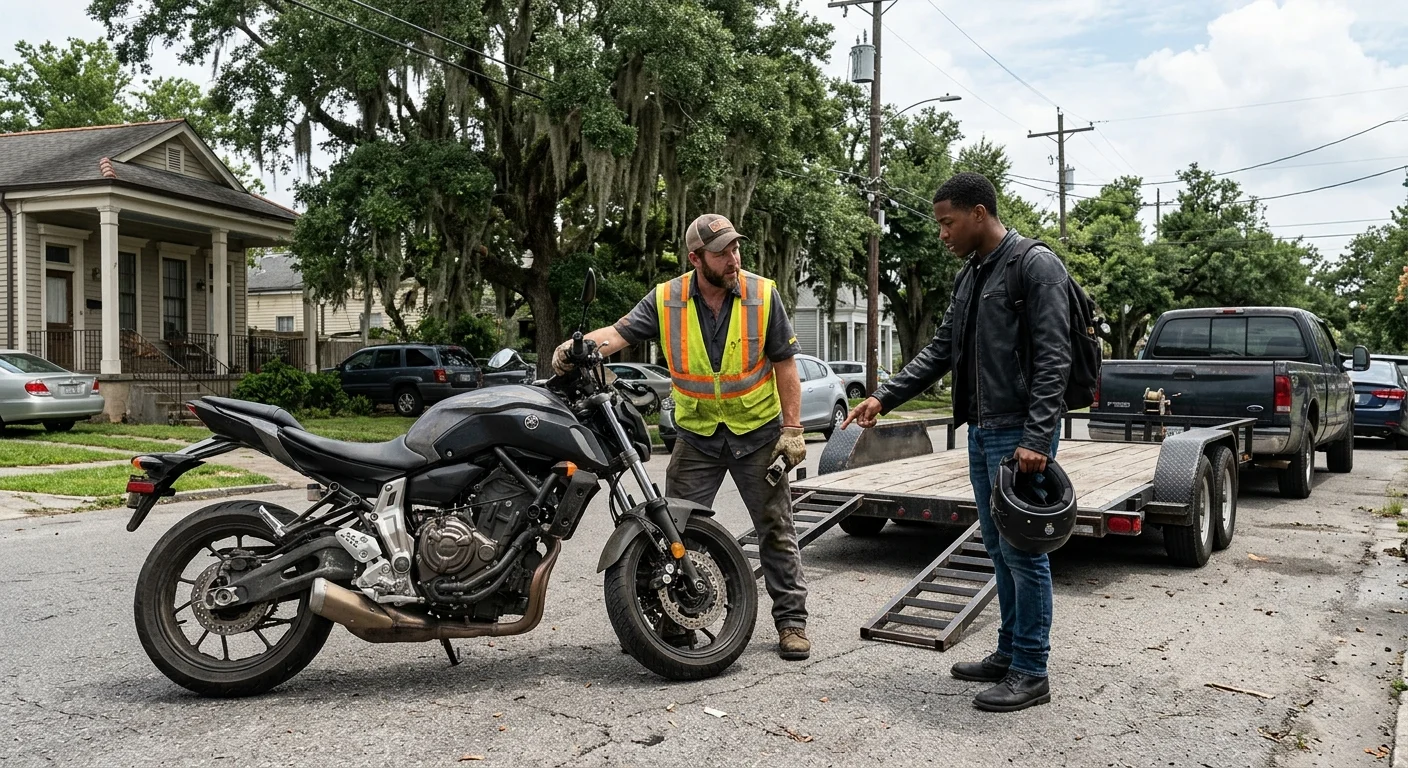
Lead with fairing, no-neutral, and distance. Do not list $95 as a motorcycle price. That figure is a light-duty auto hookup. See how motorcycle towing works.
The short answer on motorcycle tow pricing
No approved public source confirms a standard motorcycle towing cost for customer-requested jobs in New Orleans. A licensed independent operator sets the price for that consensual tow. Quick Tow doesn’t set or collect the operator’s charges.
The useful first step is describing the complete request. Give the operator both addresses, the motorcycle’s condition, and any access problems. Ask how the price is calculated and what could change it. Get that answer before the bike is attached or loaded.
A normal pickup request is different from a police-arranged tow. Louisiana’s Public Service Commission publishes maximum rates for nonconsensual towing. Those rules can apply even when the vehicle’s owner asks an officer to arrange the tow. The current LPSC nonconsensual towing schedule doesn’t create a universal price for a tow requested directly from an operator.
That distinction matters after a crash or police-controlled stop. Ask whether the request is consensual or nonconsensual before discussing any rate. Don’t treat a regulated maximum as an ordinary motorcycle quote.
Our guide to New Orleans tow costs explains the difference between customer-requested towing, nonconsensual rates, and City impound charges. For the bike itself, our motorcycle towing service page covers the information needed to request a suitable operator.
What changes the matched operator’s charge
The operator needs more than the motorcycle’s make and model. The pickup setting, bike condition, route, and planned loading method all shape the request. Missing details can make an early quote incomplete.
Start with the bike’s current condition. Tell the operator whether it’s standing, lying down, or damaged after a crash. Explain whether both wheels roll and whether the handlebars turn. Mention a locked steering column, missing key, flat tire, or damaged wheel. Don’t describe a crashed bike as simply “not starting.”
Access matters too. A motorcycle parked beside an open Metairie driveway presents a different setup from one inside a French Quarter garage. Tight courtyards, parking decks, gates, soft shoulders, and blocked curb space can limit the available loading approach. Tell the operator about them before accepting the quote.
Provide these details during the first conversation:
- The exact pickup and destination addresses
- Whether the bike rolls, steers, and remains upright
- Whether you have the key
- Visible crash, wheel, fork, or handlebar damage
- Garage clearance, gates, stairs, or narrow access
- Loose luggage, saddlebags, or detached parts
- Whether police control the scene
- Your requested destination and its access conditions
These facts help the operator decide whether the job matches its equipment. They also give you a clearer price discussion. If any detail changes, ask whether the agreed charge changes with it.
Quick Tow matches callers with licensed independent operators. You’ll contract with and pay the matched operator directly.
Why loading method and bike condition matter
A motorcycle needs support suited to its condition and the operator’s equipment. A rolling street bike, a locked scooter, and a damaged touring motorcycle aren’t identical loading requests. The matched operator decides which method fits the specific bike.
Some jobs may be suitable for a flat platform or motorcycle trailer. Others may require a different carrier or added handling. Ask what will carry the motorcycle and how the operator plans to secure it. Our guide to how motorcycle towing works explains the loading process without treating every bike as the same job.
Bike condition can change that plan. A locked wheel can’t be handled like a freely rolling wheel. Bent forks, damaged handlebars, low bodywork, and loose accessories should be disclosed. So should fuel or fluid leaking after a collision. Don’t try to force damaged controls into place before the operator sees them.
Custom parts deserve attention as well. Tell the operator about hard saddlebags, tall windscreens, fairings, low exhaust components, or unusual dimensions. Point out existing scratches and broken pieces before loading. Photos can preserve the bike’s visible condition and help you explain access or damage during the call.
A flatbed towing request doesn’t automatically carry one fixed motorcycle rate. Confirm the planned equipment, loading arrangement, and agreed charge with the operator. If the equipment or condition differs at pickup, pause and discuss the price before the bike moves.
The goal isn’t to choose the equipment yourself. It’s to give the licensed operator enough accurate information to choose properly.
How distance and destination affect the request
Distance begins with two exact addresses, not a neighborhood name. “New Orleans to Metairie” leaves too much unanswered. A pickup near the CBD and a drop in Mid-City isn’t the same route as Kenner to the West Bank or Slidell to Orleans Parish.
Metro New Orleans also has physical route divisions. Trips may involve I-10, the Crescent City Connection, or the Lake Pontchartrain Causeway. A destination across the river or across the lake changes the requested route. Don’t assume the operator uses one metro-wide zone or one mileage rule.
Ask how the operator treats distance. It may quote the complete job or explain a calculation tied to the route. Confirm where measurement begins and ends. Also ask whether the price changes if you replace the destination after loading.
Current road conditions can affect the available route. Louisiana’s official 511 traveler information service reports closures, incidents, construction, weather, and traffic speeds. It’s useful for checking conditions, but it doesn’t set the operator’s charge. The matched operator remains responsible for choosing the working route.
The destination itself needs confirmation. A repair shop may have a specific receiving entrance. A dealership may not accept an unattended motorcycle. A gated property may require someone present. If the destination is closed, ask where the bike can legally and securely be delivered before loading begins.
Don’t assume a second stop, waiting period, or storage arrangement is included. No verified public figure establishes a standard charge for those situations. Ask the operator what applies to your request and get the answer in writing when possible.
What to confirm before the bike is moved
A clear quote should match a clear description of the job. Before loading, repeat the pickup address, destination, bike condition, and planned equipment. Correct anything that changed since the first call.
Confirm these points directly with the independent operator:
- The agreed charge or the exact pricing method
- What loading and unloading include
- How the route or distance is measured
- Whether the stated bike condition changes the charge
- What happens if the destination won’t accept the bike
- Whether waiting, a second stop, or storage costs extra
- Which payment methods the operator accepts
- The operator’s business name and contact details
Ask what circumstances could change the amount after loading. A vague answer leaves room for confusion. A specific answer lets you decide before the motorcycle is committed to the move.
For a police-arranged nonconsensual tow, different protections apply. The operator must provide an itemized invoice, and you don’t have to pay first to receive a copy. The invoice should separate the applicable charges rather than presenting one unexplained total. The LPSC schedule also requires complaint information on the invoice.
A customer-requested tow is different. There’s no verified public flat rate covering every motorcycle, route, and condition in New Orleans. The matched operator’s confirmed terms control that transaction.
Keep any written quote, payment record, and condition photos together. Check the destination before departure. Those simple steps make the request easier to verify if the route, equipment, or bike condition becomes disputed.
When to call us
A disabled, damaged, or nonrolling motorcycle needs a licensed towing pro when it can’t be moved normally. The line takes calls 24/7 across metro New Orleans. Call (504) 474-5530. We match you with a licensed local operator who quotes before the truck rolls.